

Streetwear has outgrown its underground roots. One 2026 market estimate puts the global category at USD 371.09 billion in 2025, with a projection of USD 397.97 billion in 2026, while another estimate values the market at USD 218.3 billion in 2026. The useful takeaway isn't the disagreement between market models. It's that mass-price streetwear is already a dominant commercial lane, so building a sharp wardrobe doesn't require luxury drops or a closet packed with disposable pieces. (Fortune Business Insights)
The smarter question is simple: how many wears does each dollar buy? Affordable streetwear works when a tee, hoodie, or crewneck survives real rotation, fits more than one outfit, and keeps its shape after laundering. Treat your wardrobe like a small system, not a shopping haul. Buy the pieces that do the most work, inspect construction before checkout, and let your style grow from a reliable base.
Table of Contents
- Why Affordable Streetwear Is the Smartest Way to Build Your Look
- What Actually Makes a Streetwear Staple Worth Buying
- Investment Pieces Versus Rotation Pieces
- How to Judge Quality Before You Spend a Dollar
- Five Pieces That Carry a Full Week of Outfits
- Unisex Sizing and the Family Fit Advantage
- Your Starter Pack and Where It Takes You Next
Why Affordable Streetwear Is the Smartest Way to Build Your Look
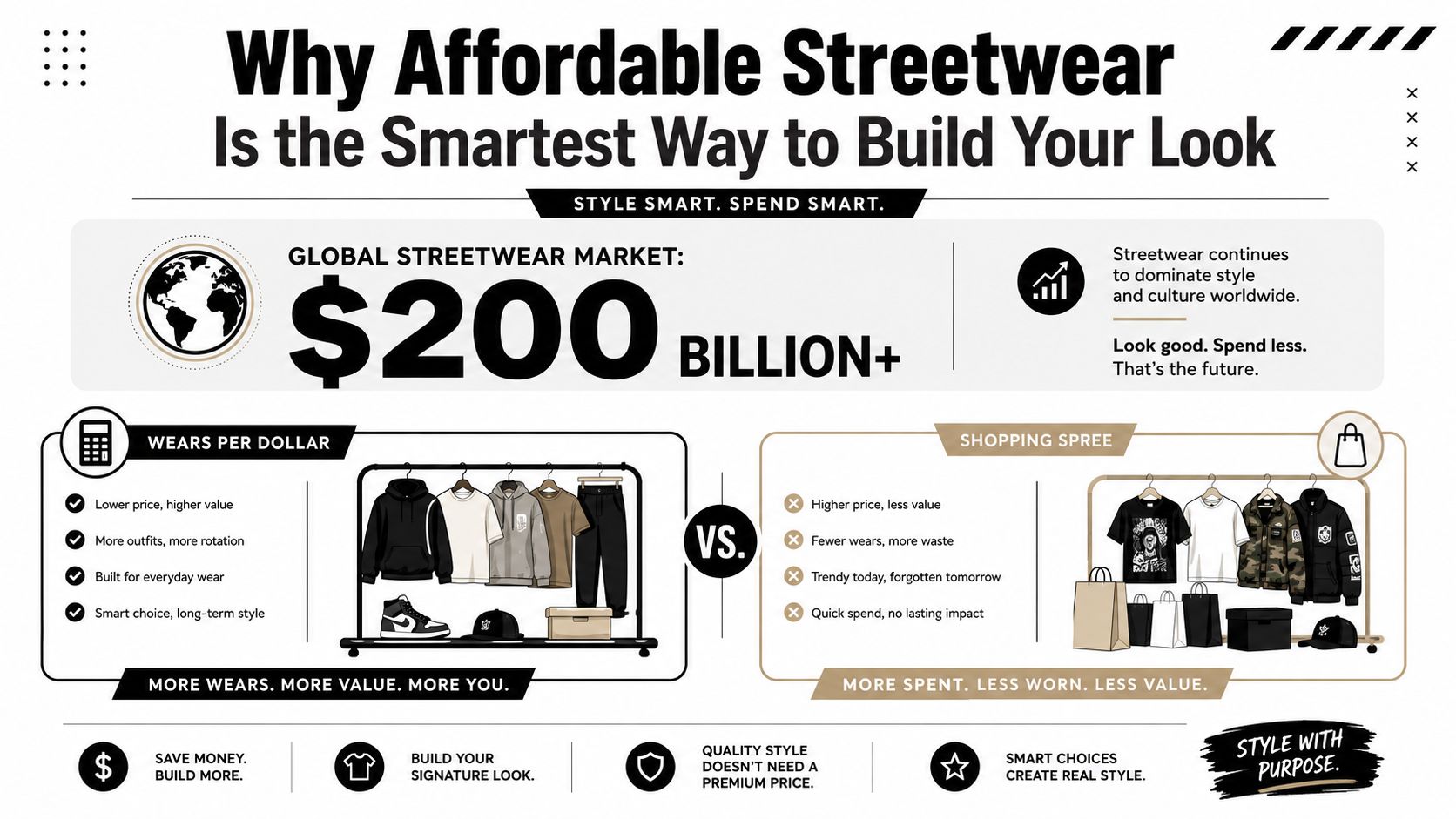
According to one 2026 market estimate, the mass-price segment is projected to hold the largest share at 65.72%. The same estimate places Asia Pacific at the largest regional block, with 36.33% to 38.21% of global share in 2025. These are projections, not settled facts, but they point toward a practical buying strategy: everyday streetwear is built around tees, hoodies, crewnecks, pants, and sneakers that earn repeat wears.
Start with wears per dollar
Use one formula before you buy anything:
Cost per wear = garment price ÷ realistic number of wears.
A $25 tee worn 80 times costs about $0.31 per wear. A $180 tee worn 30 times costs $6 per wear. The pricier shirt may carry a stronger label, but the cheaper one wins if it fits your wardrobe and survives regular washing.
Price alone does not decide value. A thin collar, unstable dye, weak seam, or peeling graphic can turn a bargain into replacement spending. Affordable streetwear works when the initial price and the service life work together. Judge every staple by the number of useful outfits and wears it can deliver, not by the excitement of the checkout page.
Build rotation before making statements
A rotation piece should solve several outfit problems. A black heavyweight tee can sit under a hoodie, crewneck, overshirt, or jacket. A neutral sweatshirt works with cargos, denim, or relaxed trousers. A clean outer layer can make the same base look intentional instead of repetitive.
Practical rule: Spend first on garments that create combinations, not garments that only complete one specific outfit.
Save statement spending for pieces that change the silhouette, such as outerwear, footwear, or accessories. One excellent jacket can give basic tees a different shape. One dependable pair of sneakers can finish several simple outfits. Variety comes later. A weak foundation makes every new purchase work harder for fewer wears per dollar.
Streetwear's history supports this accessible approach. The term emerged when Shawn Stüssy sold signature printed tees in California during the 1980s, and the 1990s pushed the style toward global fashion influence. (Hypebeast Strategy& report) Recognizable basics with a point of view remain the culture's most usable format. Affordable streetwear lets you apply that formula daily, while keeping your budget focused on pieces that leave the wardrobe.
What Actually Makes a Streetwear Staple Worth Buying
A garment can look substantial online and still feel weak in person. I judge affordable streetwear through three signals: fit tolerance, fabric weight, and decoration method. These clues matter more than a loud product description or a carefully staged campaign image.
Read GSM without becoming a textile nerd
GSM means grams per square meter, a measure of fabric weight. It isn't a complete quality score, but it gives you a useful starting point. For heavyweight tees, 220 to 280 GSM cotton generally creates a more structured hand and better shape retention than a flimsy jersey. For hoodies and crewnecks, 320 to 400 GSM is a strong target range for a substantial everyday layer.
Fabric weight should match the job. A summer tee doesn't need to feel like outerwear, while a sweatshirt that collapses at the shoulders won't deliver the relaxed streetwear silhouette you want. Check the fiber content too, then look for consistent sizing information and clear care instructions.
Construction tells you how the garment will sit
Tubular tees use a continuous body, which can create a clean, simple fit. Side-seamed tees use panels joined along the body, helping brands shape the silhouette more deliberately. Neither construction automatically wins. The right choice depends on whether you want a straightforward blank-style fit or a more intentional body shape.
For hoodies and crewnecks, inspect shoulder joins, cuffs, pocket attachment, and the transition between ribbing and the main fabric. A relaxed fit should look designed, not accidental. The collar should recover after stretching, and the body should hang without twisting.
Decoration changes the care equation
Embroidery adds texture and usually feels more integrated than a weak transfer print. A dense logo can look premium, but excess density may create puckering if the fabric or backing isn't stable. Screen printing can deliver a bold surface, while direct-to-garment printing often gives a softer graphic feel. Judge the method by the garment's intended use and the brand's wash validation, not by the decoration alone.
| Garment Type | Target GSM | Preferred Construction | Decoration Method |
|---|---|---|---|
| Heavyweight tee | 220 to 280 GSM | Stable tubular or side-seamed body | Screen print or controlled embroidery |
| Hoodie | 320 to 400 GSM | Reinforced seams and stable hood join | Embroidery or durable print |
| Crewneck sweatshirt | 320 to 400 GSM | Strong shoulder and rib construction | Embroidery, screen print, or DTG |
For embroidered staples, polyester thread is the safer technical choice because it offers strength, colorfastness, and resistance to bleach and high-temperature washing. (Embroidery quality guidance) The logo still needs proper backing and testing. A good thread cannot rescue unstable construction.
Investment Pieces Versus Rotation Pieces
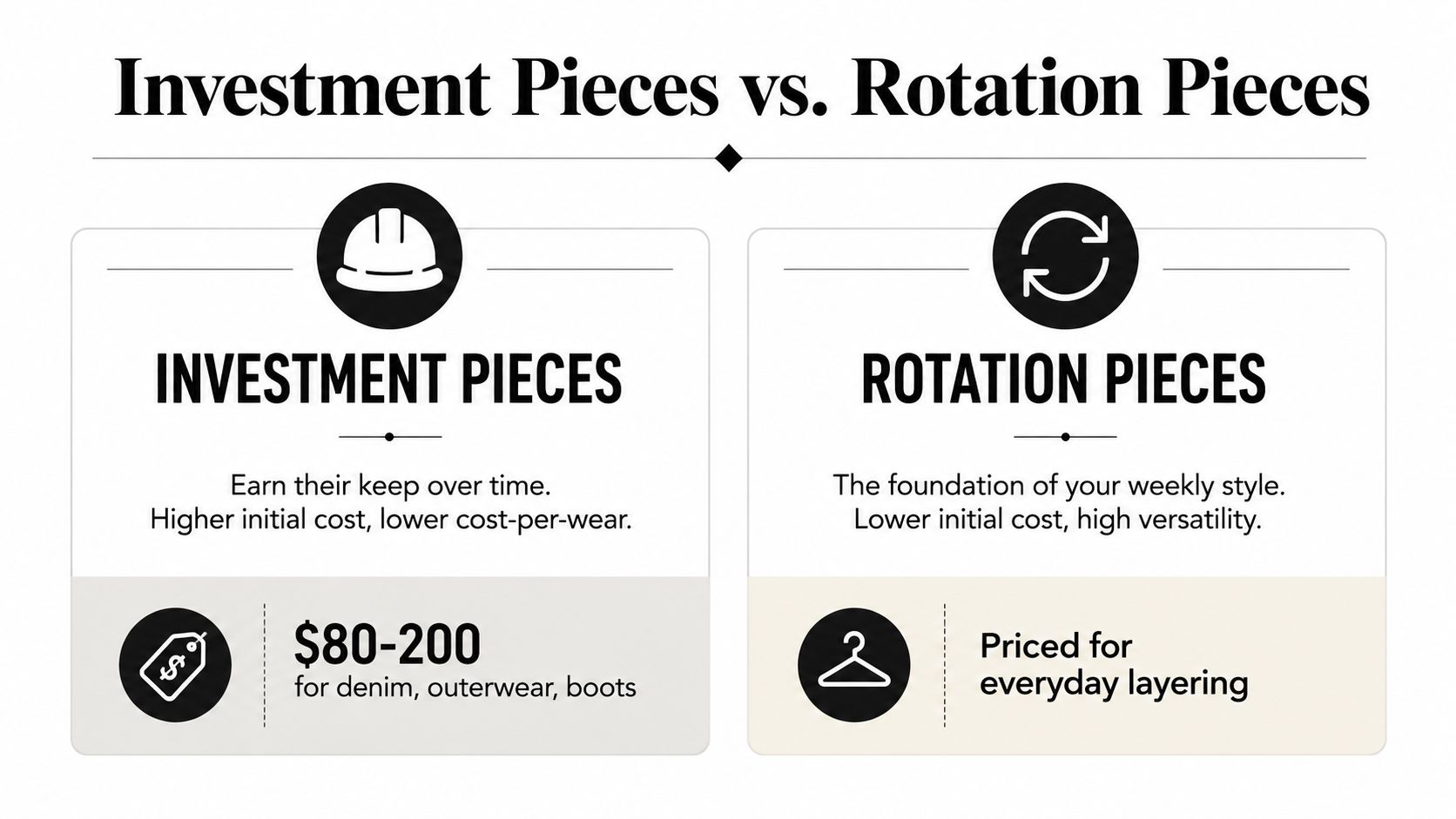
Your wardrobe needs two spending lanes. Investment pieces carry long-term wear through denim, outerwear, and boots. Rotation pieces handle the weekly grind through graphic tees, hoodies, shorts, and sweatshirts. Treating both categories the same is how people either overspend on basics or buy outerwear that falls apart before it develops character.
The two lanes
Investment garments deserve a higher price when you can wear them repeatedly and they improve with use. Rotation garments should stay accessible because they touch skin, enter laundry cycles, and need to support frequent outfit changes.
| Category | Typical Role | Price Guidance | Value Test |
|---|---|---|---|
| Investment pieces | Denim, outerwear, boots | $80 to $200 | Earn their place through 200 or more wears |
| Rotation pieces | Graphic tees, hoodies, shorts | $20 to $45 | Reach strong value through 40 to 60 wears |
The price and wear ranges above are a practical buying framework, not a guarantee. A $100 jacket worn 200 times reaches $0.50 per wear. A $30 hoodie worn 50 times reaches $0.60 per wear. Both can be excellent buys. The winning item is the one you reach for.
A lean starter lineup
A $250 starter budget can support one stronger investment item and four rotation pieces, but the exact prices depend on what you choose. The useful target is 800 or more combined wears, reached by assigning repeated use to the pieces that coordinate most easily. A durable jacket might carry the biggest individual wear count, while tees and sweatshirts create the daily variety.
Spend more on items exposed to fewer wash cycles and more abrasion from movement, weather, and footwear contact. Spend less on pieces that take heavy laundry abuse, provided the fabric and construction pass inspection. That's why a strong pair of pants or a reliable jacket can justify a larger share of the budget than a novelty graphic tee.
The cheapest item isn't automatically the affordable item. The affordable item is the one that keeps earning wears after the excitement of the purchase fades.
Watch the embedded comparison for a visual breakdown of how investment and rotation pieces work together.
How to Judge Quality Before You Spend a Dollar
Walk into a fitting room with your hands, eyes, and a little skepticism. You don't need laboratory equipment to reject a weak tee or a badly built hoodie. You need to check the areas that control fit, recovery, and wash performance.
The basic tee
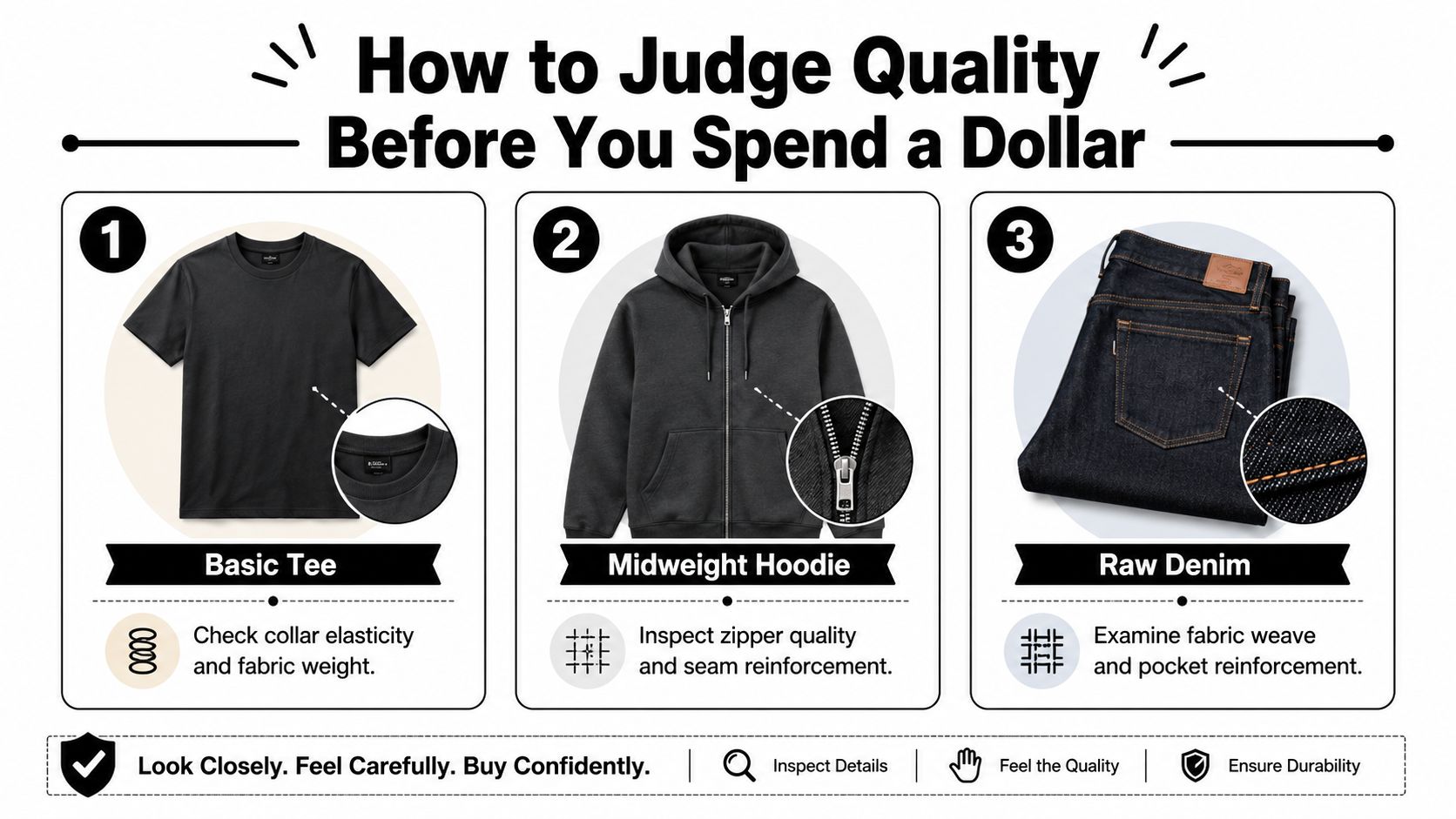
Start at the collar. Stretch it gently and release it. The rib should recover instead of staying loose. Run the fabric between your fingers, then hold the tee by the shoulders. A good streetwear tee should hang with intention, not collapse into a limp shape.
Look at the hem and side seams. A clean single-needle hem can create a neater edge, while uneven stitching, skipped stitches, or loose threads suggest rushed assembly. For a structured everyday tee, 180 to 220 GSM cotton jersey is a useful baseline, though a heavier shirt may suit a boxier look better.
The midweight hoodie
Check the hood opening, shoulder seams, cuffs, and pocket corners. A bonded seam may look clean at first but can be less reassuring than a properly reinforced split-seam construction. Tug the drawstring lightly, inspect the metal eyelets, and open and close the zipper several times if it's a zip-up.
For a substantial hoodie, 350 GSM and up is a practical target. The fabric should feel stable without becoming stiff, and the ribbing should grip without cutting into your wrists or waist. Before ordering online, use the garment measurements rather than relying on a size label.
If you want a deeper fit-focused reference, use this premium hoodie construction guide while comparing product pages.
The graphic crewneck
Run a finger across the print. High-density screen printing should feel deliberate and even. Direct-to-garment graphics usually sit more softly in the fabric. Embroidery should have clean edges, secure thread ends, and no obvious bunching around the motif.
Wash performance matters because decoration is part of the garment's identity. Textile testing checks dimensional change, wrinkling, seam puckering, and overall appearance after industrial washing. (RI textile washing procedures) Embroidered motifs are also affected by material choice and laundering. A 2025 study found that mechanical and washing stress degraded embroidered textile structures under certain conditions, showing why thread and construction need validation rather than assumptions. (2025 embroidered textile electrode study)
Use this 30-second checkout list:
- Collar: Does it recover after a gentle stretch?
- Fabric: Does the weight match the silhouette and season?
- Seams: Are joins straight, reinforced, and free of loose threads?
- Decoration: Does the print or embroidery look secure at the edges?
- Fit: Can you style the garment with at least several pieces you already own?
Five Pieces That Carry a Full Week of Outfits
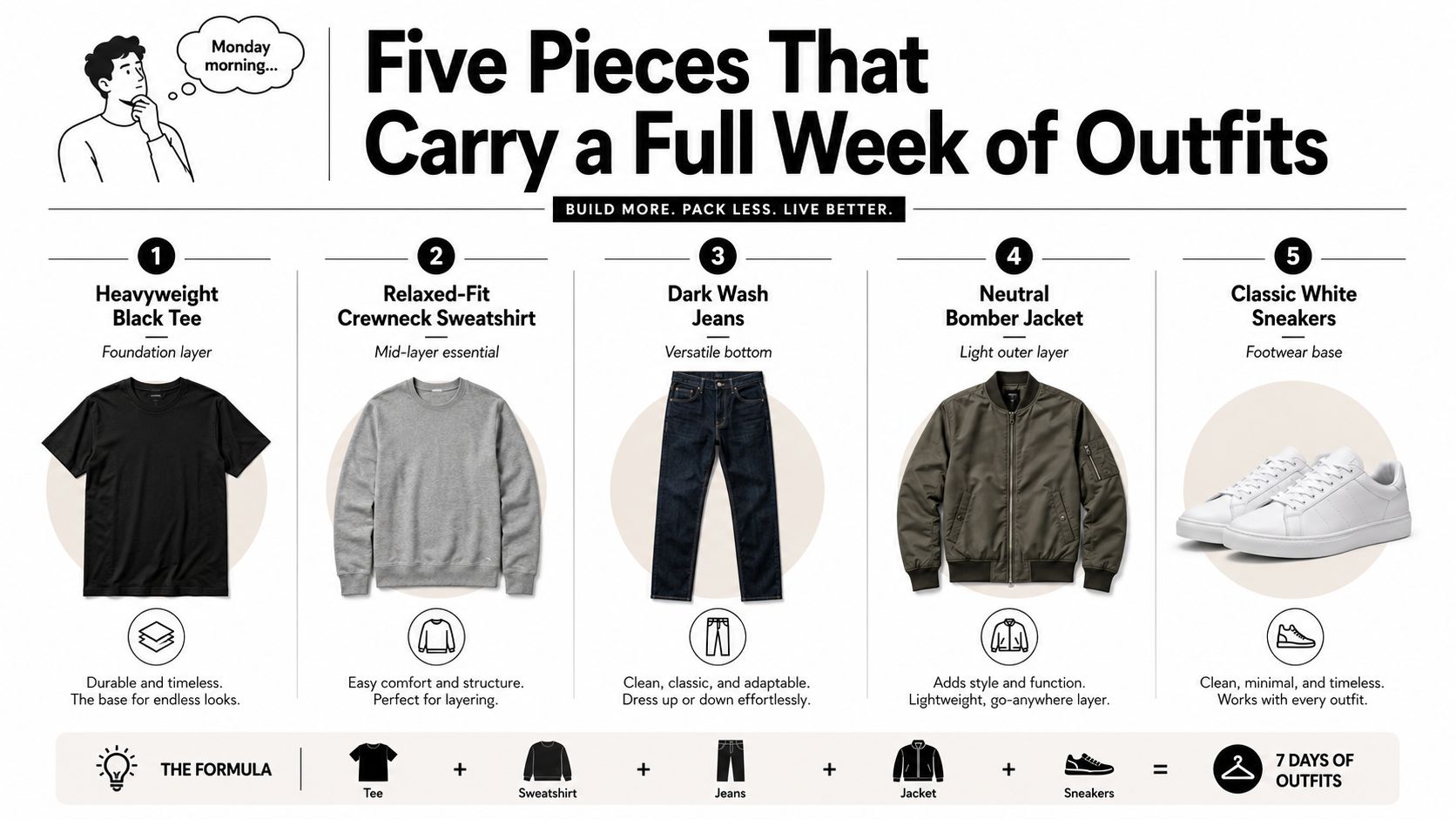
Monday morning doesn't need a new outfit if the wardrobe has the right structure. Five garments can cover a full week when every piece works across layers, colors, and proportions. The lineup is a heavyweight black tee, relaxed-fit crewneck sweatshirt, straight-leg cargo or utility pants, clean low-top sneakers, and one outer layer such as a coach's jacket or overshirt.
Monday and Tuesday
Start Monday with the black tee, straight-leg utility pants, and low-top sneakers. Keep the shape clean and let the pants provide the visual interest. On Tuesday, add the crewneck over the tee, then switch the sneakers or roll the pant hem slightly if the cut allows it.
A consistent design language makes this rotation feel intentional. The NY Crown Crest Short Sleeve Tee, Crown Crest Crewneck Sweatshirt, and Crown Crest Varsity Jacket offer a useful example of how one crest motif can move across different silhouettes without turning every outfit into the same uniform. The New York reference gives the pieces a clear identity, while the neutral layers keep them wearable.
Wednesday through Friday
Wednesday is the outer-layer day. Wear the tee under a coach's jacket or overshirt, then use the same pants and sneakers. Thursday flips the proportion, with the crewneck under the jacket for a denser layered look. Friday can return to the tee, but add a different accessory or let the jacket carry the outfit.
Fabric weight and decoration decide whether this rotation stays convincing. A structured tee gives the base enough presence to stand alone. A crewneck with stable ribbing keeps its shape over repeated use. Embroidery adds a tactile focal point, while a print can keep the surface flatter and more graphic.
For more detail on making a textured sweatshirt work with layered outfits, read this guide to an embroidered crewneck sweatshirt.
The cost-per-wear difference
A five-piece rotation can deliver the same weekly variety as a ten-piece haul when each item has multiple jobs. The smaller lineup also gives every garment more regular use, which makes it easier to identify what deserves replacement and what deserves an upgrade. More clothes don't automatically create more style. More combinations from fewer dependable pieces create better value.
Unisex Sizing and the Family Fit Advantage
Unisex sizing can reduce wardrobe waste and improve cost per wear, but only when the measurements match the intended silhouette. One design language can work across different bodies and age groups, allowing a household to share visual cues without buying separate versions of every idea. That makes each staple useful to more wearers and gives the garment more chances to earn its cost.
Independent unisex charts commonly cover adult sizes from XS through 3XL, with chest measurements ranging from 32 to 34 inches at the smaller end to 53 to 56 inches at the larger end, depending on the chart. (Brixton unisex apparel size chart) Treat those labels as a starting point, not a fit decision. Compare chest and length measurements with a garment you already own, then choose whether the new piece should sit close, relaxed, or oversized.
Read the chart by silhouette
The table below gives you a fit-planning framework. Product measurements vary by cut, so check the retailer's listing before ordering.
| Size | Chest (in) | Length (in) | Recommended Fit |
|---|---|---|---|
| XS | 32 to 34 | Shorter body | True-to-size or neat fit |
| S | 35 to 37 | Standard body | True-to-size |
| M | 38 to 40 | Standard-to-long body | Relaxed |
| L | 41 to 44 | Longer body | Relaxed |
| XL | 45 to 48 | Long body | Relaxed or oversized |
| XXL | 49 to 52 | Longer body | Oversized |
| 3XL | 53 to 56 | Longest body | Oversized |
Size up a tee when you want dropped shoulders and more drape. Hoodies need room through the chest and sleeves, especially over another layer. A varsity jacket should fit a sweatshirt underneath, yet a larger size will not fix sleeves that already run long. Check the proportions first.
Use this unisex sweatshirt sizing guide when you are choosing between close, relaxed, and oversized fits.
Matching works when the design stays grown-up
Coordinated parent-and-child outfits look strongest when the motif stays simple and the color palette does the styling. A crest, varsity reference, or restrained embroidered mark communicates shared identity without turning the outfit into a novelty costume. A focused catalog also improves cost per wear. The same design language can serve adult unisex pieces and toddler garments while keeping proportions appropriate to each wearer.
Broader reporting has connected streetwear's appeal with affordability and exclusivity, while gender-fluid, size-inclusive silhouettes have become more central to relaxed basics. (FashionUnited streetwear report) A 2019 report projected that global resale and secondhand apparel would reach $256 billion in 2025, reinforcing the value of garments with broad, reusable appeal.
The practical takeaway is direct: unisex basics can serve more outfits, more wearers, and more future wardrobe combinations when the measurements are honest. Buy the piece that fits the intended body and layering plan, then judge it by how often it can return to rotation. A versatile garment that works across a household delivers more wears per dollar than a narrowly styled item that sits untouched.
Your Starter Pack and Where It Takes You Next
Start with five pieces and make each one prove its cost per wear. Choose a heavyweight tee, relaxed hoodie, clean crewneck, well-cut pants, and one practical accessory with a recognizable reference point. This starter pack should create outfit coverage before it creates shopping momentum. Every next purchase must solve a clear gap.
The five-item test
- Heavyweight tee: Choose black, white, grey, navy, or a color already present in your wardrobe. It should return to rotation weekly. Reject it if the collar loses its shape quickly.
- Relaxed hoodie: Pick enough structure for layering without letting the fabric swallow your frame. It must work under a jacket and over a tee.
- Clean crewneck: Use it as the sharper mid-layer. Embroidery adds texture without making the garment depend on a large graphic.
- Well-cut pants: Straight-leg cargo pants, utility pants, or dark denim should anchor casual outfits and more styled combinations.
- One accessory: Choose a cap, bag, or similarly useful piece that supports your streetwear language instead of chasing a random logo.
Set a personal cost-per-wear target before buying. A tee earns its place through frequent routine use. A jacket can justify higher upfront spending when it works across seasons and stays active in the rotation. Keep the target measurable. An unworn garment delivers no practical value, regardless of its original quality or price.
The NY Crown Crest capsule shows how one focused motif can organize a starter pack. The Crown Crest Heavyweight Unisex Tee, embroidered hoodie, and embroidered crewneck establish a consistent base, while the crest connects them to New York's fashion vocabulary. NYFW describes itself as a force shaping culture, trends, and the evolution of American fashion, making New York a credible style reference rather than a decorative location tag. (Official NYFW site)
Grow with discipline
Your next purchase should fix a visible limitation. Add a textured overshirt when your layers feel flat. Choose statement outerwear when your basics need a stronger silhouette. Coordinate with a partner or child only after checking chest and length measurements. A larger label does not automatically produce a better streetwear fit.
The official CFDA fashion calendar has listed a preliminary September 2026 NYFW schedule for October 13 to 15, 2026, giving New York's fashion ecosystem a concrete seasonal anchor. (CFDA official NYFW schedule) You do not need runway pricing to participate in that visual world. Use deliberate proportions, useful layers, and pieces that keep earning wears.
Build the uniform first. Add the flex only when the uniform is doing its job.
Affordable streetwear works best as a repeat-wear system. Track wears, repair pieces that deserve to stay, and replace items that fail. Let your lifestyle create the next gap, not artificial urgency around a new drop.
If you want to test this approach with a focused wardrobe, DM-Flexwear.com offers NY Crown Crest heavyweight unisex tees, embroidered hoodies, crewneck sweatshirts, and coordinated baby tees in multiple colorways and sizes. Start with one piece, count its wears, and use that result to decide whether the next purchase has earned a place.