

You've got two crewnecks in your cart that look almost identical online. Same color, same clean front, same “this should work with everything” energy. Then one shows up boxy in a good way, keeps its shape after a few washes, and feels substantial on body, while the other turns limp, twists at the hem, and makes you wish you'd read the fabric tag before checking out.
That gap is why the best crewneck sweatshirts aren't really about hype. They're about construction, the stuff you feel after a long day, a wash cycle, and a season of repeat wear. In New York basics culture, that's the whole game. A crewneck has to do real work under a coat, over a tee, on a commute, or as the main piece when the fit is otherwise simple. DM-FlexWear's NY Crown Crest lane fits that mindset well, because clean staples and embroidered details only matter if the garment holds up in daily rotation. If you're shopping smart, the question isn't “what looks good in the product photo.” It's “what was built to live in my closet and still look right three months later?” For more context on how premium heavyweight layers are discussed in their lineup, see the brand's premium hoodies overview.
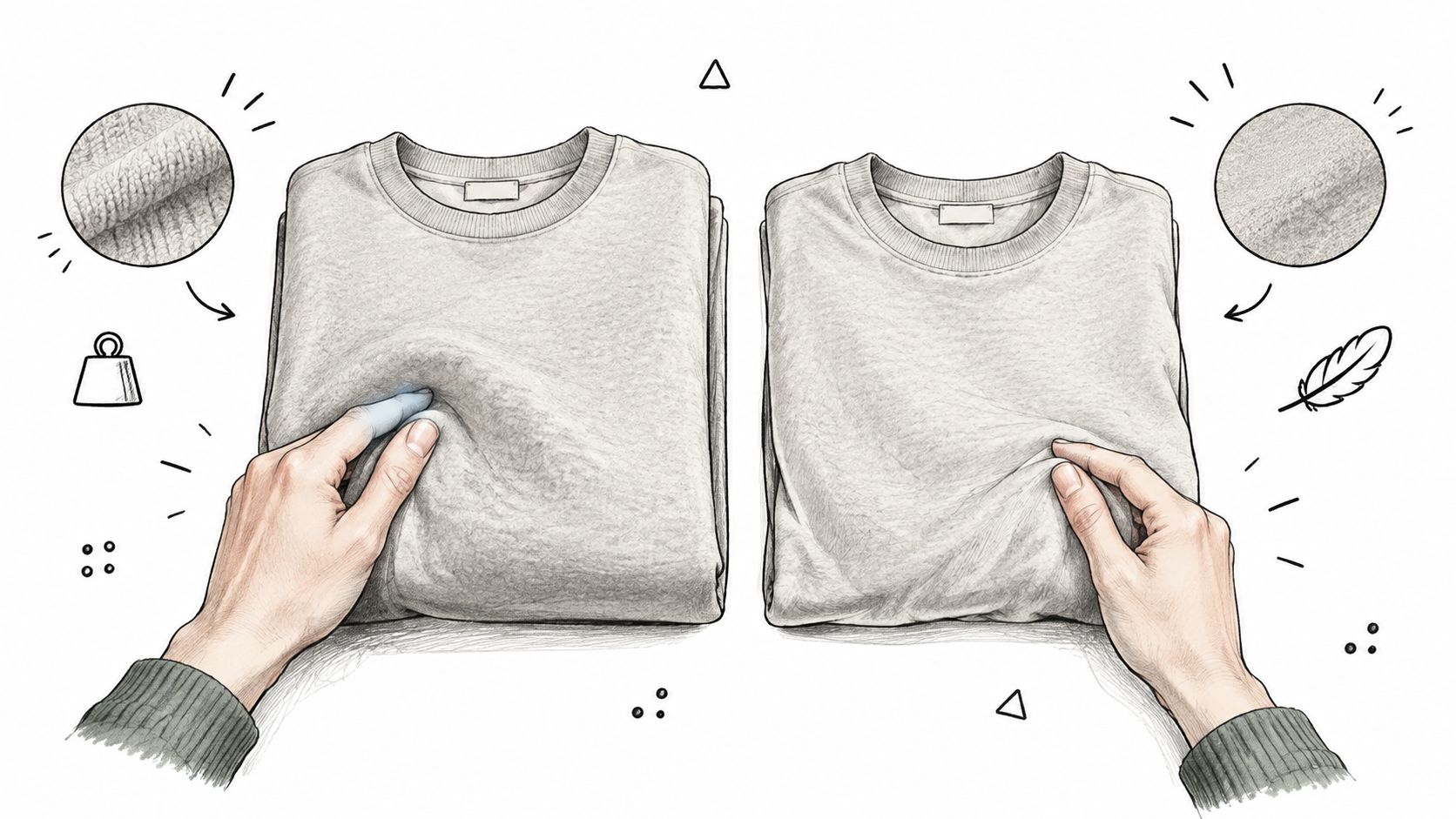
Table of Contents
- Introduction Why the Best Crewneck Is About Construction Not Hype
- Where the Crewneck Came From and Why It Still Matters
- Fabric Weight Decoded What GSM Really Means for Warmth and Drape
- Cotton Poly and Fleece Blends That Hold Their Shape
- Construction Details That Separate Premium From Basic
- How to Choose the Right Crewneck for Your Fit Climate and Lifestyle
- Final Take Your Everyday Heavyweight Starts Here
Introduction Why the Best Crewneck Is About Construction Not Hype
A crewneck can look identical on a screen and still wear like a completely different garment. One might sit clean on the shoulders, stay stable after washing, and layer under a jacket without bunching. The other might feel fine at first, then shrink, pill, or lose its shape so fast that the “basic” in basics starts to feel expensive in the wrong way.
What actually separates the good ones
The first separator is fabric weight, because a crewneck with substance behaves differently on the body than a thin one. The second is blend, since cotton alone and cotton-poly blends don't age the same way. The third is the finishing work, the neckline, cuffs, hem, seams, and decoration method that decide whether the sweatshirt stays crisp or turns sloppy.
Practical rule: if two crewnecks cost about the same, pick the one that tells you more about its build. Weight, fiber content, and finish are the clues that survive the photo shoot.
That's also why NYC-inspired basics hit differently. A good streetwear crewneck doesn't need a loud graphic to do its job. It needs structure, balance, and enough visual clean-up to work with denim, cargos, structured outerwear, or a simple beanie and sneakers combo.
Why the product-page details matter
The strongest product pages don't just sell a colorway. They tell you what the garment is made from, how dense it feels, and whether it was designed for layering or for stand-alone wear. That's the lens DM-FlexWear's NY Crown Crest style suggests naturally, because a crest, embroidery, or minimal front hit only works when the blank underneath is strong enough to carry it.
A lot of shoppers ask for the best crewneck sweatshirts but really mean something more specific. They want one piece for campus, one for cold-weather layering, or one that can handle regular washing without losing its shape. Once you start judging crewnecks that way, the buying decision gets much easier.
Where the Crewneck Came From and Why It Still Matters
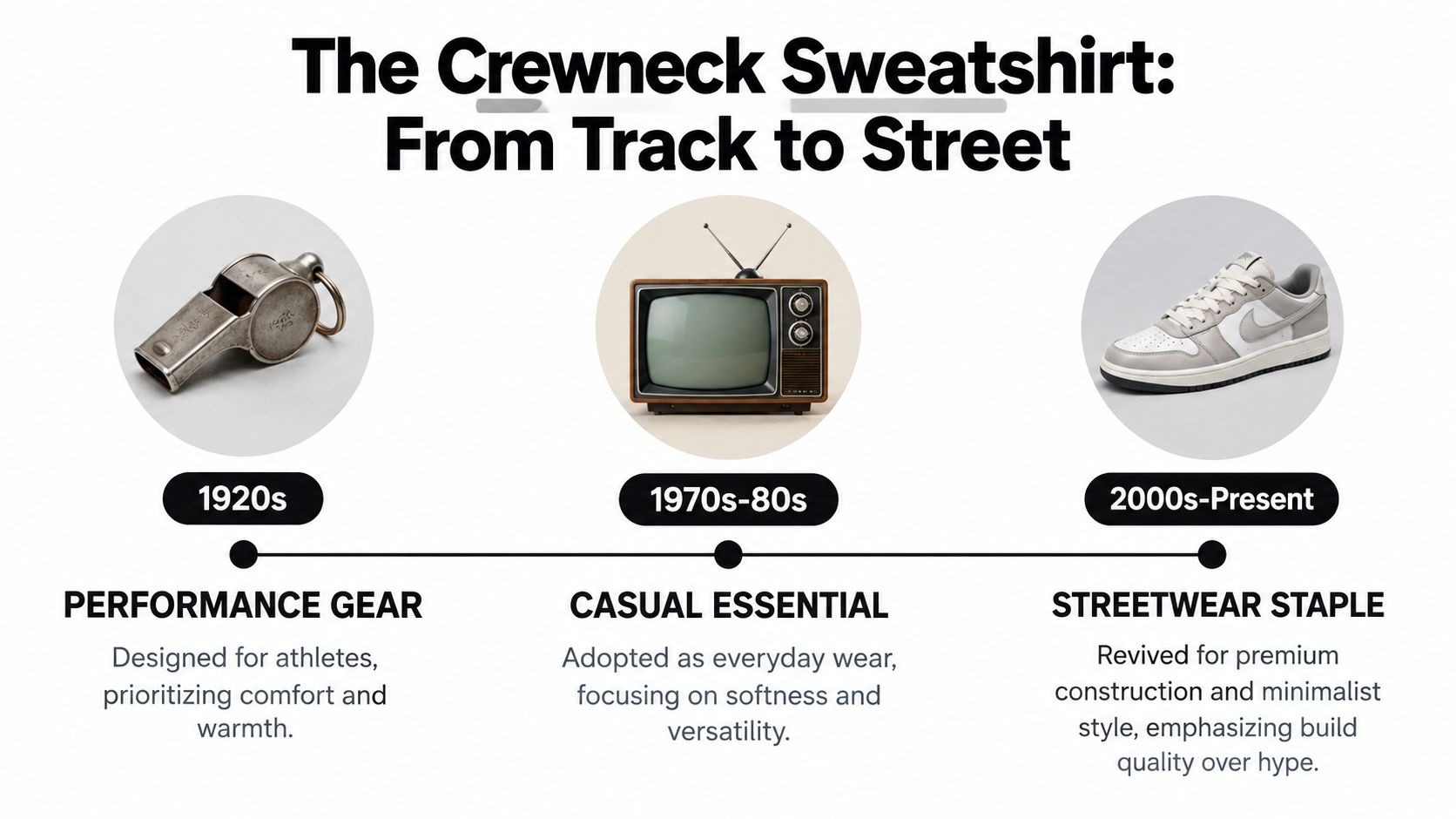
The crewneck sweatshirt didn't start in fashion, it started in sport. Russell Athletic says the original sweatshirt idea emerged in 1926, and crew neck sweatshirt production began in 1930, after Benjamin Russell Jr. proposed an all-cotton alternative to uncomfortable wool football jerseys. That history matters because the garment was built around comfort, durability, and ease of movement from the beginning, not decorative trend logic. Russell Athletic's sweatshirt history makes that origin plain.
From performance gear to daily uniform
That athletic DNA still shows up in the best modern versions. A solid crewneck should let your arms move naturally, sit comfortably over a T-shirt, and survive repeat wear without going misshapen. The style's long run is also a demand signal. A design that's been relevant for about 96 years has already crossed generations, which is rare in apparel and useful for anyone buying a staple instead of a novelty.
By the time streetwear locked onto the silhouette, the crewneck already had a practical reputation behind it. That's why it works so well with layered outfits in NYC. It can sit under an overshirt, under a coat, or over a base tee without fighting the rest of the look.
Why a nearly century-old shape still feels current
The crewneck's staying power isn't mysterious. Clean necklines are easy to wear, easy to style, and easy to repeat. A hoodie brings more attitude, but a crewneck has more room to read as sharp, especially when the fit is clean and the fabric has enough body.
That's the part that's easy to miss. The silhouette itself doesn't make the sweatshirt good. The build does. A well-made crewneck inherits the original purpose of the garment, then upgrades it for daily life, which is exactly why it still belongs in a modern wardrobe.
Fabric Weight Decoded What GSM Really Means for Warmth and Drape
GSM means grams per square meter, and it's the fastest way to predict how a crewneck will feel on body. Like paper weight, lighter stock feels airy and flexible, while heavier stock feels firmer and more substantial. In sweatshirts, that translates into real wearing differences you can feel the second you put it on.
Reading the weight bands without overcomplicating it
For crewneck sweatshirts, 280 to 350 GSM is the practical heavyweight threshold, and 350+ GSM moves into true heavyweight territory according to fabric guidance from SwatchOn's GSM calculator. That higher mass improves warmth, opacity, and structure, while lighter 237 to 298 GSM crewnecks usually balance layering comfort with less bulk. The same guidance points to 280 to 300 GSM as a common all-round sweet spot, with 320 GSM+ making more sense when you want winter utility or a stiffer, more substantial drape. SwatchOn's GSM guide lays out those ranges clearly.
If you see a sweatshirt around the 298 GSM mark, that's a recognizable midweight benchmark in streetwear and wholesale contexts. Three Layer identifies 298 GSM as a midweight crewneck benchmark and 339 GSM as heavy fleece, which is useful if you want a modern NY-inspired silhouette that still feels grounded rather than flimsy. Three Layer's GSM guide
A heavier crewneck doesn't just feel warmer. It hangs with more authority, and that changes the whole outfit.
How to match weight to the way you dress
A lighter crewneck works best when it's doing quiet support under jackets or over shirts. Midweight works because it gives enough body to look intentional without turning bulky. Heavyweight becomes the move when you want the sweatshirt itself to carry the fit, especially in colder weather or with wide-leg pants and clean sneakers.
Industry guidance also groups 280 to 350 GSM as a standard hoodie-and-sweatshirt band, while 400 to 500 GSM is usually reserved for heavyweight pieces. Renrui Textile's fleece and GSM guide makes the difference between everyday and premium structure feel measurable instead of vague.
The buying shortcut
If you want one crewneck for almost everything, start in the 280 to 300 GSM zone. If you know you'll wear it as a visible top layer through colder months, move up. The point isn't to chase the biggest number, it's to pick the weight that matches your weather, your layers, and the amount of shape you want the garment to keep.
Cotton Poly and Fleece Blends That Hold Their Shape
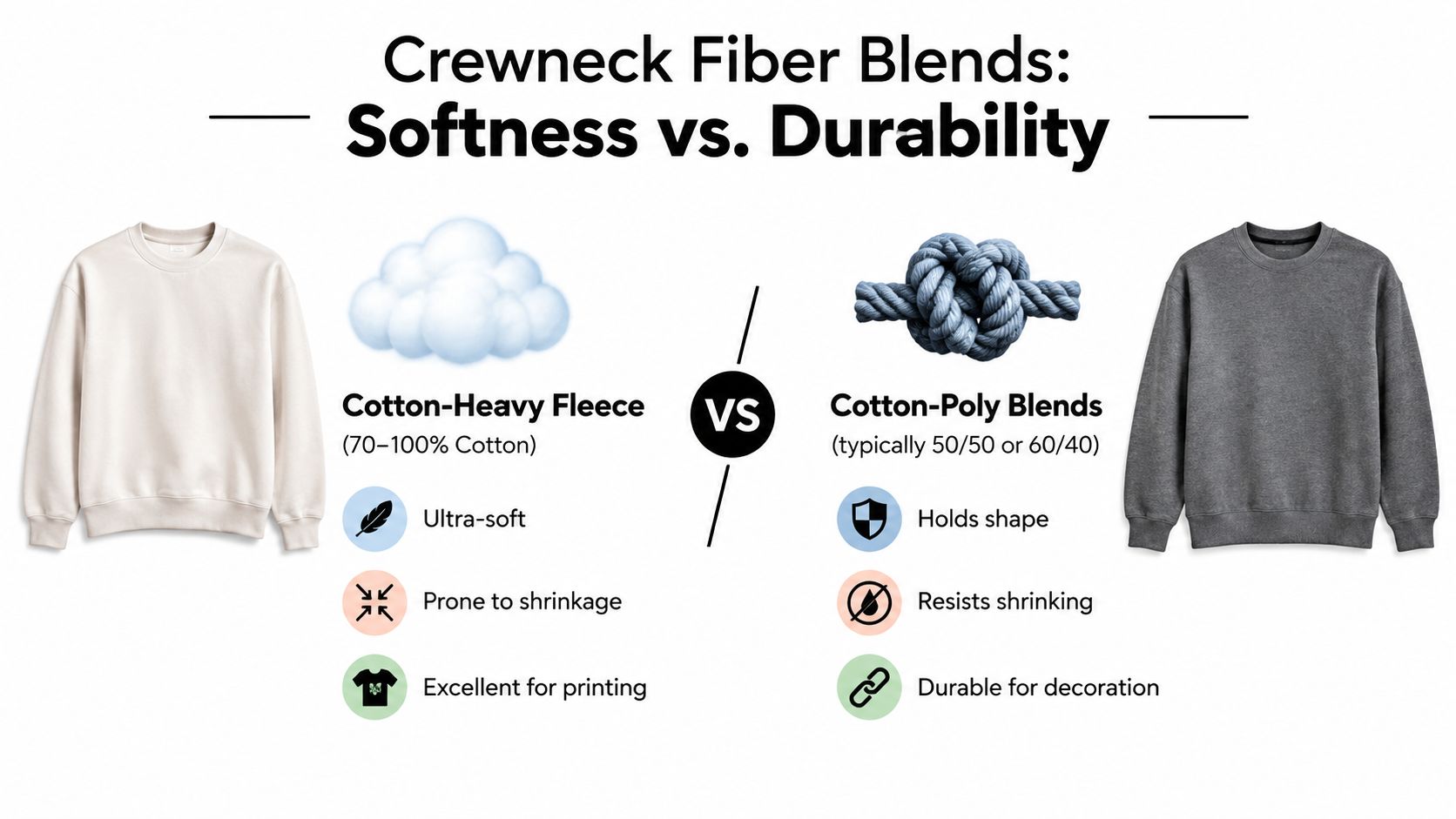
Fabric blend changes how a sweatshirt behaves after you wash it, wear it, and wear it again. Cotton-heavy fleece usually feels softer and prints well, but it tends to shrink and pill more than cotton-poly blends. Adding polyester improves dimensional stability and recovery because the synthetic fibers help the fabric resist growth, twisting, and repeated deformation. That's the core difference between a crewneck that stays tidy and one that starts looking tired.
Cotton-heavy versus cotton-poly in real life
If you want that plush, classic hand-feel, 100% cotton has real appeal. It's comfortable, familiar, and often the easiest base for print-heavy graphics. The tradeoff is that the garment can be less forgiving when laundry, heat, and wear start stacking up.
Cotton-poly blends make more sense when you care about shape retention. The blend helps the sweatshirt bounce back better, which matters on the body and on the hanger. For everyday basics, that stability often feels like the cleaner choice because the fit you buy is closer to the fit you keep.
Practical rule: if you want the sweatshirt to feel softer out of the box, cotton-heavy can work. If you want the sweatshirt to look like itself longer, a cotton-poly blend is usually the safer bet.
Why embroidery pushes the decision toward stability
Decoration makes fabric behavior more obvious. Embroidery adds weight and density in one area, so weak knits show distortion faster. Guidance from custom apparel suppliers notes that 80/20 or 70/30 cotton-poly fleece is often a safer technical choice for durable, long-wear basics when the goal is consistent fit over time, especially when embroidery is involved. Yaya Prints on custom crewneck sweatshirts explains why that extra stability matters.
That's why embroidered crewnecks feel so different from simple blanks. Stitching can look crisp on day one and still need the fabric underneath to carry it. A stable blend supports the decoration instead of letting the garment sag around it.
The simplest way to choose
Go more cotton-heavy if hand-feel and printability matter most. Go cotton-poly if you care about repeat wear, fewer surprises after laundry day, and a cleaner silhouette across the season. For a streetwear basic that's meant to live in rotation, the blend is part of the style, not just a technical footnote.
Construction Details That Separate Premium From Basic
A crewneck can look fine on the hanger and still fall apart in daily wear. The difference shows up in the build. Start with the neckline. A ribbed collar that lies flat usually means the opening is made to keep its shape, while cuffs and hem tell you whether the edges will stay tidy or go slack after a few wears.
What to look for before you buy
Strong crewnecks usually have dense seams, clean edge finishing, and a fleece interior that looks even instead of loose. If product photos show the inside, check for a knit that looks consistent across the panel. If you can handle the garment, pinch the ribbing and see whether it springs back instead of stretching out right away.
Pre-shrunk or pre-washed treatment matters too. It lowers the chance that the fit changes after laundry day, which is one of the most annoying problems with basic sweatshirts. A piece that keeps its shape is easier to wear on repeat, especially if you want it to sit the same way with jeans, cargos, or layered under outerwear.
Decoration should be built to last
Embroidery adds another test. Stitches put extra density in one area, so the fabric underneath has to stay steady. Guidance from workwear embroidery recommends polyester thread because it holds color well and wears hard, plus cut-away stabilizer on knits because it stays with the garment and helps the design keep its shape through washing. Embify's embroidery guide lays out that setup clearly.
That matters for a piece like DM-FlexWear's Embroidered Crewneck Sweatshirt. The point is not only the crest. It is the way the decoration sits on a staple silhouette without making the sweatshirt feel fragile. Done well, embroidery adds texture and gives the crewneck more presence.
A 60-second quality audit
Check the collar, the ribbed cuffs, the hem, and the seams. Look for structure, then balance, then recovery. If the edges bounce back, the seams look clean, and the decoration sits flat on the fabric, you are probably looking at a crewneck that will age better than the average basic.
How to Choose the Right Crewneck for Your Fit Climate and Lifestyle
The smartest way to shop crewnecks is to match the garment to your actual use case. Some people want a layer under a jacket. Some want one top that can stand alone all day. Some want a piece that feels warm without looking bulky. That's where weight, blend, and fit work together.
Crewneck Choice Matrix by Use Case
| Use Case | Ideal GSM Range | Best Blend | Fit Tip |
|---|---|---|---|
| Daily campus wear | Midweight, around 280 to 300 GSM | Cotton-poly or cotton-heavy if shrinkage isn't a concern | Go relaxed enough for a tee underneath, but not so loose that it swallows the frame |
| NYC winter layering | 320 GSM+ | Cotton-poly for better shape retention | Choose a roomier cut so it sits cleanly over base layers and under outerwear |
| Travel-friendly packing | Midweight | Cotton-poly | Pick a fit that resists wrinkling and doesn't collapse after a day in a bag |
| Stand-alone streetwear fit | Heavyweight, often 350 GSM+ | Cotton-poly or a sturdy cotton-heavy fleece | Look for structure in the body so the sweatshirt carries the outfit |
| Soft, classic lounge wear | Lower midweight to midweight | Cotton-heavy | Prioritize comfort, but expect a little more change over time |
The table above does more than sort by style. It shows how a crewneck's build changes its role in the wardrobe. A relaxed fit in thin fabric can still look underwhelming, while a cleaner fit in a heavier body can read intentional without looking overworked.
Fit is part of construction
People often debate slim versus oversized as if fit exists on its own. It doesn't. The same oversized shape can look sloppy in a light fleece and look premium in a heavier one because the fabric holds the silhouette. That's why the common “just size up” advice misses the point.
If you want a crewneck that layers well, check the neckline and body width so it doesn't bunch under a coat. If you want a stand-alone piece, make sure the shoulders, hem, and sleeve volume create shape rather than collapse. For sizing specifics, DM-FlexWear's unisex sweatshirt sizing guide is a practical reference point for understanding how a unisex fit should sit across different bodies.
A simple way to decide
Cold climate and visible outerwear lean heavier. Mild climate and layer-first dressing lean lighter. If you want one reliable answer, choose a midweight or heavyweight crewneck with enough structure to wear on its own and enough room to layer without fighting your jacket.
Final Take Your Everyday Heavyweight Starts Here
The best crewneck sweatshirts aren't the loudest ones on the rack, they're the ones whose construction matches how you live. If you keep coming back to the same three questions, the choice gets easy. How heavy is it, what's the blend, and does the build look strong enough to keep its shape?
That's the decision matrix. Weight tells you how the sweatshirt will drape and warm your body. Blend tells you how it'll handle washing, recovery, and embroidery. Construction tells you whether the collar, cuffs, seams, and finish will still look clean after repeated wear.
DM-FlexWear's NY Crown Crest lineup fits that staple-first logic, with crewnecks, hoodies, and tees built around a consistent New York identity and multiple colorways and sizes for broader fit needs. For shoppers who want one dependable piece instead of a closet full of thin basics, that kind of focused catalog makes sense. Choose the crewneck that feels substantial, then take care of it the same way you'd protect any real staple.
Wash it cold. Air-dry it when you can. Let the shape, the embroidery, and the drape stay intact instead of gambling with heat and shrinkage. A good crewneck should look better the longer it lives in your rotation, not worse.
DM-FlexWear.com carries NY Crown Crest crewneck sweatshirts, hoodies, and tees in multiple colorways and sizes, so you can pick a staple that fits your build and your rotation. If you want a clean starting point for a New York basics wardrobe, visit DM-FlexWear.com and check the crewneck options for yourself.