

You pull on a substantial hoodie, feel the raised crest catch against your hand, and pause in front of the mirror. The tee underneath works, the sneakers are ready, but one question remains: does the hoodie look intentionally oversized, or did you accidentally buy the wrong size?
That decision sits alongside two others. Embroidery versus print changes how the graphic feels and ages. Fabric weight changes warmth, structure, and drape. Fit determines whether the piece looks relaxed, polished, or swallowed by excess volume. Good embroidered hoodie streetwear brings all three decisions together, so the garment works as a repeat-wear staple instead of a one-off graphic.
Table of Contents
- Why the Embroidered Hoodie Earned Its Streetwear Status
- How Embroidery Differs From a Printed Graphic
- Reading Fabric Weight and Fleece Construction
- Finding the Right Fit From Streetwear Small to 3XL
- The NYC and NYFW Connection Behind a Crown Crest
- Building Outfits Across the NY Crown Crest Colorways
- Care Routine That Protects the Embroidery and the Fleece
- Putting It All Together Before You Buy
Why the Embroidered Hoodie Earned Its Streetwear Status
A crest hoodie earns its place in a rotation through touch and repetition. The raised chest motif gives a simple fleece silhouette a point of focus, while the hood, ribbed cuffs, and substantial body keep the piece practical for commuting, late-night food runs, and layered city outfits. Put it over a clean tee with straight-leg trousers, or let it sit beneath a jacket where the crest becomes the visual anchor.
The appeal isn't only visual. A stitched emblem feels integrated, not casually placed on top of the garment. That difference matters when the design is meant to communicate identity. A crown crest can suggest belonging, confidence, and a specific city vocabulary without covering the entire front in graphics.
The commercial context supports that role. A Grand View Research market analysis estimated the global decorated-apparel market at USD 28.9 billion in 2023 and projected it to reach USD 68.2 billion by 2030, representing a 13.0% compound annual growth rate from 2024 to 2030. The same analysis reported that embroidery generated more than 40% of global decorated-apparel revenue in 2023, which places stitched decoration well beyond niche craft territory.
Three choices shape the result
Start with the graphic. A stitched crown crest brings texture and relief, while a print can deliver a flatter, sharper image with less structural presence. Neither method is automatically better, but they create different relationships between the wearer and the garment.
Next, look at the fleece. A hoodie that's too light may feel more like a sweatshirt, while an overly dense body can become awkward indoors or under a coat. Weight should match the season and the way you dress.
Fit completes the equation. The NY Crown Crest idea works particularly well across tees, hoodies, and crewnecks because the same motif can move through a rotation without every outfit looking identical. A tee may handle a cleaner summer silhouette, the hoodie can provide the main volume, and the crewneck can fill the space between them.
Streetwear rule: A recognizable motif becomes more useful when it appears across different garment shapes, not just one loud statement piece.
How Embroidery Differs From a Printed Graphic
Embroidery sends thread through the garment. A printed graphic deposits color onto the outer surface, usually as a film or ink layer. That construction difference explains the raised hand feel of a crest and why the decoration can read as part of the hoodie rather than an image sitting above it.
Run your fingers over a stitched crown and you'll notice the light moving across the thread direction. Satin stitches create denser, smoother zones, while outlines and small details give the emblem definition. On a print, the surface is generally flatter, so the impact comes from color, scale, and graphic sharpness rather than relief.
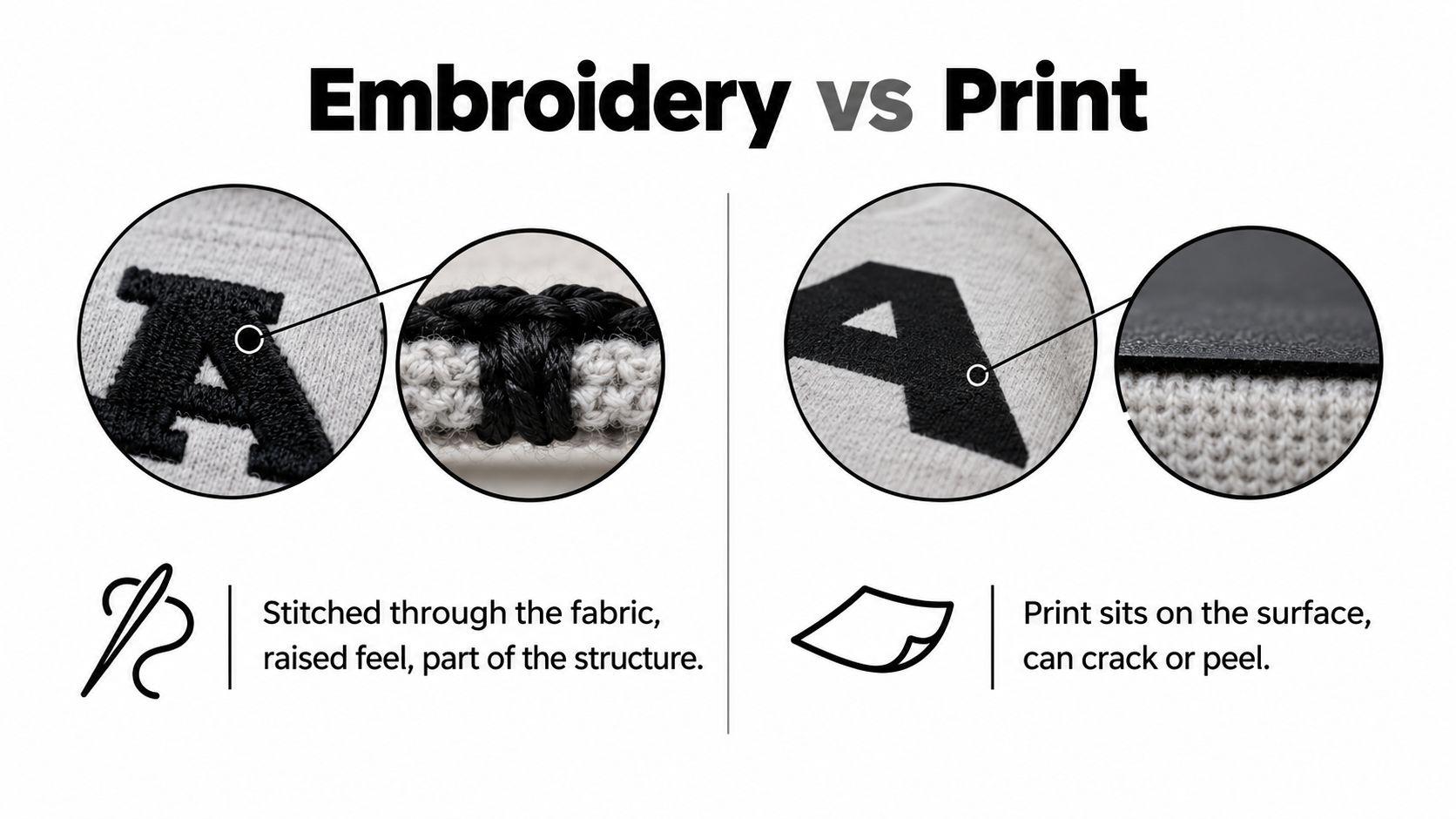
Thread choice affects repeat wear
Thread selection matters because the chest area receives friction from seat belts, bags, jackets, and regular handling. Comparative testing reported resistance to approximately 12,400 abrasion cycles for polyester embroidery thread, compared with 8,900 cycles for rayon under the cited protocol, making polyester the safer general choice for a frequently worn hoodie. The embroidery abrasion comparison provides the supporting test context.
That doesn't mean polyester thread makes the whole hoodie indestructible. Stitch density, backing, garment tension, and laundering still influence whether the crest puckers, snags, or loses definition. A well-digitized design avoids forcing too much thread into a small area, especially around dense crown points and narrow outlines.
The decision is straightforward. Choose embroidery when you want a repeat-wear identity piece with tactile presence. Choose print when you need a broad image, a temporary event graphic, or a design whose fine tonal detail matters more than texture. For a focused crest collection, stitching usually makes the garment feel more considered.
For a deeper comparison of construction and use cases, see this guide to screen printing versus embroidery.
Reading Fabric Weight and Fleece Construction
A product page that says “heavyweight” hasn't told you enough. GSM, or grams per square meter, gives you a clearer starting point because it describes the fabric's mass. More mass often brings more body and warmth, but the number only becomes useful when you also know the fleece construction and fiber blend.
Technical apparel guidance places typical fleece hoodies around 280 to 400 GSM. A range of 300 to 360 GSM offers a practical balance between substantial hand feel and everyday wearability, while 380 to 420 GSM creates a more structured, premium winter garment, according to this fleece hoodie weight guide.
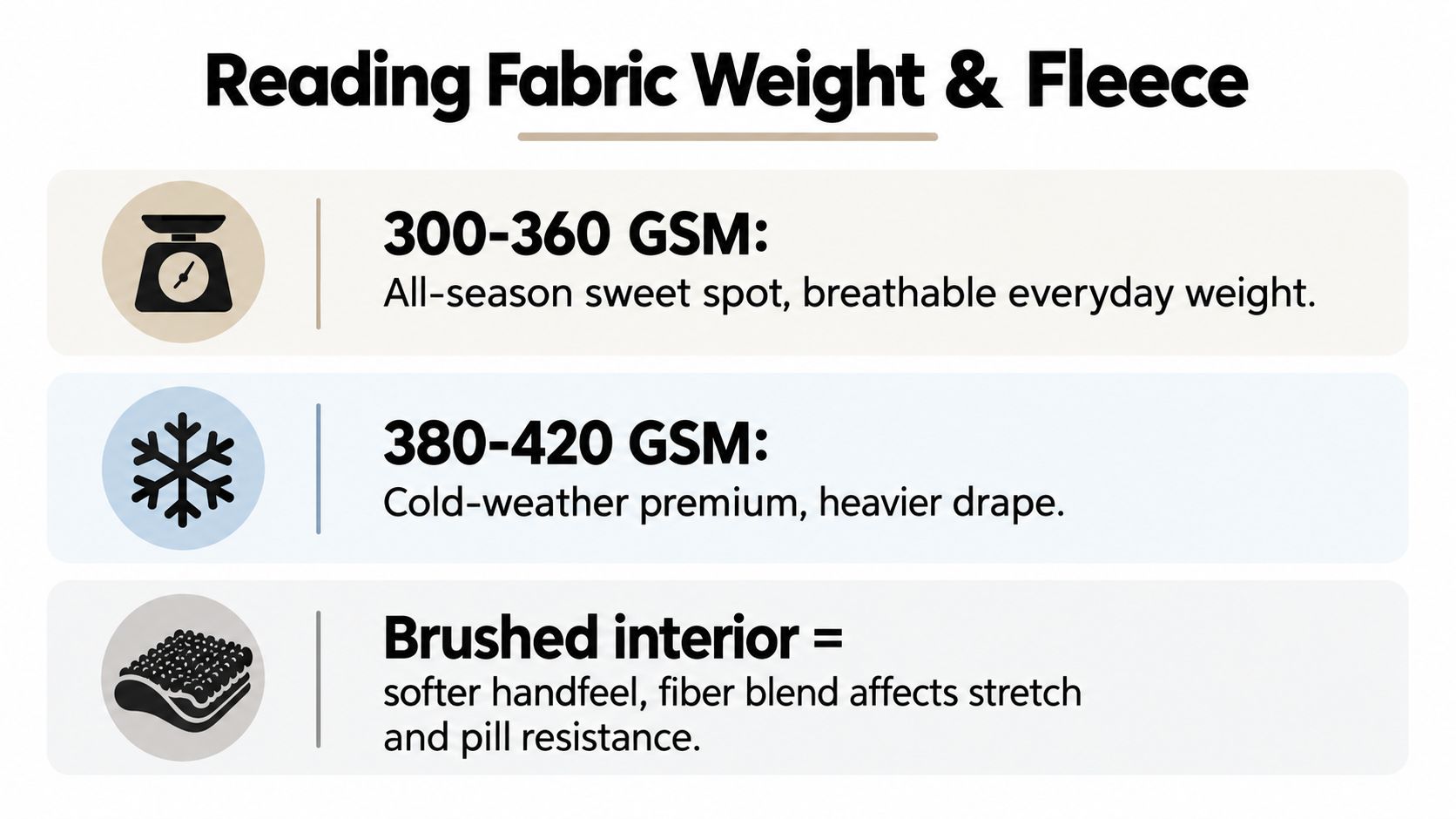
Weight isn't the same as warmth
A brushed interior can feel warmer than a heavier unbrushed fabric because the raised fibers trap more air against the body. That softer backing also changes the garment's personality. Brushed fleece feels cozy and familiar, while a smooth loopback interior may feel cleaner, cooler, and more structured.
For an everyday embroidered crest hoodie, 300 to 360 GSM is a versatile target. It can carry a raised chest design without becoming difficult to layer, and it remains practical across indoor and outdoor settings. A 380 to 420 GSM body suits cold-weather styling or a more architectural silhouette, but you'll want room in the fit for the added drape and bulk.
Fiber content adds another layer. Cotton-rich fleece usually offers softness and breathability, but it can shrink if the garment isn't properly treated. Polyester content supports dimensional stability and shape retention, which can help the hoodie keep its proportions after repeated washing.
Check the construction, not just the label
Embroidery adds localized stiffness to the chest. That makes pre-shrinking, rib recovery, and anti-pilling performance especially important. If the body shrinks unevenly around a fixed crest, the motif may look distorted or the surrounding fabric may pucker.
Before judging any “heavyweight” claim, look for four details:
- GSM: Confirm the actual weight rather than relying on a marketing adjective.
- Fleece type: Ask whether the interior is brushed or unbrushed.
- Fiber blend: Check the cotton and polyester balance.
- Shrink treatment: Look for pre-shrinking information and clear care instructions.
That checklist tells you far more about how the hoodie will wear than the word premium by itself.
Finding the Right Fit From Streetwear Small to 3XL
The best hoodie fit isn't automatically the largest one available. Recent evidence suggests that ultra-loose sweatshirts declined 17% from 2023 while moderately oversized styles rose 22%, pointing toward comfort with more structure, as reported in this 2025 oversized hoodie trend analysis.
That shift matters for a unisex hoodie offered from S to 3XL. Instead of telling every shopper to size up, compare your body measurements with the garment's chest width, body length, and sleeve length. Chest width controls the visible volume, while sleeve length determines whether the hoodie looks intentionally relaxed or merely too large.
Measure the garment you already like
Lay a hoodie flat and measure across the chest from underarm to underarm. Measure the body from the highest shoulder point to the hem, then compare the sleeve from shoulder seam to cuff. Use those numbers alongside the product chart rather than comparing only the letter on the tag.
Men who usually wear a regular fit may choose their usual size for a clean streetwear shape or move up one size for a looser layer. Women may prefer their usual unisex size for a relaxed fit, a smaller size for a neater shoulder line, or a larger size when styling the hoodie over a thick tee or jacket. Neither approach is universal because torso length, shoulder width, and preferred sleeve coverage vary.
A heavyweight body can also make a hoodie look larger than its measurements suggest. The fabric holds its shape instead of collapsing close to the body, so a moderately oversized size may deliver the relaxed effect you want without reaching for the biggest option.
Use intent instead of a vague size-up rule
| Fit Intent | Recommended Size | Layering Use | Style Note |
|---|---|---|---|
| Clean and close to the body | Your measured regular size | Over a tee | Keeps the crest sharp and the silhouette controlled |
| Relaxed everyday fit | Your usual unisex size | Over a tee or light long sleeve | Gives comfort without excessive volume |
| Moderately oversized | One size above your measured regular size | Over a tee and light jacket | Adds streetwear shape while preserving structure |
| Maximum layering room | The largest size supported by your measurements | Over heavier winter layers | Check sleeve and body length before choosing |
Read the unisex sweatshirt sizing guide for a second measurement reference, especially if you're between sizes. Also account for shrinkage expectations. Cotton-rich fleece can change after laundering, so a snug first try-on may become restrictive if the garment hasn't been pre-shrunk or washed according to its care instructions.
Fit check: Stand naturally, raise your arms, and sit down. The right size should keep the crest positioned across the chest without pulling, while the cuffs should stay usable rather than covering your hands.
The NYC and NYFW Connection Behind a Crown Crest
A crown crest feels at home in New York because the city has long made compact identity marks part of its visual language. Street signs, sports references, transit graphics, neighborhood emblems, and fashion labels all compete for attention in a dense environment. A small stitched symbol can carry presence without needing a giant front print.
New York's fashion history gives that symbol additional context. The city's first organized fashion event, Press Week, was founded in 1943 by publicist Eleanor Lambert to spotlight American designers when World War II restricted travel to Paris. The history of New York Fashion Week records that the Council of Fashion Designers of America consolidated New York's scattered shows in 1993, staging them in white tents at Bryant Park.
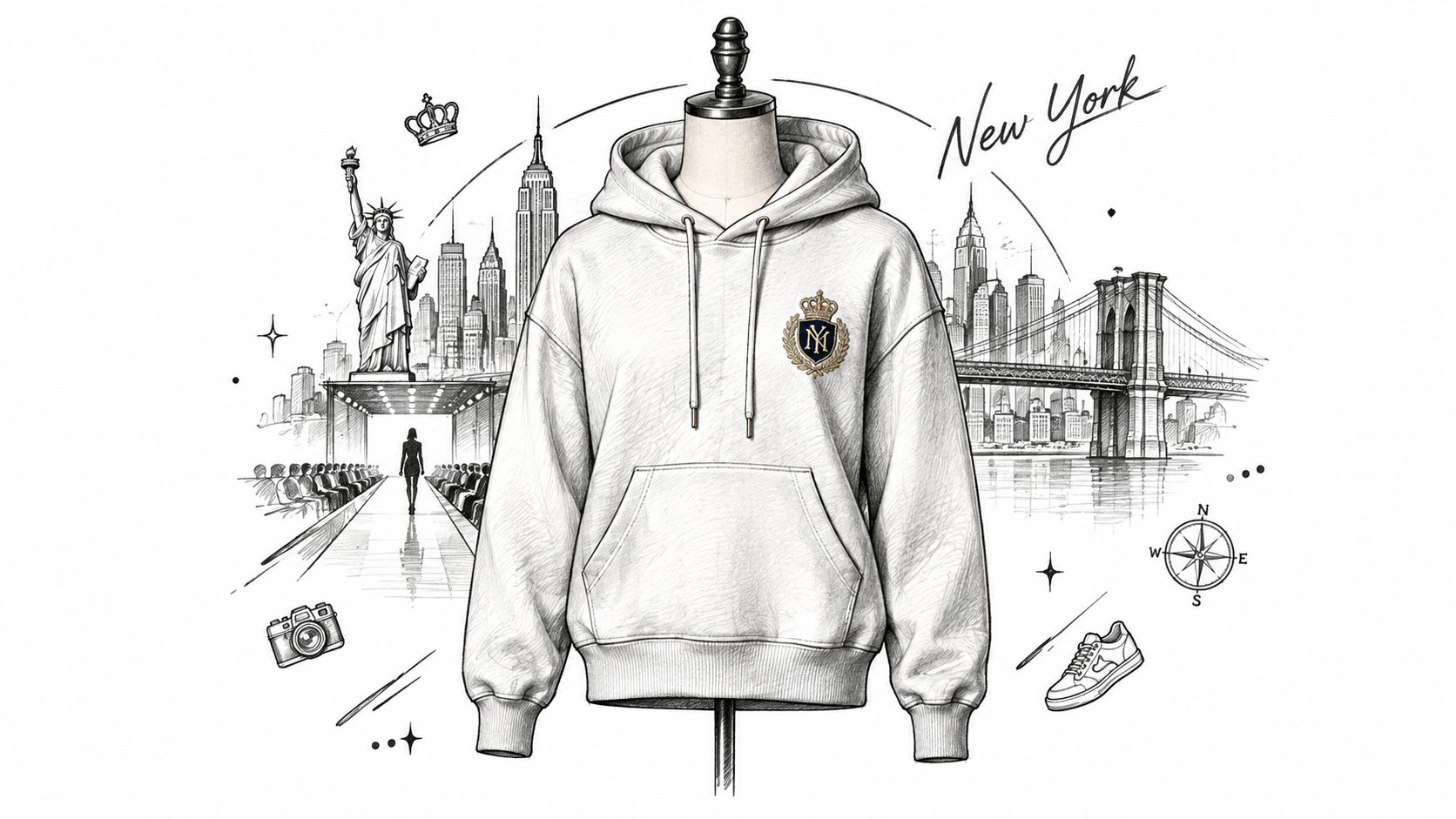
Fashion-week polish, everyday function
That history doesn't turn a crest hoodie into runway clothing. It explains why the motif can borrow some of fashion-week branding's authority while remaining practical. A crown gives the garment a defined point of view, and embroidery gives it the finish of a deliberate design decision.
The strongest styling stays grounded. Wear the hoodie with loose trousers and low-profile sneakers for a balanced city uniform. Add a coat when the weather turns, allowing only the hood and crest to show. For a sharper read, pair the hoodie with straight denim and a clean leather or nylon outer layer.
New York style rarely depends on a single category. It mixes polished and casual pieces, practical layers, and recognizable marks. A crown crest works within that vocabulary because it can look considered in a fashion setting and unforced on a daily commute.
A useful crest doesn't ask the rest of the outfit to compete. It gives the outfit a focal point and lets the city do the atmosphere.
Building Outfits Across the NY Crown Crest Colorways
A coordinated rotation starts with color roles, not with buying every option. Black, white, grey, and navy act as neutral anchors because they pair easily with denim, khaki, charcoal trousers, and technical outerwear. Pink brings a more visible accent, while gold works best when the rest of the outfit stays quiet.
The hoodie should also have a relationship with the matching tee and crewneck. A tee can sit underneath as a small color echo, while the crewneck offers a lighter alternative when a hood would add too much volume. Repeating the crest across different weights makes the collection feel connected without forcing identical outfits.
Three formulas that work
Tonal neutral set: Start with a grey or navy hoodie, matching neutral trousers, and understated sneakers. Add a tee in white or a nearby grey so the crest remains the strongest contrast.
High-contrast city look: Use a white or pink hoodie with black trousers and dark footwear. Keep outerwear simple, since the contrast between the garment and the base layer already creates the visual energy.
Coordinated family or partner fit: Let one person wear the adult hoodie while another wears a matching tee or crewneck. The baby tee color options, including pink, blue, and yellow, create a coordinated read without requiring everyone to wear the same silhouette.
The gold option works especially well as a small color note under a darker crewneck or jacket. If the hoodie is already the loudest item, keep the rest of the outfit textural rather than graphic. A plain cap, washed denim, or clean trousers gives the crest room to register.
Care Routine That Protects the Embroidery and the Fleece
Embroidery is built to handle regular wear, but the decoration and the fleece still have specific weak points. Dense satin areas can flatten under heat, thread can snag, and the backing or surrounding knit may distort before the thread itself fails.
Use a simple laundering routine:
- Turn the hoodie inside out. This reduces direct abrasion against the crest during the wash.
- Wash in cold water. Cold washing helps protect thread color and reduces stress on the fleece.
- Skip bleach. Even when polyester thread resists wear, bleach can damage the surrounding textile and alter color.
- Line dry or use low heat. High heat and tumbling can relax the knit, flatten stitch geometry, and encourage shrinkage.
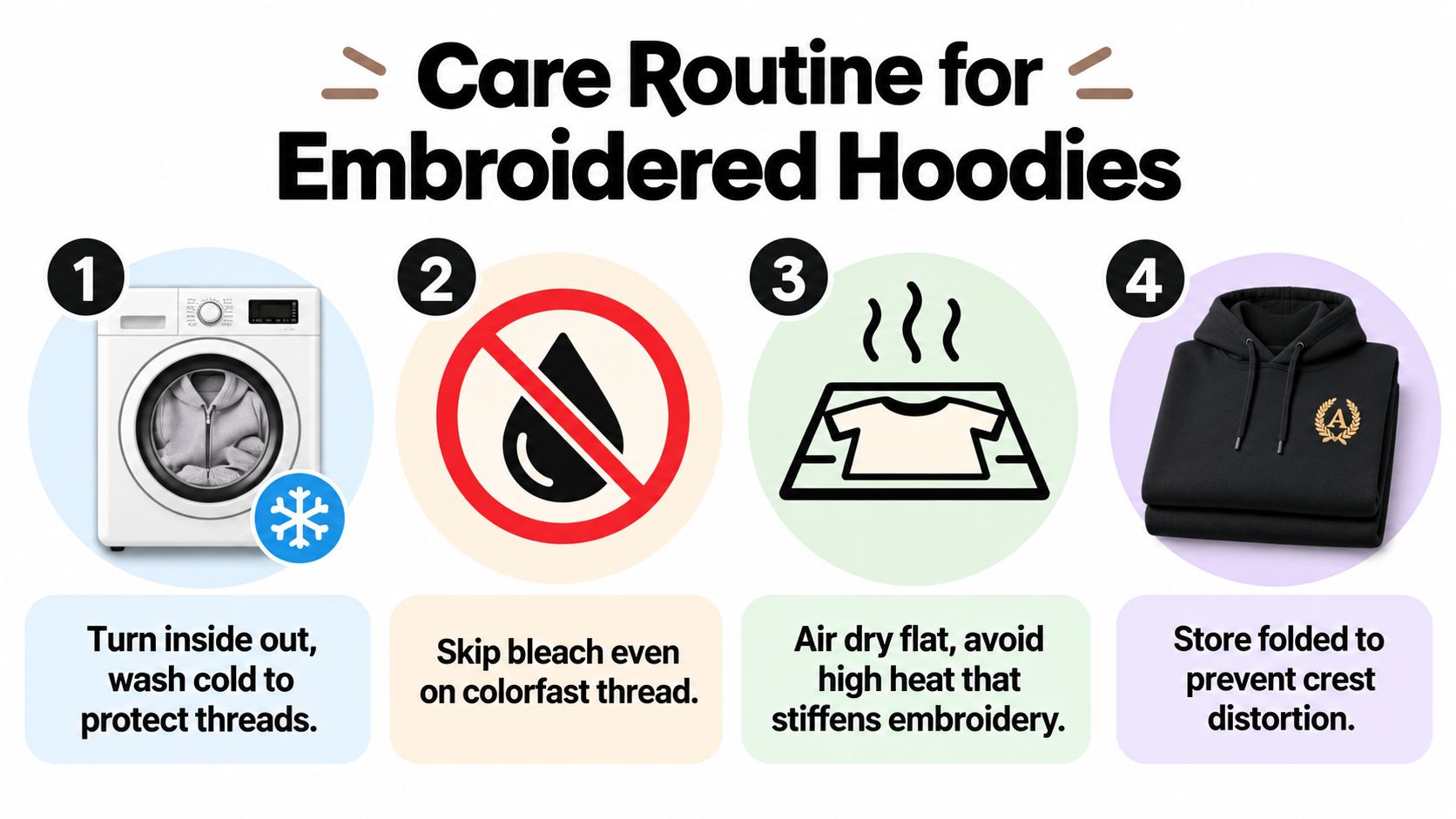
Respond to common problems early
If the fleece begins to pill, don't pull the fibers by hand. Use a fabric shaver carefully on the body, keeping it away from the raised crest and any loose thread ends. Slight puckering around the motif can result from stitch tension or laundering stress, so avoid ironing directly over the embroidery.
Treat stains from the reverse side when possible. Blot rather than scrub, use a mild detergent, and test any treatment on an inconspicuous area first. Aggressive rubbing can disturb the thread direction or force residue deeper into dense stitching.
For more guidance on caring for stitched sweatshirt decoration, consult this embroidered crewneck care guide.
Store the hoodie with its shape intact
Fold the garment rather than hanging it for long periods on a narrow hanger. A hanger can create shoulder dents, while a compressed stack can flatten the fleece and distort the crest. Fold the hood naturally, keep heavy items off the embroidery, and store the hoodie clean and fully dry.
A useful durability mindset is to think in wear cycles, not an absolute promise that the garment will last forever. Care, handling, repair, and the environment where you wear the hoodie all influence its useful life.
Putting It All Together Before You Buy
A strong embroidered hoodie purchase comes down to three clear calls. First, choose stitching when you want a repeat-wear staple with a raised identity mark, and choose print when the graphic needs a flatter or more temporary treatment.
Second, match fabric weight to your routine. Look for 300 to 360 GSM when you want an adaptable everyday layer, or 380 to 420 GSM when you want a more structured cold-weather piece. Confirm the fleece type, fiber blend, and shrink treatment before trusting a heavyweight description.
Third, choose fit by intent. Compare your measurements with the garment chart, decide whether you want regular, relaxed, or moderately oversized proportions, and check sleeve and body length instead of sizing up automatically.
Before checkout, run through this list:
- Graphic: Is the crest meant to become a repeat-wear signature?
- Fabric: Does the GSM match your climate and layering habits?
- Fit: Have you compared chest, sleeve, and length measurements?
- Care: Can you wash inside out, use cold water, and avoid high heat?
- Rotation: Will the color work with tees, crewnecks, trousers, and outerwear you already own?
That final question separates a good-looking hoodie from a useful one. The best piece doesn't wait for a special event. It earns its place every time you reach for something comfortable with enough structure to make the outfit feel finished.
DM-Flexwear.com offers NY Crown Crest tees, embroidered hoodies, crewneck sweatshirts, and coordinated baby tees in multiple colorways and sizes. Explore the collection at DM-Flexwear.com to find a crest-led layer that fits your streetwear rotation and your styling needs.