

You're probably here because you've already seen the gap.
The family fit looked good in your head. Then the pieces arrived, the toddler tee fit like a crop top, the adult hoodie swallowed the frame, and the whole “matching” idea started reading less like style and more like costume. That's the part most mini me matching outfits guides skip.
The good version isn't about cloning one look across three bodies. It's about building a shared visual language that still makes sense on a school run, a downtown brunch, a quick subway ride, or a photo you'll want to keep.
Table of Contents
- The Mini Me Look Is Everywhere Right Now
- Why Shared Visual Language Beats Identical Outfits
- Building the Set From Infant to Adult
- Picking Colorways That Actually Read as a Family
- Sizing and Fit Across Ages Without the Guesswork
- Photo Tips So the Match Pops on Camera
- Making Mini Me a Repeat Wear Habit Not a One Off
The Mini Me Look Is Everywhere Right Now
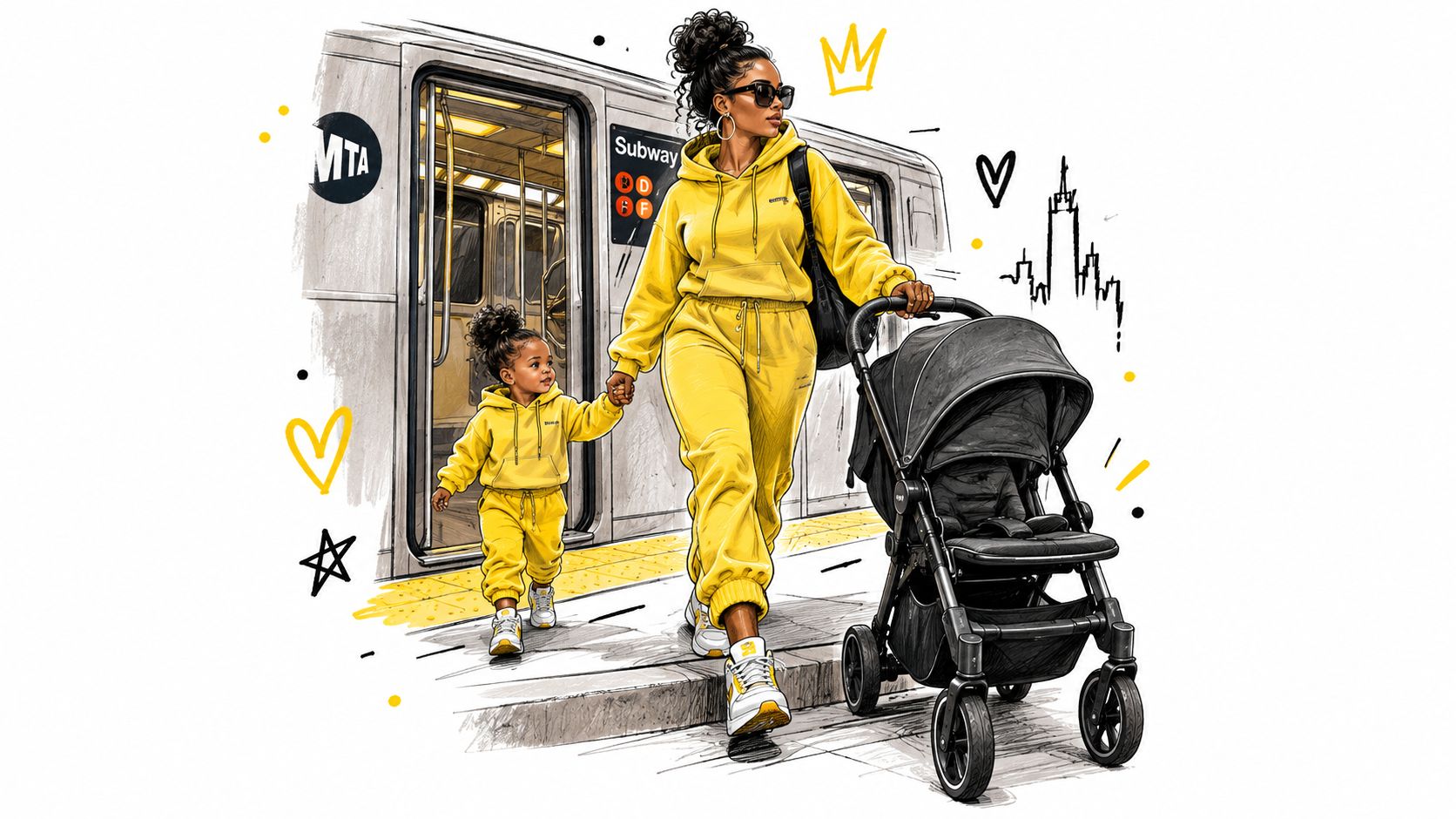
A parent steps off the subway in a washed hoodie and clean sneakers. The stroller bumps the curb. The kid next to them is wearing the same color family, same energy, same attitude, but not a copy-paste fit. That's the modern mini me look when it's done right in New York. Coordinated, sharp, and casual enough that nobody looks like they got dressed only for a camera.
It's older than social media
People talk about mini me matching outfits like TikTok invented them. It didn't. Coordinated family dressing has deep roots. One history of the look notes that siblings were dressed alike for centuries, the modern mother-daughter version is commonly traced to Jeanne Lanvin's early-1900s designs, one account places her matching children's line launch in 1908, and matching family sleepwear is documented as early as 1954, with vintage examples noted from 1958. The same piece points out that the look resurged in the 1950s and 1960s, which tells you this isn't a novelty. It's a recurring cycle in fashion history with more than a century behind it (history of mommy-and-me fashion in The Atlantic).
What changed is the styling language. Older matching often leaned literal. Same print, same silhouette, same everything. The current wave feels closer to streetwear logic. Shared colorway, repeat motif, similar fabric mood, different cuts for different ages.
This is a real market now
The category isn't small anymore either. One 2025 industry estimate values the global matching family outfit market at $23.4 billion, with a projection to $37.8 billion by 2034 at a 6.8% CAGR. That same estimate says T-shirts hold 28.5% of the market and Asia Pacific accounts for 35.2% of revenue. In a separate 2018 report, the luxury childrenswear market was forecast to reach $6.6 billion in 2018, up 3.8% year over year, and parents were described as spending upwards of $500 for matching miniature luxury items (matching family outfit market estimate).
That range matters. Mini me matching outfits now live in two lanes at once.
- Mass everyday lane: Tees, hoodies, fleece, easy bundles.
- Premium fashion lane: Miniature luxury pieces, occasion wear, designer versions.
- Hybrid lane: Basics that can handle both errands and photos.
Streetwear read: The strongest family sets don't scream “we bought the same outfit.” They say “we understand proportion, color, and mood.”
Buyers aren't just dabbling
There's another reason the category keeps getting stronger. A survey-style study reported that 44% of respondents always buy matching outfits, 23% do so occasionally, 17% rarely purchase them, and 16% never do. That points to repeat-buy behavior, not just random one-off impulse shopping (matching outfit buying behavior study).
That's why the best family looks now resemble planned wardrobe systems, not holiday gimmicks. Search interest also tends to spike toward year-end, especially in November and December, with related family-coordination terms also rising in spring and around February. Separate demand data in that same trend roundup also reports +30.8% search growth over the last 90 days for “mommy and me matching outfits,” which suggests the demand runs beyond holiday pajamas and one-day novelty use (matching outfits trend analysis).
Why the current version hits harder
The mini me revival also has fashion backing. One childrenswear industry article names mini me dressing as a recognized 2025 trend and says family-matching looks stay especially popular around holidays and special occasions (2025 childrenswear trend coverage). A major fashion publication also describes the revival across a wide range of aesthetics, from tartans and tiaras to nautical motifs and color-blocked details, which proves the look isn't boxed into one lane (The Guardian on the mini me revival).
The streetwear version is the one with staying power. Embroidered hoodies. Heavy tees. Tonal crewnecks. Clean crest placement. Colors that work on grownups, kids, and babies without tipping into cartoon territory. That's also why NYC and NYFW energy matters here. New York style has always rewarded people who can make basics look deliberate.
Why Shared Visual Language Beats Identical Outfits
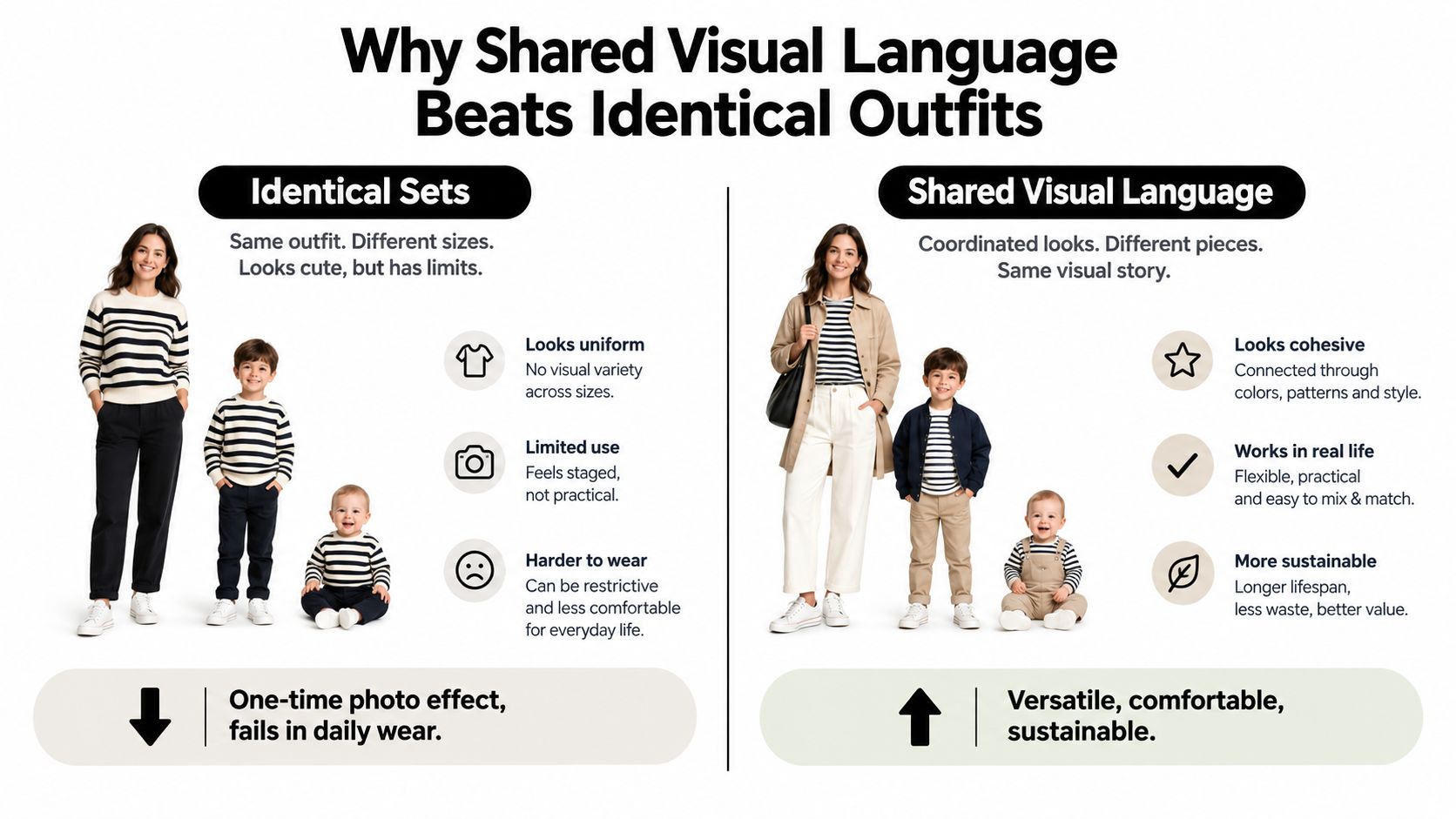
Head-to-toe duplication works for one thing. A fast photo. After that, it usually falls apart.
An infant, a six-year-old, and an adult don't wear the same silhouette the same way. An oversized hoodie on a toddler can look swallowed. A scaled-down graphic can lose impact on a baby tee. A slim adult fit copied from a kid's shape kills the drape that makes streetwear feel good in the first place.
The better formula
The better move is shared visual language. Same family of colors. Same motif placement. Same fabric mood. Different silhouettes based on age, movement, and proportion.
Independent styling guidance lands in the same place. It notes that family coordination often works better when one person wears the main print and the others echo it through neutral pieces, accessories, or layered basics. It also points out that adult looks should stay more understated while children's outfits can carry more playfulness (guidance on matching outfits from C&A).
That's the whole point. Matching doesn't need to mean literal duplication. It can mean a shared code.
- Adults need restraint: cleaner graphics, steadier proportions, better drape.
- Kids need room: movement, comfort, and enough structure to survive real life.
- Infants need adaptation: softness and practical closures beat visual perfection.
A lot of family sets would improve overnight if people treated them like coordinated styling instead of costume design. If you want a simple starting point, this kind of family matching T-shirt styling approach makes more sense than forcing exact copies across every age bracket.
Wearable mini me matching outfits don't ask every family member to become the same person. They ask each piece to speak the same language.
Building the Set From Infant to Adult
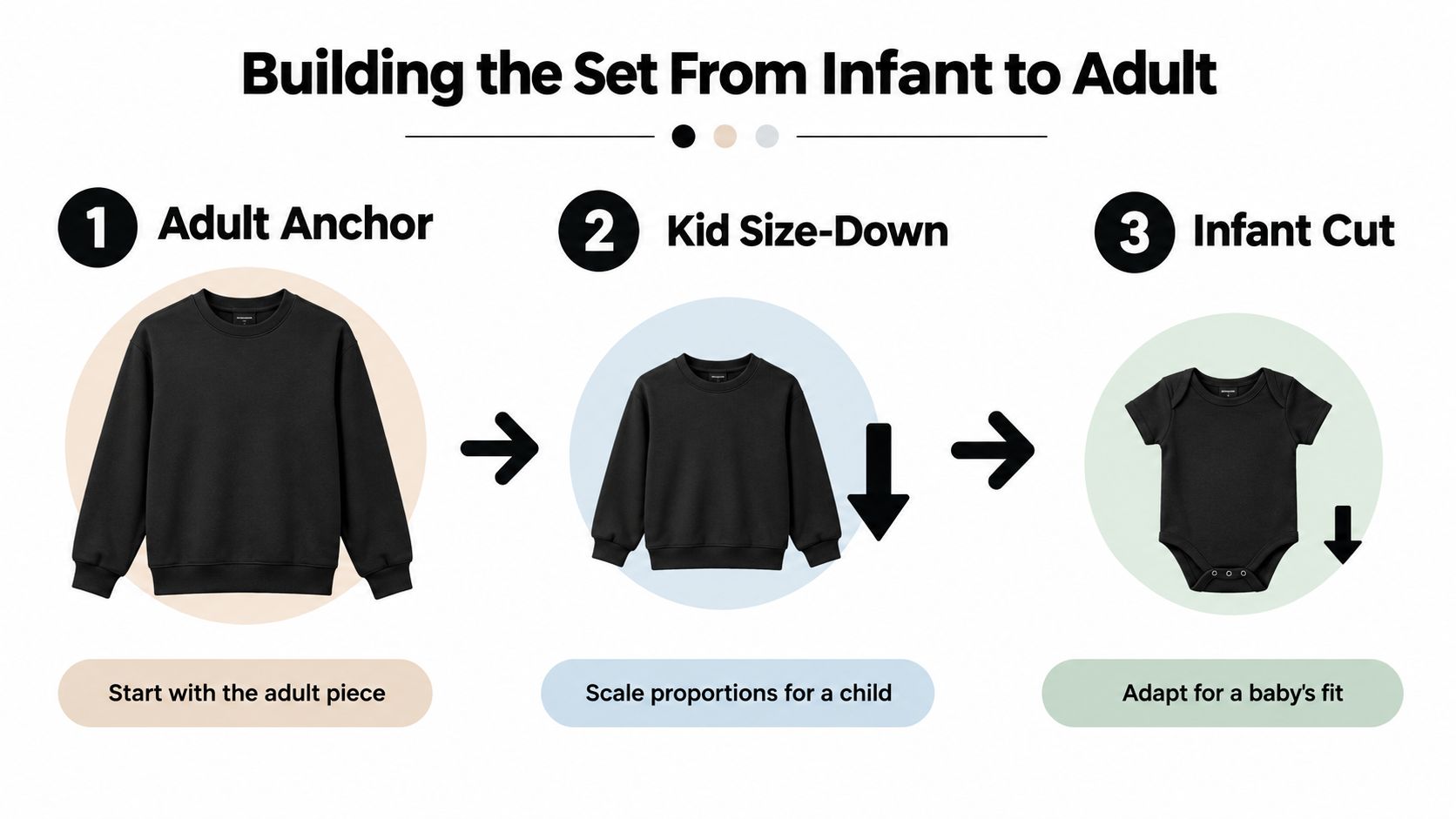
The easiest way to build a clean set is to start at the top of the age ladder and work down. Adults set the tone. Kids inherit the energy. Infants get the softest version of the idea.
Start with the adult anchor
Pick the piece that defines the whole look. In streetwear, that's usually the hoodie, crewneck, or heavyweight tee. Decide first whether the outfit should read soft and tonal, crisp and graphic, or darker and more city-coded.
Adult sizing should establish the silhouette. If the adult piece is boxy and heavyweight, the whole family set can lean more structured. If it's lighter and closer to body, the set will read more casual and less editorial.
Size down with adjustment, not blind copying
Kid versions need breathing room. Not sloppy room. Movement room. School pickup, playground crouch, snack spill, random sprint toward a pigeon. Real room.
The move is to keep one shared element while changing one practical variable.
- Keep the colorway consistent if that's the main statement.
- Reduce graphic dominance for smaller bodies if the motif starts to overwhelm.
- Ease the fit slightly so the outfit still works after the first wear.
Drop into the infant cut last
Infant pieces should never be treated like mini posters. The fit and feel matter more than logo scale. Soft hand, easy neckline, practical construction. That's what keeps the set from becoming frustrating.
Fit rule: Buy the adult piece first, the child piece second, and the infant piece last. The older the wearer, the more the garment should shape the look. The younger the wearer, the more the garment should serve comfort.
If you're building over multiple seasons, anchor with the grownup layer, then add the child version when the color still works in rotation. Baby sizing moves fastest, so that piece comes last.
Picking Colorways That Actually Read as a Family
Most matching sets fail at color, not concept. Too many loud shades fighting each other and suddenly the family looks coordinated only in theory.
The fix is a simple three-slot system. One lead shade, one echo shade, one grounding neutral. That gives the eye a pattern to follow without forcing everyone into the exact same garment.
Use one voice, not three arguments
A clean family set might put the adult in Black, the child in Olive, and the infant in Sand. Or the adult in Bone, the child in Steel, and the infant in a lighter neutral. The point is visual hierarchy.
Saturated color should be used with restraint. One strong color in a set can carry the whole story. Two can work if one is clearly secondary. Three usually turns into noise.
| Slot | Role | Suggested Colorway | Works Best On |
|---|---|---|---|
| Lead shade | Main visual statement | Black or Olive | Adult hoodie or crewneck |
| Echo shade | Repeats the mood without copying | Steel or Bone | Kid tee or sweatshirt |
| Grounding neutral | Keeps the set coherent | Sand, White, or Grey | Infant piece or base layer |
Think about fabric weight too
Color doesn't behave the same on every garment. A deep shade on heavyweight fleece reads dense and rich. The same hue on a lighter baby tee can look brighter or flatter depending on fabric texture and surface.
That's why tonal family dressing works so well in streetwear. Black, Bone, Steel, Sand, and Olive all hold up because they don't depend on gimmicks. They let shape and styling do the talking.
- For fall and winter: keep the neutral fixed and rotate the lead shade darker.
- For spring: lighten the lead shade but keep one steady base tone across all ages.
- For repeat wear: don't rebuild the palette every time. Swap one slot, not all three.
The family should read like one playlist, not three songs playing at once.
Sizing and Fit Across Ages Without the Guesswork
A lot of mini me matching outfits go wrong. People shop by age labels, assume a 4T is a 4T everywhere, then act surprised when the fit is chaos.
A pilot study on parents buying children's clothing online found that 86.4% reported size inaccuracy or poor fit as a problem, 65.9% said online kidwear sizes are unreliable and confusing, and 55.3% of returns were directly caused by the wrong size. The same research package also cites a separate sizing-model study where only 9.15% of individuals maintained consistency across bust, waist, and hip measurements, while 35.45% did not fit any existing sizing category. That study says an SVM-based prediction approach reached 89.66% accuracy using key measurements (children's clothing sizing and fit research).
Age labels are weak signals
“6M,” “4T,” “S,” and “L” are shorthand, not truth. Across family sets, age-only shopping creates three common misses.
- Toddlers: chest fits, but the length or rise gets awkward fast.
- Teens and smaller adults: shoulder line drops wrong, so the piece looks borrowed instead of intentional.
- Infants: brand variation is wild enough that the same label can fit completely differently.
That's why measurement-led size charts matter more than generic age buckets. If you need a practical baseline, this unisex sweatshirt sizing guide shows the kind of measurement-first thinking that prevents avoidable mistakes.
Measure three points and move on
You don't need a tailoring studio. You need consistency.
- Chest width: especially important for hoodies and sweatshirts.
- Body length: for toddlers and younger kids, where proportions shift fast.
- Sleeve length: the easiest way to avoid the “almost fits” look.
Adults should usually size true unless they want extra drape. Growing kids often benefit from a little room, but not so much that the shoulder collapses and the neckline starts floating. Babies need soft practicality over visual symmetry.
| Selection Method | Fit-Related Return Rate | Average Exchanges per Order | Best Use Case |
|---|---|---|---|
| Age-only label selection | Higher | More frequent | Last-minute buying with no measurements |
| Measurement-based selection | Lower | Fewer | Planned family sets and repeat ordering |
| Hybrid method using age plus garment measurements | Moderate | Occasional | Fast reorders when you already know the brand fit |
Wrong sizing breaks the whole story. Even the best colorway won't save a family fit if one piece hangs off the body and another one shrinks the frame.
Photo Tips So the Match Pops on Camera
A lot of matching outfits look better in person than they do on a phone. That's usually a shooting problem, not a clothing problem.
Streetwear family photos work when the setup respects the garments. Treat it like a quick location shoot, not a formal portrait session where everyone stands frozen and smiles through pain.
Light matters more than pose
Golden hour is forgiving. Even shade is reliable. Both let colorways read true without blowing out whites or flattening darker fleece and jersey.
Heavy filters are a trap. They shift black into charcoal, bone into yellow, olive into mud. If the point of the fit is color coordination, don't edit the evidence out of it.
Frame the set from the child's world too
At least half your shots should drop to kid eye level. Adults always want to shoot downward because it's easy. It also makes the child look smaller, the proportions look weirder, and the garments lose shape.
Good background choices stay quiet. Concrete, brick, clean walls, muted park greens. Let the fit carry the frame.
- Walking shots: best for catching movement and proving the outfit works in real life.
- Side-by-side standing frames: strongest for showing color harmony.
- Detail crops: perfect for texture, embroidery, cuffs, sneakers, and layering.
Keep the session moving
Kids don't care about your perfect mood board. The best mini me images usually happen between poses. A hand grab, a laugh, a stroller push, a quick shoulder glance. Those moments feel lived-in, which is exactly what everyday streetwear should feel like.
Shoot the clothes like they belong to the day, not like they're props for a holiday card.
One more thing. Don't overload the scene with props. Matching cups, matching balloons, matching signs. That stuff competes with the clothing and cheapens the whole visual.
Making Mini Me a Repeat Wear Habit Not a One Off
The smartest families don't build one matching outfit. They build a small rotation.
That changes everything. Once the look is part of normal wardrobe logic, you stop chasing the “perfect family set” and start making better decisions about color, durability, and layering. That's where mini me matching outfits become useful instead of performative.
Build a compact rotation
Three core pieces per person is enough to create repeat combinations without overthinking it. A lead top, a supporting layer, and one neutral bridge piece can carry a lot of mileage if the palette is tight.
Kids wear clothes hard, and they grow fast. That means the system has to absorb change. If the child outgrows one lead piece, the rest of the set should still make sense.
Favor decoration that survives real use
If the look depends on a crest, logo, or compact front hit, decoration method matters. Independent apparel-decoration guidance says embroidery commonly lasts 200+ wash cycles, and another source notes that embroidery often outlasts the garment itself because the thread is stitched directly into the fabric instead of sitting on top like a print (decoration method durability guide). A separate 2026 durability guide also says embroidery resists cracking, peeling, and fading better than many print methods, and that it's especially suited to small-to-medium logos on structured items like hoodies and jackets (embroidered vs printed workwear durability comparison).
That's one reason crest-based family streetwear ages better than oversized novelty graphics. If you want to think through that trade-off, this breakdown of screen print vs embroidery is worth the read.
Make repetition easy
The easiest trick is boring and effective. Save your winning combinations in a note on your phone. Parent top, kid top, baby tee, bottom choice, sneaker option. Done.
- For weekdays: use the simplest version of the palette.
- For weekends: bring in the stronger lead shade or heavier layer.
- For trips and events: pack the piece that visually ties everyone together first.
The whole thing should feel low-friction. If a set only works for one polished post, it wasn't built well. If it can survive errands, travel, weather shifts, and messy real life, then you've got something.
DM-FlexWear brings this idea into a clean NYC lane with the NY Crown Crest collection, built around staple tees, hoodies, crewnecks, and baby sizes that make coordinated family dressing feel sharp instead of gimmicky. If you want mini me matching outfits with real streetwear backbone, durable embroidered options, and colorways that work across ages, check out DM-Flexwear.com.