

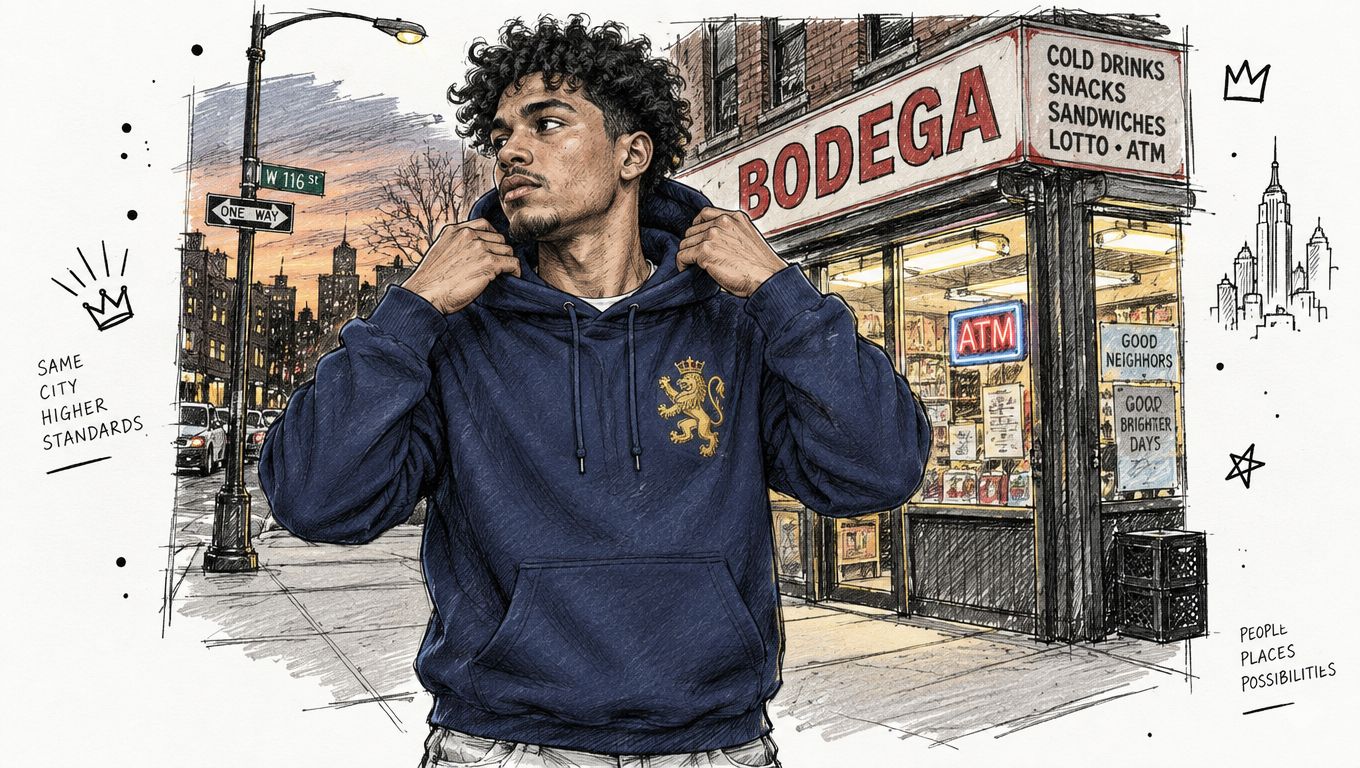
You're standing outside a bodega in Manhattan, hoodie pulled up, coffee in one hand and your phone in the other. The small crest on your chest catches the light without shouting for attention. Later, at a NYFW after-party, the same piece works under a jacket because the decoration feels built into the garment, not pasted onto it. That's the appeal of embroidered hoodies: they bring texture, identity, and a premium streetwear attitude to an everyday layer.
The finish isn't magic, though. Thread type, stitch density, fabric stability, placement, and care decide whether a hoodie becomes a reliable rotation piece or starts puckering after a couple of washes. This guide breaks down how embroidery works, where it fits best, and what to check before buying.
Table of Contents
- What Embroidered Hoodies Actually Are
- How Embroidery Ended Up on Your Hoodie
- Embroidery vs Print on Hoodies
- What Makes an Embroidered Hoodie Last
- Where the Design Goes and Why It Matters
- Caring for Embroidered Hoodies the Right Way
- Styling and Buying Embroidered Hoodies
- Quick Answers Before You Buy
What Embroidered Hoodies Actually Are
An embroidered hoodie is a pullover or zip-up sweatshirt decorated with a design stitched into the fabric using thread rather than ink. A computerized embroidery machine follows a digitized file, sending a needle through the fleece or French terry while a bobbin thread locks the construction underneath. The result is a raised, tactile mark that becomes part of the garment's surface.
That texture separates a stitched crest from screen print, direct-to-garment ink, or heat-transfer vinyl. A print sits on the fabric. Embroidery builds a small structure through it. The finish can feel especially at home on streetwear basics because the garment stays understated while the logo adds physical detail.
The common design formats
A crest-style chest piece usually keeps the branding compact. Think shield outlines, lions, crowns, initials, or varsity-inspired symbols placed above the heart. That format works well for NYC-style branding because it suggests heritage without turning the hoodie into a billboard.
Other options change the garment's attitude:
- Full-back embroidery makes the hoodie a statement layer, especially when the design has a strong emblem or wordmark.
- Sleeve embroidery gives the piece a layered feel, with the logo appearing beneath a varsity jacket or workwear overshirt.
- Tonal marks use thread close to the hoodie color for a quieter, more fashion-led finish.
- Center-chest designs create a louder focal point but need careful spacing around the kangaroo pocket and seams.
A premium result depends on restraint as much as complexity. Too much thread in a small area can make the fabric stiff or cause distortion. The design file, thread tension, backing, and hoodie blank all matter before the needle starts moving.
How Embroidery Ended Up on Your Hoodie
A small NYC-style crown or club crest can look current on a hoodie, yet the method behind it reaches back roughly 150 years. Josue Heilmann is generally credited with inventing a hand-operated embroidery machine around 1828, and the Schiffli machine followed in the 1860s. Commercial production grew from those early mechanical approaches, eventually connecting traditional needlework with the small-batch streetwear drops common today. A market research report on the graphic hoodie market provides broader industry context, though it should not be treated as a federal historical archive.
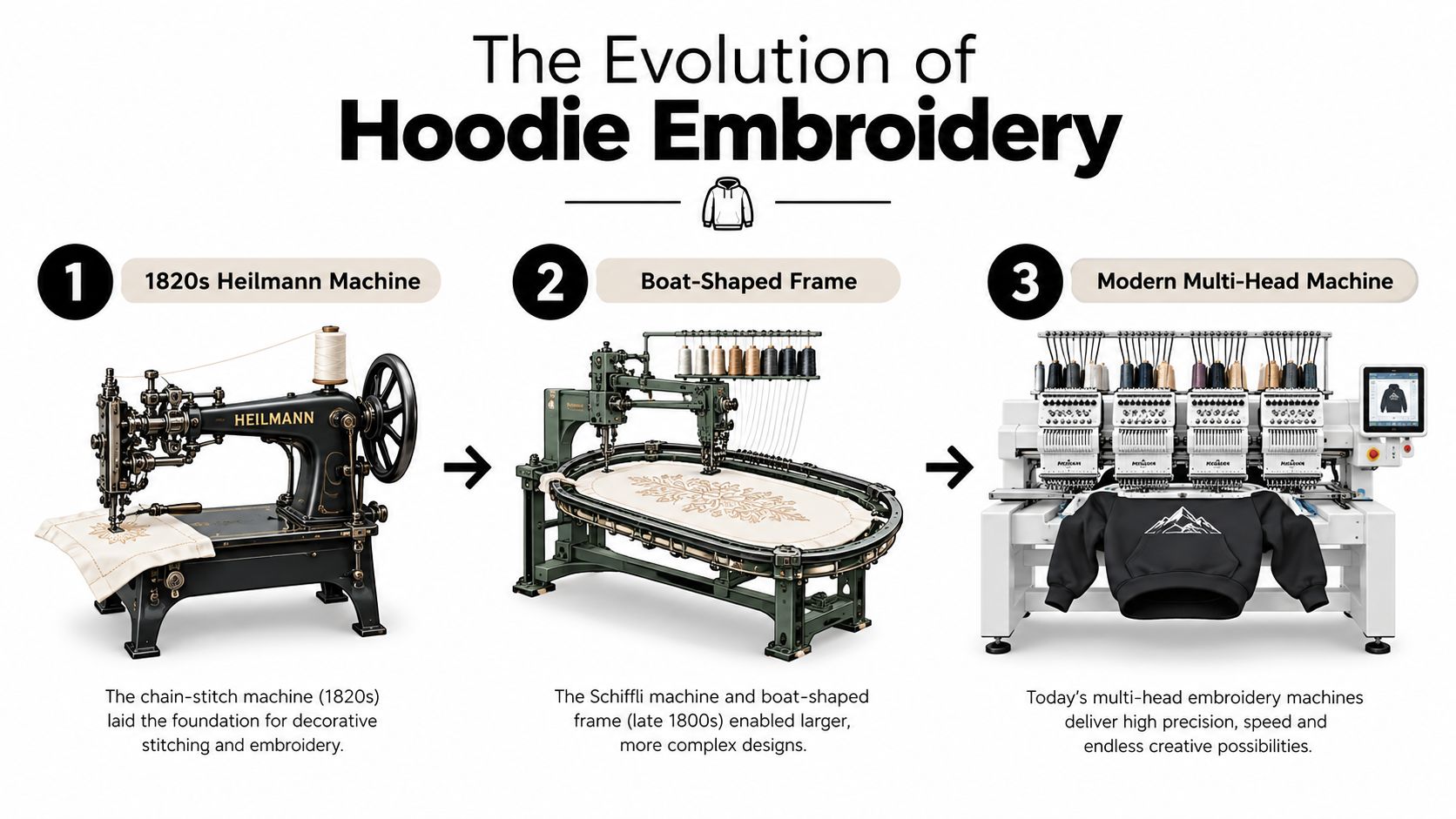
Modern programmable equipment follows the same basic logic: control the needle, guide the thread, and hold the fabric steady. The difference is speed, repeatability, and the ability to translate a detailed crest into a consistent production file.
From artwork to finished crest
A typical run moves through four stages:
- Digitization comes first. The designer rebuilds the artwork as instructions for stitch direction, underlay, color changes, density, and trim points. A crown or shield is not uploaded like a photo. It becomes a stitch plan.
- The hoodie panel gets stabilized. The operator places the chest, sleeve, or back panel in a hoop with backing material. That support limits movement as the needle passes through knit fleece.
- The needle forms the design. Top thread creates the visible surface while bobbin thread secures the underside. Satin stitches sharpen borders and lettering; fill stitches cover broader sections.
- Loose connections are trimmed. Automatic cutting removes jump threads between separate parts of the artwork, leaving a cleaner face and a tidier interior.
Durability comes from choices, not magic. Thread quality, stitch density, backing, tension, and the stability of the hoodie blank determine whether a crest stays crisp or puckers the fabric. Dense stitching can give an NY Crown Crest Hoodie satisfying relief and weight, while poor settings can make the same idea stiff or warped.
Early machines established the route from handcraft to scalable decoration. Today's equipment lets a label repeat that crest across a small run while keeping placement and color consistent. The result carries old technique into a streetwear format that feels personal rather than mass-produced.
Embroidery vs Print on Hoodies
For a logo-driven hoodie, embroidery usually has the stronger premium feel. Thread creates a raised surface and doesn't crack or peel in the same way a surface film can. That makes it a natural choice for crests, initials, small wordmarks, and heritage-style symbols.
Print still wins in the right situation. Screen printing handles bold graphics efficiently, DTG works well for detailed full-color artwork, and HTV can suit simple lettering or small custom runs. A photorealistic back graphic with gradients and fine tonal shifts usually belongs on a print process, not inside a dense stitch file.
The tradeoff is physical. Embroidery can feel heavier under the fingers, costs more to produce per decorated piece, and struggles with tiny details that need to remain visually open. Poor digitization or an unstable blank can also create puckering. Print offers a flatter hand and more freedom for large artwork, but the surface decoration can show wear through cracking, lifting, or fading depending on the process and care.
| Factor | Embroidery | Screen Print / DTG / HTV |
|---|---|---|
| Best for | Crests, monograms, compact logos, premium basics | Large graphics, illustrations, gradients, photographic artwork |
| Surface feel | Raised, textured, tactile | Flat to slightly raised, depending on the method |
| Visual character | Heritage, collegiate, workwear, streetwear polish | Graphic, expressive, collaborative, campaign-led |
| Main limitation | Fine detail and large dense areas need careful engineering | Surface treatments can crack, peel, or fade with wear |
| Fabric demand | Stable, smooth, mid- to heavyweight blanks perform best | More fabric types can work, depending on the print method |
| Ideal use | A hoodie you want to read as a lasting wardrobe staple | A graphic-heavy release or budget-conscious run |
For a practical breakdown of process differences, the screen print versus embroidery guide is useful. My rule is simple: choose thread when the mark carries the brand, and choose print when the artwork carries the story.
What Makes an Embroidered Hoodie Last
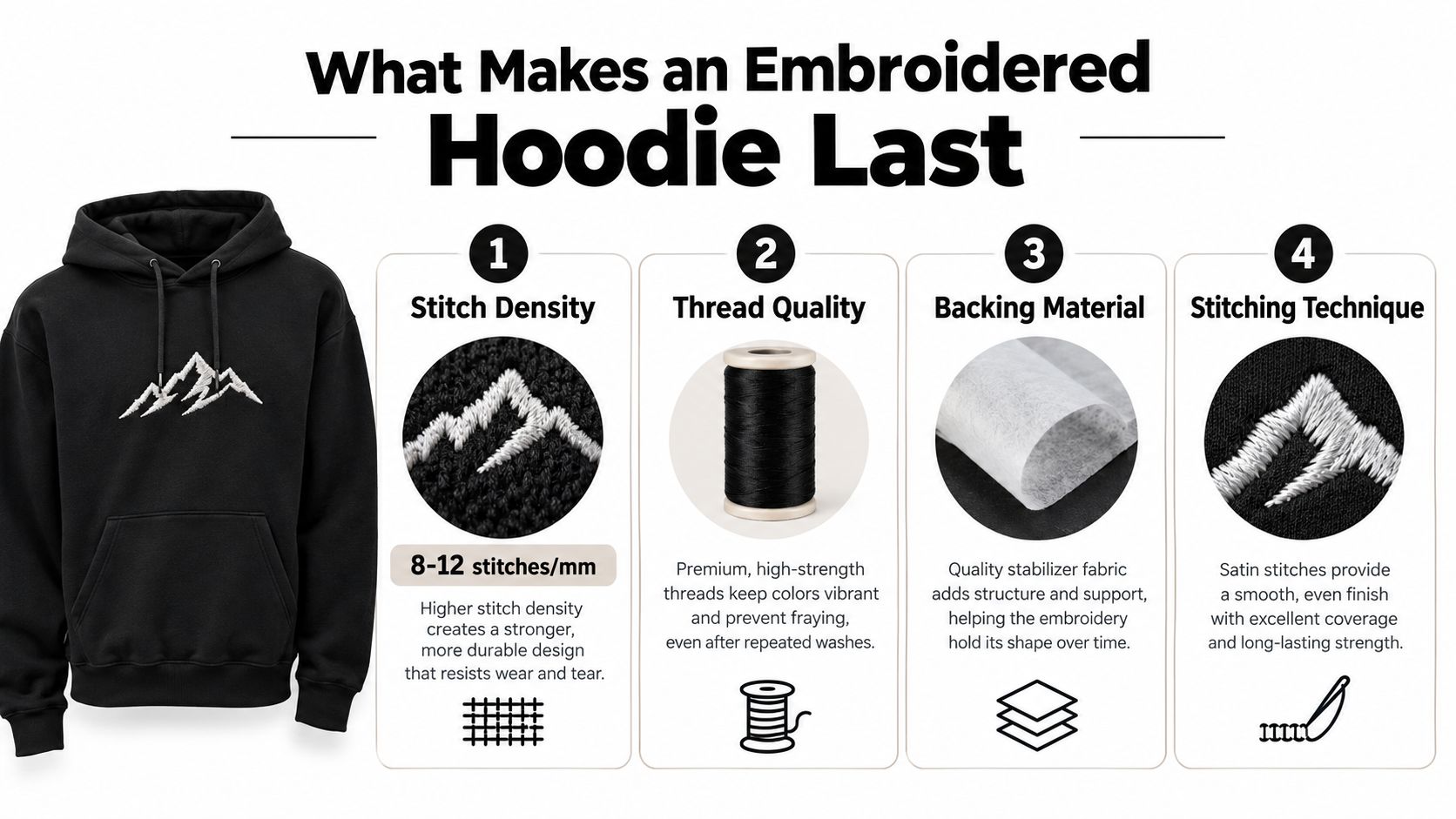
Durability comes from production decisions, not the word “embroidered” on a product page. Four variables deserve attention: stitch density, backing, fabric stability, and thread.
Stitch density and fabric control
Density describes how closely stitches sit inside a design. The supplied production guidance identifies 8 to 12 stitches per millimeter as a working range for a logo that holds together, while dropping below 6 stitches per millimeter can leave visible gaps and increase fraying risk after repeated wear. That guidance comes from independent embroidery advice on hoodie construction.
More stitches don't automatically mean better quality. A dense file on stretchy fleece concentrates needle penetration in one area, which can create puckering, stiffness, or fabric distortion. Medium- and light-density artwork usually moves better on knit fabrics, especially when the design covers a flexible panel.
Backing gives the stitches a stable foundation. A tear-away or cut-away stabilizer can limit movement, while a soft interlining helps prevent the design from sinking into fleece loops. The right choice depends on the design, fabric, and movement zone.
Thread and the hoodie blank
Thread material changes how a crest behaves over time. Polyester embroidery thread is reported at roughly 4.5 to 6.0 cN/dtex, compared with approximately 2.0 to 3.0 cN/dtex for rayon or viscose, and it offers stronger resistance to abrasion, bleach, ultraviolet exposure, and commercial laundering, according to this polyester and rayon thread comparison.
Rayon has an attractive sheen, but it absorbs more moisture and loses substantial tensile strength when wet. Polyester has very low moisture regain and generally retains strength better through demanding washes. For a hoodie meant for regular rotation, polyester is usually the safer choice.
The blank matters just as much. Guidance on hoodies suitable for embroidery recommends stable, smooth, mid- to heavyweight construction because the fabric gives the needlework a firmer bed. A strong backing system and sensible density still matter, but unstable fleece can undermine both.
Practical rule: A clean, moderately detailed crest on a stable blank will usually age better than a complicated, overfilled design on soft, loose fleece.
For a closer look at how garment quality supports decoration, see this guide to premium hoodies and sweatshirt construction.
Where the Design Goes and Why It Matters
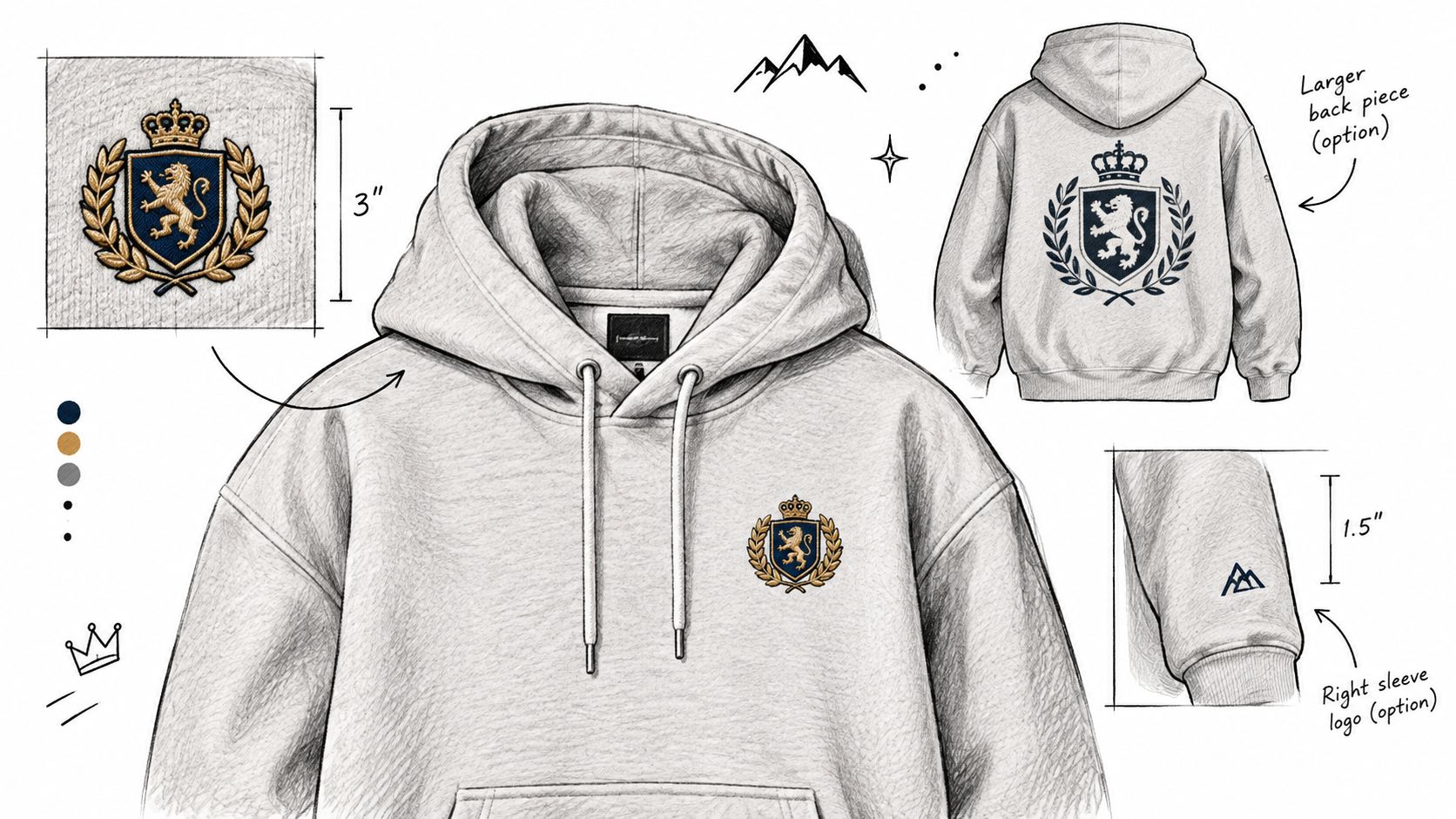
Placement changes the message before anyone reads the logo. A left-chest crest feels established and controlled. A large back emblem feels more like a drop piece. Sleeve embroidery turns a basic hoodie into part of a layered outfit.
The left chest
The left chest remains the classic streetwear choice. A compact crest sits above the heart, leaves the zipper line clear on a zip-up, and layers cleanly beneath a jacket. It also works across unisex styling because the mark doesn't depend on a highly shaped silhouette.
This placement suits NYC-inspired branding especially well. A crown, shield, lion, or borough-style emblem can suggest club identity and local attitude without overwhelming the garment. The smaller scale also lets the fabric, fit, and colorway do part of the visual work.
Center chest and back
Center-chest embroidery reads louder. It works for one strong wordmark or a crest paired with a short identity line, but the artwork needs breathing room around the pocket seam. If the lower edge drops too close to the kangaroo pocket, the garment can look crowded and the stitching may fight the seam.
A back placement creates the strongest statement. Keep the front quiet if the back carries the main emblem, or use a small matching chest mark to make the design feel intentional rather than duplicated.
Sleeves, hood, and neck
Sleeve hits near the bicep or cuff reveal themselves as you move. They're effective under varsity jackets, denim layers, and overshirts because the logo appears in fragments instead of dominating the outfit.
Hood and neck embroidery is less forgiving. Curved surfaces stress the stitches, and the area moves constantly as the hood folds and shifts. That placement works best on a heavyweight blank with a controlled, uncomplicated design.
Match the position to how you'll wear the hoodie. A logo that photographs well in a flat product shot may disappear under a jacket or collide with a pocket in daily rotation.
Caring for Embroidered Hoodies the Right Way
Embroidery is durable, but it isn't care-free. Thread can snag on rough surfaces, and repeated friction can roughen the design even when the stitching itself remains secure. The safest routine protects the face of the garment before the wash begins.
The wash routine
Turn the hoodie inside out. That simple step reduces contact between the embroidery, the drum, and other garments. Use cold water and a gentle cycle, and choose a mild liquid detergent rather than a product that may leave residue around dense stitching.
Skip fabric softener. It can coat polyester thread and gradually interfere with the finish. The custom hoodie care guidance from Underground Shirts also emphasizes cold washing, reduced friction, and avoiding high heat to preserve stitch integrity.
- Before washing: Close zippers and remove rough accessories from the load.
- During washing: Keep the hoodie inside out and avoid abrasive garments.
- After washing: Reshape the shoulders and lay the piece flat or over a thick towel.
- For drying: Air dry whenever possible. If you need a dryer, use low heat briefly, then finish drying in the open air.
High heat can stress both the hoodie fabric and the decoration. Don't leave the garment tumbling longer than necessary, even if the crest looks fine when it comes out.
Storage and pressing
Fold embroidered hoodies instead of hanging them for long periods. A hanger can place unnecessary weight on the shoulder and chest area, especially while the garment is damp.
Never press an iron directly onto the design. Turn the hoodie inside out, use a cotton press cloth, or hover the iron from the reverse side with controlled heat. For more detail on caring for embroidered sweatshirt construction, see this embroidered crewneck sweatshirt guide.
The best care routine is boring: inside out, cold wash, low friction, and no direct heat on the stitches.
Styling and Buying Embroidered Hoodies
A good embroidered hoodie decision starts with fit, then color, then the role you want the piece to play. The NY Crown Crest Hoodie is a useful example because a crest can move from low-key daytime layering to a sharper evening outfit without changing the basic garment.
Start with the silhouette
Unisex crest hoodies generally look strongest with a relaxed body and shoulders. Go true to size if you want the hoodie to sit as an everyday staple. Size up when you plan to layer over a long-sleeve tee, thermal, or lighter sweatshirt.
Don't size only by chest measurement. Check shoulder width, sleeve length, and body length together. A roomy shoulder with a short body can feel cropped, while a long body with narrow sleeves can lose the relaxed streetwear balance.
Let the colorway set the mood
Color changes how the thread reads:
- Black with a metallic crest: The strongest evening option, especially under a wool coat, leather jacket, or dark varsity layer.
- Heather grey with tonal stitching: Easy for daytime, gym-to-street outfits, and neutral wardrobes.
- Cream with navy thread: Cleaner and more downtown, with enough contrast to make the crest visible without looking loud.
- Navy with a lighter crest: A classic collegiate direction that works with denim, khaki, and grey trousers.
The point isn't to match every color exactly. Let the embroidery provide one controlled accent, then repeat that tone in a cap, sneaker detail, or outer layer.
Coordinated family dressing
Matching family sets work best when the motif and placement stay consistent while the silhouettes remain age-appropriate. An adult hoodie can carry the full crest, while a child's or toddler's garment uses the same emblem at a smaller scale. The result feels connected without making everyone look like they're wearing uniforms.
Before checkout, confirm four things:
- Stitch density: Ask whether the file was tested on the actual hoodie fabric.
- Placement: Look for a diagram or model image showing the crest's position.
- Fabric weight: Choose a stable, smooth blank suited to embroidery.
- Return window: Check the policy before ordering a size or colorway.
That verification routine tells you more than vague claims about premium quality. A strong hoodie should make the construction easy to understand.
Quick Answers Before You Buy
Do embroidered hoodies shrink in the wash?
A pre-shrunk cotton hoodie should show limited shrinkage, but the garment can still change shape if you expose it to aggressive heat. Lay it flat or reshape it while damp so the chest panel and crest dry without pulling.
Can you iron directly over the design?
No. Direct heat can flatten the raised thread and leave unwanted shine. Press from the reverse side or place a cotton cloth over the embroidery before using controlled heat.
Are embroidered hoodies warmer than printed ones?
The hoodie fabric determines most of the warmth, not the decoration. Raised thread may trap a very small layer of air, but it won't turn a lightweight sweatshirt into a winter coat.
How long should a quality crest hoodie last?
A quality crest hoodie can realistically last 3 to 5 years of regular wear with proper care, while typical screen prints may last 1 to 2 years, according to the figures specified for this comparison. Actual lifespan still depends on fabric strength, thread selection, stitch density, washing, and how often you wear the piece.
If you skipped the care section, go back to the inside-out wash and low-heat routine before you put your new hoodie into rotation.
DM-Flexwear.com offers NY Crown Crest embroidered hoodies, crewneck sweatshirts, and coordinated staples in multiple adult and young-child sizes and colorways. Visit DM-Flexwear.com to choose a crest-led streetwear piece that fits your rotation, then protect the stitching with the care routine above.