

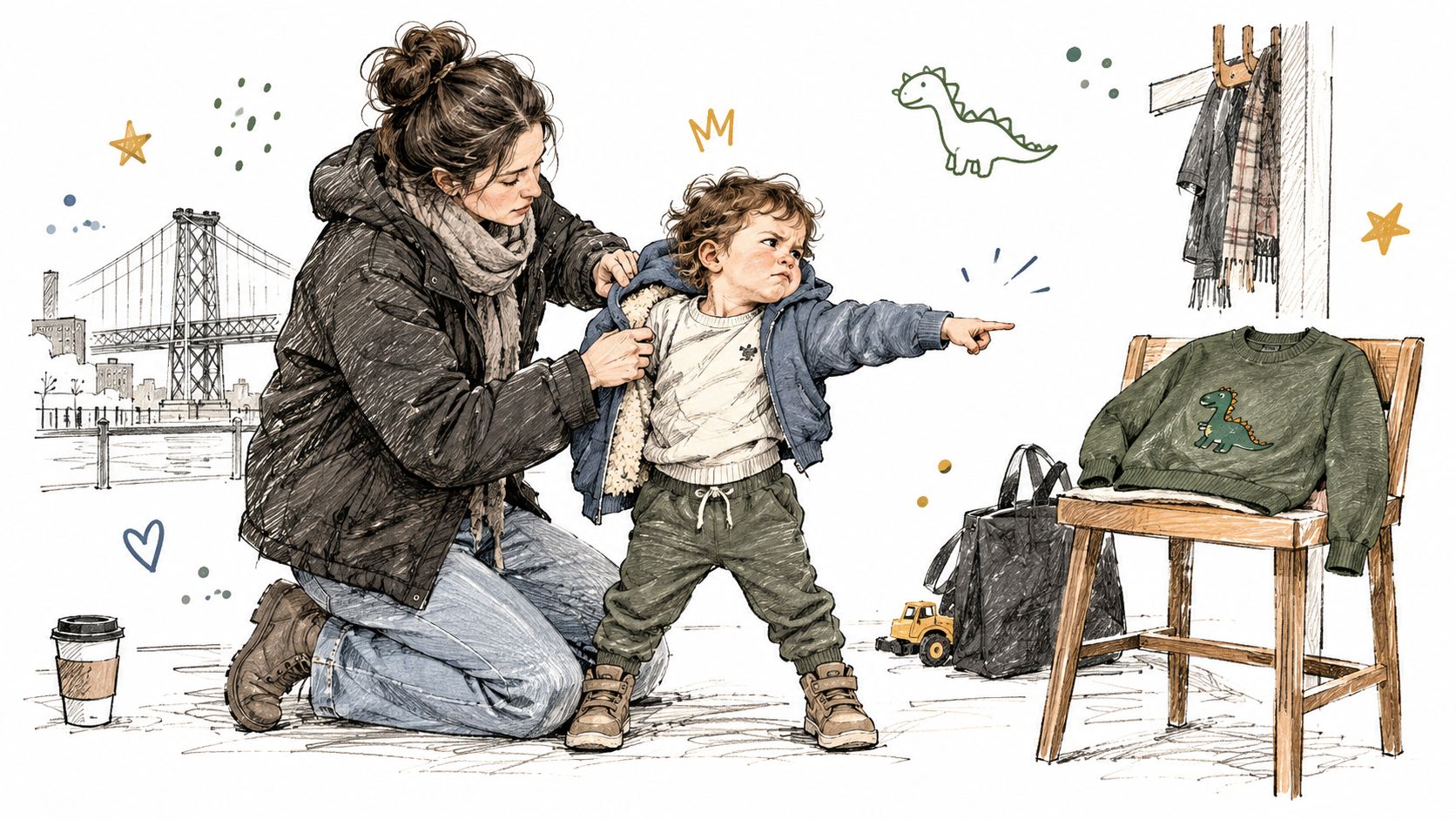
You're standing in a cold Williamsburg doorway, one shoe on your toddler and the other disappearing under the sofa. The plain sweatshirt is ready, but your two-year-old points at the embroidered dinosaur crewneck and refuses to negotiate. The fleece-lined hoodie wins the temperature argument, the dinosaur wins the morning.
That scene explains why toddler sweatshirts deserve more thought than a quick color choice. They're daycare uniforms, stroller layers, playground armor, nap-time backups, and, increasingly, real streetwear. The category sits inside a broad apparel-led toddler wear market valued at USD 265.71 billion in 2024, with a projection of USD 397.30 billion by 2030 and apparel representing 71.8% of revenue in 2024, according to Grand View Research's toddler wear market analysis.
The buying decision comes down to five things: size window, weight versus breathability, safety features, wash routine, and style direction. Matching family sets can be part of that last decision, but only if the garments survive real life. This is a field guide for choosing sweatshirts that look intentional at daycare drop-off and still have their shape after repeated washing.
Table of Contents
- The Toddler Sweatshirt Moment
- Sizing Toddler Sweatshirts From 6M to 4T
- Safety Rules Every Toddler Sweatshirt Must Clear
- Heavyweight Versus Breathable Which Actually Wins
- Wash Care That Protects Embroidery and Color
- Style Notes From the NYC Streetwear Playbook
- Why Durability Matters More Than Softness
- Your Toddler Sweatshirt Buying Checklist
The Toddler Sweatshirt Moment
Streetwear has stopped waiting for children to grow up. Small-size drops, embroidered crests, boxier silhouettes, and coordinated family colorways have moved toddler dressing beyond soft pastels and novelty graphics. The visual language associated with New York styling is especially useful here. NYC and NYFW remain strong cultural references for bold runway color and street-style layering, as shown in recent coverage of New York Fashion Week's fashion identity.
A toddler doesn't need an adult logo scaled down to look streetwear-ready. The better move is borrowing the silhouette, palette, and finish. A roomy crewneck over a thermal, a clean hoodie with joggers, or a tonal embroidered sweatshirt with a beanie looks considered without turning your child into a walking billboard.
The practical test is tougher than the style test. Toddlers crawl, climb, spill, tug at necklines, nap in warm rooms, and come home with mystery marks on sleeves. A sweatshirt that looks excellent on a product page but twists at the side seam or traps heat during active play isn't a smart buy.
The five calls that matter
- Size window: Decide whether the sweatshirt needs to fit now or cover a thermal layer through colder months.
- Weight: A thick fleece feels warm in the hand, but a breathable midweight can work better for a child who runs constantly.
- Safety: Skip functional cords, inspect embellishments, and treat sleepwear rules differently from ordinary playwear.
- Wash routine: Cold washing and low-heat drying protect embroidery, color, and shape.
- Style direction: Choose a restrained NYC-inspired palette, a playful graphic, or a coordinated family look that doesn't rely on identical prints.
Practical rule: Buy for the child's actual day, not the fantasy outfit. If the sweatshirt can't handle daycare movement and laundry, the aesthetic doesn't matter.
Sizing Toddler Sweatshirts From 6M to 4T
Age labels are a starting point, not a fit guarantee. Toddlers vary widely in height, torso length, shoulder width, and layering habits, so compare the garment chart with your child's measurements before ordering. The DM-FlexWear baby range runs from 6M through 4T, which makes it a useful reference point for families building a coordinated wardrobe across infant and toddler sizes. The same brand's approach to gender-neutral basics is outlined in its guide to gender-neutral baby clothes.
The most useful measurements are weight, chest, and intended layer underneath. A 12M sweatshirt commonly serves an 8 to 10 kg child with a 19 to 20 inch chest, while 2T typically covers 12 to 13 kg and a 23 to 24 inch chest. A 4T range can extend to 16 to 18 kg with a 25 to 26 inch chest. Those figures are a reference framework, not a substitute for the seller's own chart.
| Size | Age | Weight (kg) | Chest (in) | Layering Fit |
|---|---|---|---|---|
| 6M | 6 months | Check brand chart | Check brand chart | Exact fit over a light base |
| 12M | 12 months | 8–10 | 19–20 | Light layer |
| 2T | 2 years | 12–13 | 23–24 | Room for a tee or thin thermal |
| 3T | 3 years | Check brand chart | Check brand chart | Moderate layering room |
| 4T | 4 years | 16–18 | 25–26 | Roomier fit for cold-weather layers |
Size for the use case
Choose true to size for spring, indoor wear, or a clean crewneck silhouette. Size up one full size when the sweatshirt needs to sit over a thermal base, especially if the garment has a narrow streetwear cut or a substantial embroidered front.
Embroidered crewnecks deserve extra attention because the decoration and heavier construction can make the garment feel less forgiving. Plan for roughly 5% length shrinkage after the first hot wash, and treat that as a reason to avoid buying an already-short fit. Follow the care label rather than relying on a hot wash to “settle” the size.
Try this quick check before removing tags: lift both arms, bend the elbows, and see whether the hem rides above the waist. If the neck stretches dramatically while going over the head, the opening is too tight for independent dressing. If the sleeves cover the hands before the torso fits, the cut is wrong, not necessarily the size.
Safety Rules Every Toddler Sweatshirt Must Clear
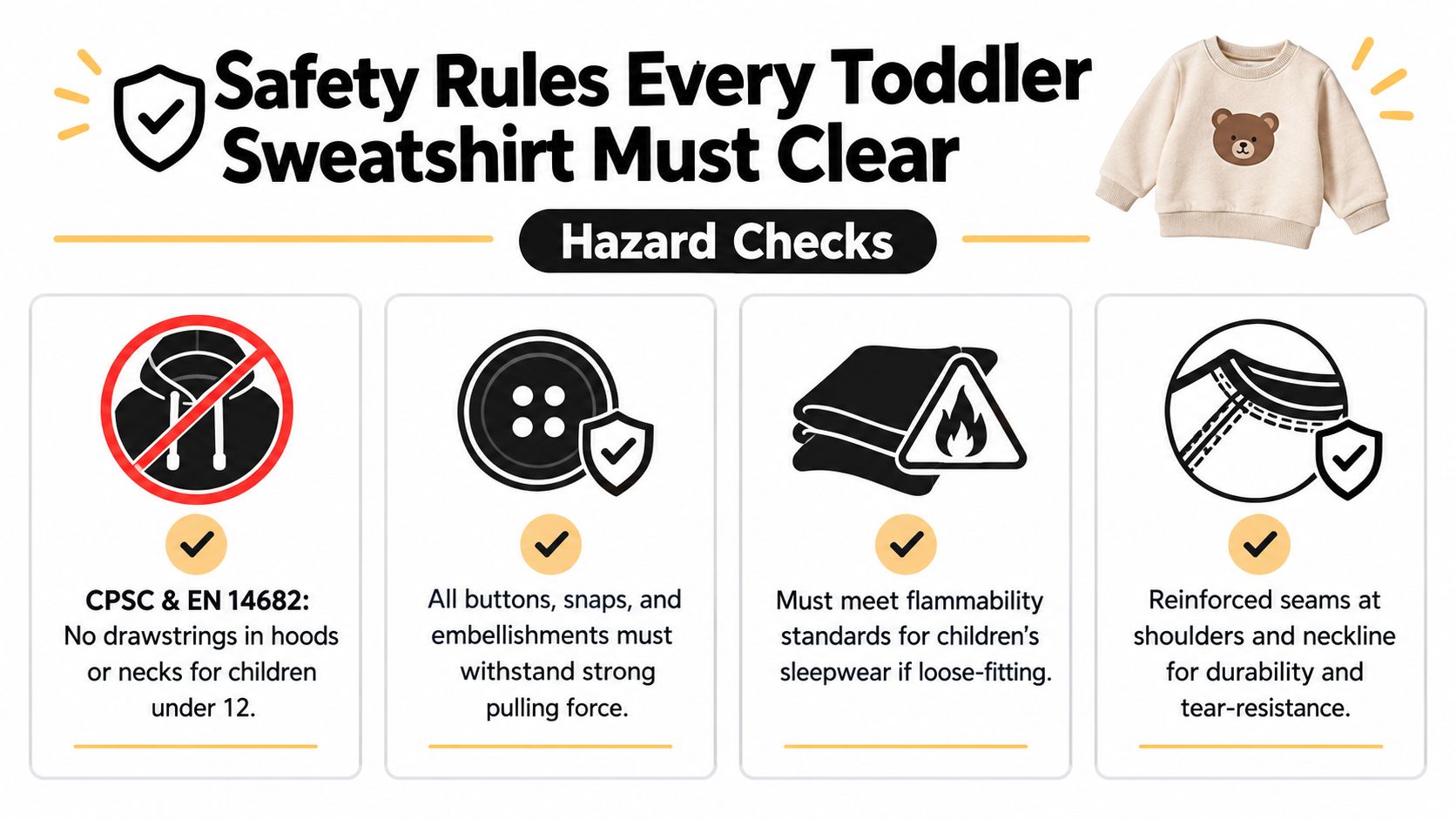
A sweatshirt can be warm, stylish, and still be a poor toddler garment if it has the wrong cord, trim, or intended use. Hood and neck drawstrings are the first feature to reject. For children's upper outerwear in sizes 2T through 12, the CPSC says drawstrings aren't allowed in the hood and neck area under ASTM F1816-97 rules, as explained in its children's clothing drawstring safety materials. EN 14682 addresses cords and drawstrings in children's clothing across European markets through placement and length controls, according to the Swedish Institute for Standards overview of EN 14682.
Look for a clean hood opening, elasticized construction, or a printed design instead of a functional cord. Toggle-free is not the same as safe if a separate cord still hangs near the neck. Check waist details too. A sweatshirt doesn't need a decorative tie that can snag on playground equipment.
Treat sleepwear as a separate category
Don't assume an everyday sweatshirt is suitable for sleep. U.S. rules for children's sleepwear above size 9 months through size 14 require garments to be flame resistant and self-extinguish, unless they're designed as tight-fitting sleepwear. Testing covers fabric, seams, and trim, and the garment must continue to pass after laundering, including 50 wash cycles, according to the CPSC Children's Sleepwear Lab Bulletin.
If a product is sold or described as sleepwear, check its compliance language. The CPSC also provides specific labeling guidance for infant and tight-fitting garments in its infant tight-fitting garment FAQ. A loose fleece pullover may be fine as playwear and inappropriate for overnight use.
Inspect small components before the first wear. Detached pom-poms, loose buttons, poorly secured snaps, and back patches that lift at the edge deserve a return, not a repair experiment. Run a finger around the neckline and shoulder seams. Rough, exposed stitching can irritate skin and signals weak construction.
Heavyweight Versus Breathable Which Actually Wins
The thickest toddler sweatshirt usually isn't the most useful one. A toddler who runs through daycare, climbs playground equipment, and melts down in a heated car can overheat in a fleece-lined pullover while staying comfortable in a midweight loopback terry layer.
Material choice matters more than a vague “cozy” label. Cotton remains a leading toddler wear material because parents value softness and breathability. One market estimate places cotton at more than 50% share in 2025, while another assigns it 32.9% of toddler wear revenue in 2025, as reported by Persistence Market Research's toddler wear analysis. The sources use different market definitions, so don't treat the figures as interchangeable. The practical point is clear: breathable cotton-led fabrics remain central to the category.
| Weight Class | Typical GSM | Breathability | Best For | Layering |
|---|---|---|---|---|
| Lightweight | Under 280 | High | Indoor wear, stroller naps, transitional weather | Over a tee |
| Midweight | 280–350 | Moderate to high | Daycare, everyday outdoor play | Over a tee or thin thermal |
| Heavyweight | Over 350 | Lower | Cold mornings, slower-paced outdoor wear | Needs room underneath |
| French terry | Varies | Often high | Active toddlers and flexible layering | Easy over a base layer |
Read the construction, not just the hand-feel
A brushed interior traps more warmth and feels plush, but it can hold heat during active play. A smooth-face loopback or French terry construction usually gives a toddler more breathing room. Heavyweight embroidered crewnecks have visual authority and can handle a sharper streetwear outfit, but they need enough space through the arms and torso.
Hoods create another tradeoff. A double-lined hood adds structure and warmth, while an unlined hood feels lighter and dries faster. Neither is automatically better. Choose based on whether the child spends the day outdoors or moves between heated rooms and cold sidewalks.
For a heavyweight embroidered option, DM-FlexWear's premium hoodies guide gives shoppers a useful comparison point for structured layers. My recommendation is simple: choose weight by activity level, not by touch alone. For an active toddler, start with midweight or French terry. Reserve heavyweight fleece for cold conditions and short outdoor stretches.
Wash Care That Protects Embroidery and Color
Daycare laundry isn't gentle. There are shared machines, food stains, mud, paint, and weekly cycles that punish decorative details. A good wash routine prevents most avoidable damage before it starts.
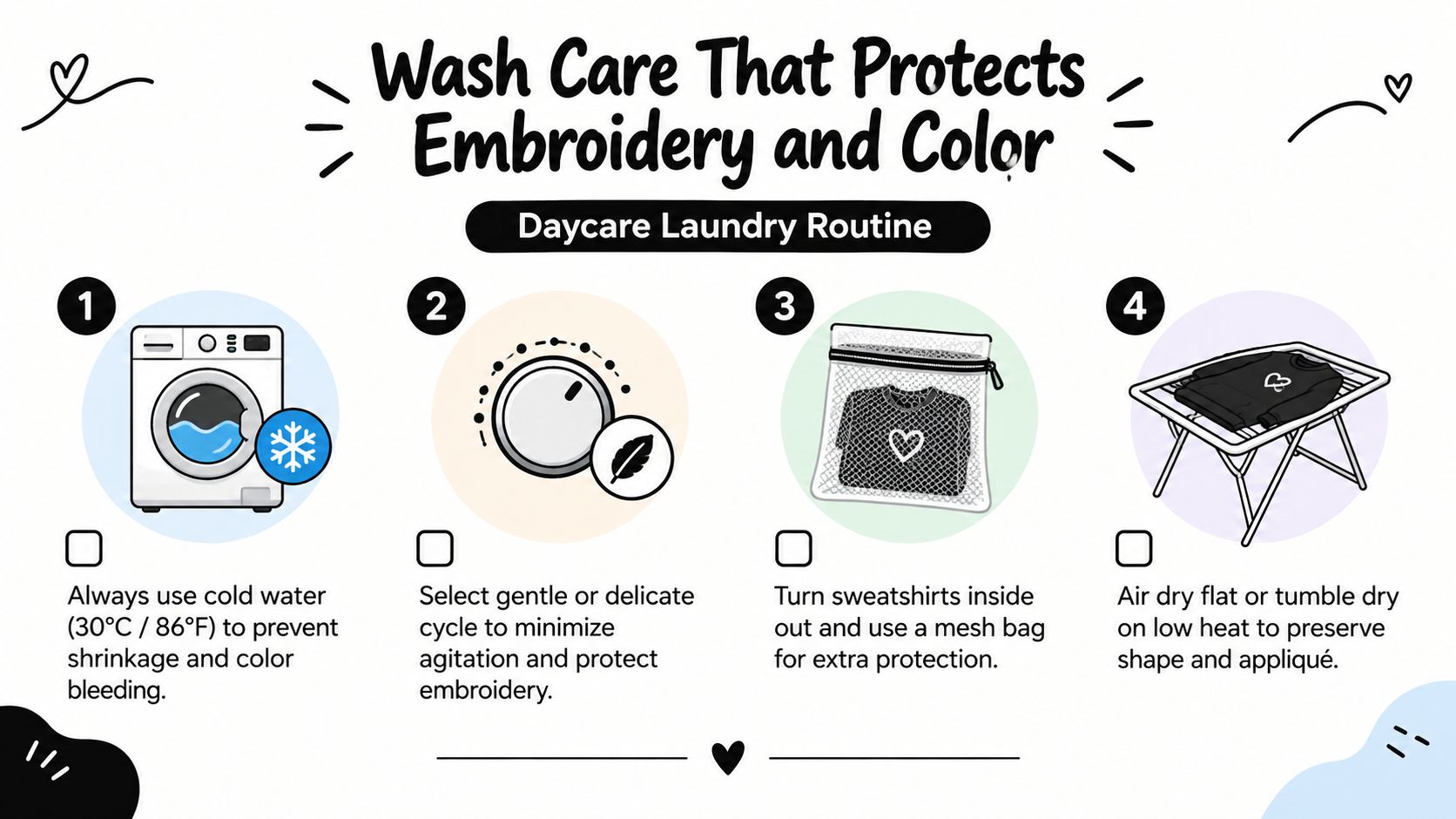
Turn the sweatshirt inside out, close any fasteners, and separate it from abrasive items. Put embroidered pieces in a mesh laundry bag, especially when washing them with denim, towels, or garments with Velcro. Use cold water at 30°C / 86°F on a gentle or delicate cycle. Skip fabric softener. It can coat fibers and interfere with moisture management finishes.
A daycare-proof routine
- Pretreat quickly: Rinse food or paint marks with cool water and use a mild stain treatment that suits the care label.
- Protect the surface: Turn the sweatshirt inside out and place embroidered garments in a mesh bag. Avoid washing them directly against Velcro.
- Keep the cycle cool: Select cold water, 30°C / 86°F, and a gentle or delicate setting.
- Dry with restraint: Air dry flat when possible, or tumble dry on low heat. Don't leave the garment tumbling after it's dry.
High heat is the fastest route to cracked thread, faded graphics, warped ribbing, and unnecessary shrinkage. Chlorine bleach can weaken color and fibers. Over-drying creates more stress than the garment needs, while Velcro can catch embroidery and rough up the face fabric.
For embroidered construction, compare the care instructions with the product details in DM-FlexWear's embroidered crewneck sweatshirt guide. The label wins if the listing and general advice disagree.
Laundry rule: Cold wash, inside out, mesh bag, low heat. If you remember only one routine, use that one.
Style Notes From the NYC Streetwear Playbook
Toddler streetwear works when it borrows proportion and color, not when it copies every adult trend. A cropped-looking crewneck, a slightly relaxed sleeve, tonal embroidery, and a restrained palette can feel modern without restricting movement or turning the outfit into costume.
NYC styling is good at making basics look deliberate. Start with a strong neutral, then add one controlled accent. Black, grey, navy, white, and gold create a clean city palette. Pink, yellow, or blue can soften the look without pushing it into novelty territory. The DM-FlexWear catalog uses the NY Crown Crest across tees, hoodies, and crewneck sweatshirts, with infant sizes from 6M through 4T and adult options extending to 3XL, making coordinated family dressing straightforward without requiring identical outfits.
Build the outfit around one anchor
Pair a heavier embroidered crewneck with relaxed joggers, clean sneakers, and a beanie on cold mornings. Keep the rest quiet so the embroidery does the work. A lighter pullover hoodie fits better with cargo pants or straight-leg trousers during transitional weather, especially when the child moves between outdoor play and indoor heating.
Matching family outfits work best when the palette coordinates instead of every person wearing the same graphic. Put the toddler in navy, the parent in grey, and use one shared crest or accent color. The result reads like a family uniform with streetwear logic, not a novelty photo prop.
Avoid too many competing signals. Dinosaur embroidery, contrast sleeves, a loud slogan, and a neon hat all in one outfit create visual noise and can make the garment feel dated quickly. Choose one focal point, then let the toddler's personality supply the rest.
Why Durability Matters More Than Softness
The softest sweatshirt on day one isn't automatically the best sweatshirt by month six. Hand-feel matters against a toddler's skin, but softness can't compensate for a stretched neckline, twisted side seam, cracked print, or hem that loses its recovery after washing.
Toddlers put garments through abrasion, pulling, climbing, food spills, and repeated laundry. That makes construction quality more useful than a plush product description. Look for double-needle hems, reinforced shoulder seams, taped neck seams, stable ribbing, and dense embroidery. These details indicate that the maker has considered stress points instead of optimizing only for the first try-on.
What durability testing actually measures
Durability has technical foundations. Standardized abrasion testing includes ISO 12947-2, also known as the Martindale method, and ASTM D4966, while broader textile durability frameworks track abrasion, seam strength, and tensile strength as core wear metrics, according to the ECOS report on textile durability standards.
You won't get a full lab report on every product page, so inspect the construction clues you can see. Embroidery is stitched into the garment, while screen prints and heat transfers sit on the surface and can crack, peel, or lose adhesion. Rayon embroidery thread can produce a smooth sheen, while polyester thread is often chosen where tougher wear resistance matters. The exact result depends on stitch density, backing, fabric, and production quality.
| Finish Type | Softness Rating | Failure Point |
|---|---|---|
| Brushed fleece | Very soft at first | Heat retention, pilling, flattened nap |
| Basic screen print | Smooth hand-feel | Cracking and fading |
| Heat-transfer graphic | Smooth or slightly raised | Peeling at edges |
| Tonal embroidery | Moderate | Loose stitches or snagging if poorly secured |
| Dense embroidery | Moderate to firm | Fabric distortion if the base is too light |
Check the failure points
Stretch the crewneck gently. It should recover instead of staying open. Look at the side seam, shoulder join, and hem corners. A sweatshirt can feel luxurious while using weak stitching in exactly the places a toddler grabs.
Softness still matters, especially for direct skin contact. It just shouldn't be the only filter. The winning combination is a comfortable interior, breathable fabric, stable shape, and decoration that remains attached after real wear.
Your Toddler Sweatshirt Buying Checklist
A product page should answer most of your questions before you reach checkout. If it doesn't show the fiber blend, size chart, care instructions, decoration method, and safety details, treat the missing information as a reason to keep browsing.
The seven-second product-page audit
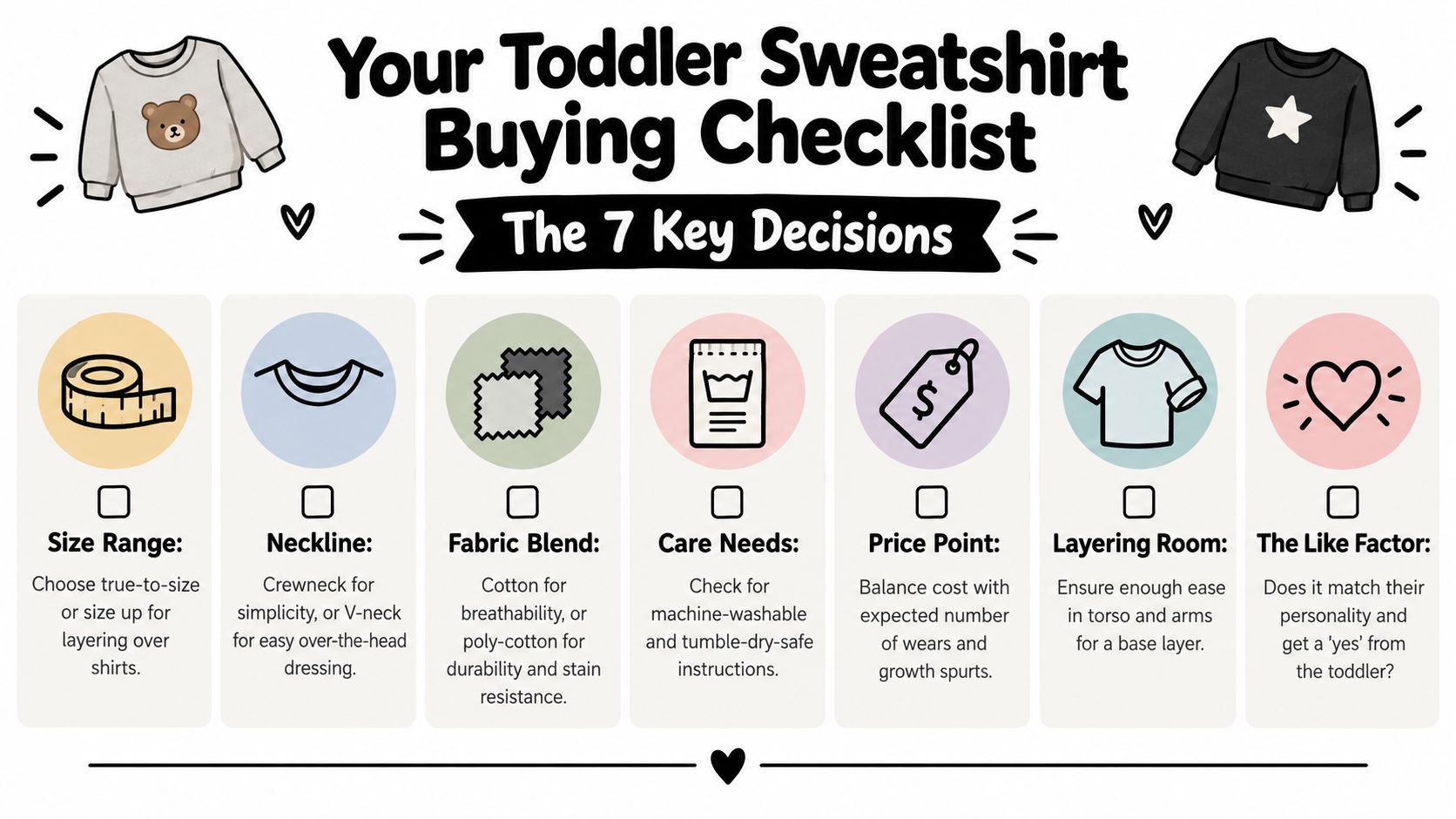
- Size range: Choose true-to-size for a close indoor fit, or size up for a thermal layer. Check chest and torso measurements instead of trusting age alone.
- Neckline: Pick a crewneck for a clean, simple outfit. Choose a hoodie when you need more coverage, but reject functional neck cords.
- Fabric blend: Favor cotton-led fabric when breathability matters. A cotton-poly blend can make sense when you prioritize shape retention and stain tolerance.
- Safety details: Confirm there are no hood or waist drawstrings, inspect small embellishments, and verify sleepwear compliance if the item is intended for overnight use.
- Care needs: Look for machine-washable instructions and a low-heat or air-dry option. If the garment requires fussy care, it probably won't become a reliable daycare staple.
- Finish quality: Choose embroidery for a stitched, textured decoration. Treat prints and transfers as style choices that need closer inspection for cracking or peeling.
- Style direction: Decide whether the sweatshirt supports a coordinated family palette, a playful graphic, or a clean NYC-inspired outfit. The toddler still gets veto power.
The smartest purchase balances fit, airflow, safety, washability, durability, and personality. Don't pay for heavyweight construction if your child overheats indoors. Don't buy a delicate graphic for a daycare rotation. Don't size down for a sharp photo if the neckline makes dressing a daily battle.
A toddler sweatshirt earns its place when it gets worn often, washed without drama, and reaches for the right balance between parent-approved styling and toddler-approved comfort.
DM-Flexwear.com offers NY Crown Crest tees, hoodies, and embroidered crewneck sweatshirts in coordinated infant, toddler, and adult sizing, with multiple colorways for family outfits. Visit DM-Flexwear.com to shop a practical New York-inspired layer that fits the streetwear direction without losing the everyday function toddlers need.