

Two people can grab the same tee off the same rack and walk out looking like they bought two different garments. One gets that clean, straight, downtown silhouette. The other gets something long, slim, or awkward through the shoulders. That's usually the moment people start asking what unisex tees mean.
The confusion makes sense. “Unisex” sounds like it should mean universal. It doesn't. It means the shirt was built from a single fit logic meant to work across a wider range of bodies than a narrowly gendered cut. That's a different idea, and it's way more useful once you know how to read it.
If you live in tees, layer them under hoodies, tuck them into trousers, crop them, size up for weekend wear, or want one shirt that can move through real life without drama, fit matters more than the label on the neck. In NYC streetwear, that's the whole game. Silhouette first. Fabric second. Styling third.
This guide breaks it down in plain language. No fashion-school jargon. Just the stuff that helps you predict how a tee will sit on your frame before you buy it, from cut to weight to flat measurements. I'll use the NY Crown Crest Heavyweight Unisex Tee as a familiar reference point for the kind of structured streetwear basic people reach for on repeat.
Table of Contents
- Introduction Why Unisex Tees Are Everywhere Right Now
- What Unisex Tees Really Mean Beyond the Label
- How Unisex Fit Compares to Gendered Cuts
- Fabric Weight Shrink Control and Why Quality Shows
- How to Find Your Perfect Size in Unisex Tees
- Styling Unisex Tees for Every Body and Occasion
- Your Next Tee Made Simple
Introduction Why Unisex Tees Are Everywhere Right Now
You're in a shop in SoHo. Two people pull the same tee off the wall because it looks clean, simple, safe. One puts it on and gets that sharp, straight silhouette that works with cargos and sneakers. The other gets extra length, dropped shoulders, or a body that feels wider than expected.
That moment explains why unisex tees are everywhere and why people still hesitate before buying one.
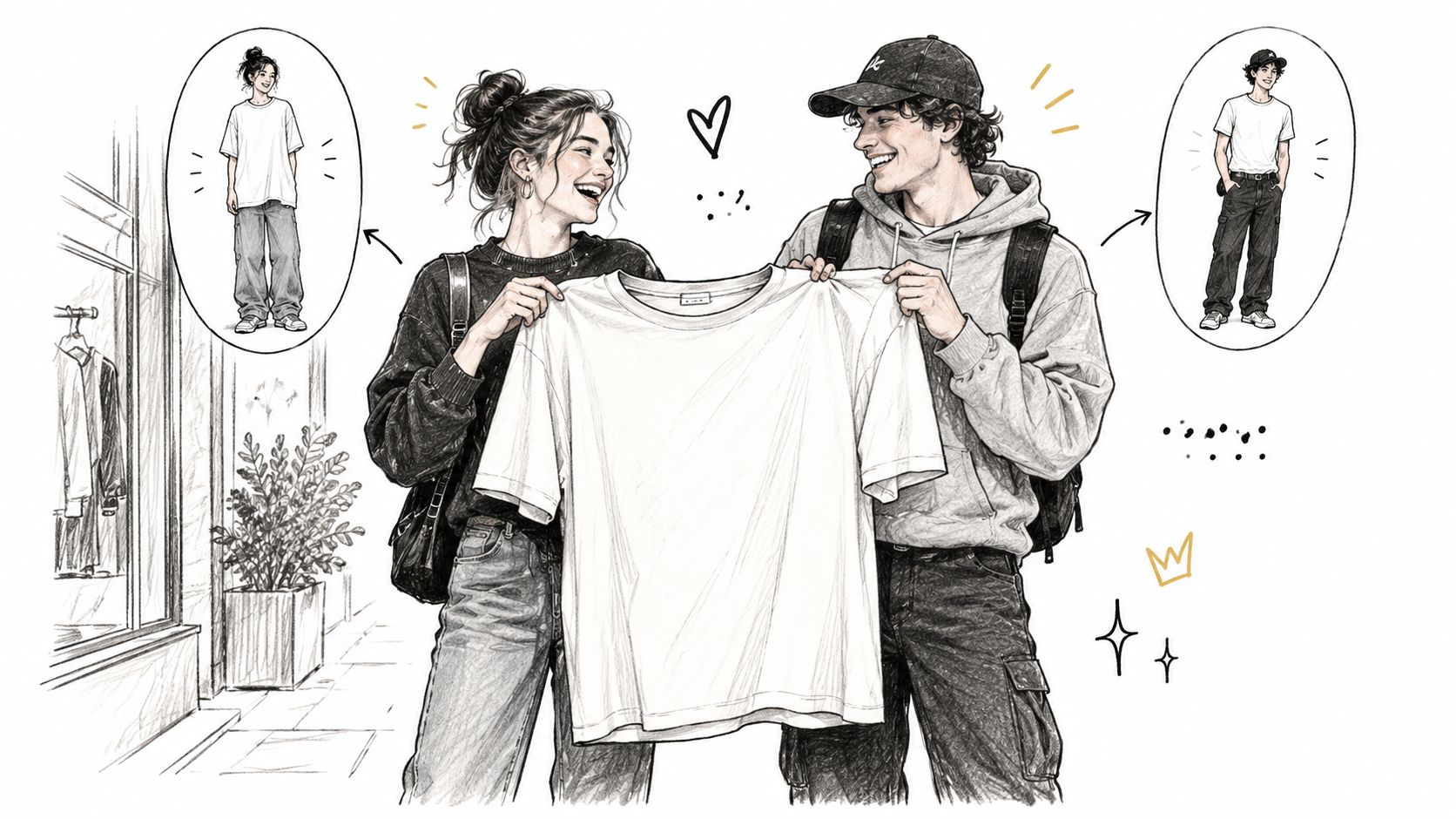
The label sounds easy. The fit takes a closer look
“Unisex” reads like a universal promise. In practice, it points to one silhouette built to cover a wider range of bodies. That matters because range is not sameness.
A good unisex tee works like a well-cut pair of straight-leg pants. The shape stays consistent. The effect changes depending on your proportions, the size you choose, and how much structure the fabric holds.
That's a big reason these tees show up everywhere right now. Style has moved toward pieces that feel less locked into old menswear or womenswear rules. People want room to size up, tuck in, crop, layer, or wear a tee loose without fighting an aggressively shaped cut.
In NYC streetwear, that logic is basic wardrobe math. The tee sets the line of the outfit. If the shoulders sit right and the fabric has enough body, everything on top reads better.
The better question is: What silhouette is this shirt built to create?
Why shoppers are paying more attention
Gender labels tell you less than they used to. Flat measurements tell you more.
Three details usually predict how a unisex tee will wear:
- Cut: shoulder width, sleeve shape, torso straightness, and body length
- GSM or fabric weight: whether the tee drapes soft or holds a more architectural shape
- Flat measurements: the actual numbers that tell you how the shirt will sit on your frame
That's the shift. People are shopping for outcome, not just category.
It also explains why heavyweight unisex tees keep winning space in real wardrobes. They hold shape under an open overshirt, sit clean under a hoodie, and look intentional with denim, trousers, or shorts. One silhouette. A lot of range. That is why the category keeps growing.
What Unisex Tees Really Mean Beyond the Label
A unisex tee is not a magical shirt that fits every body the exact same way. It's a single silhouette engineered for range. That's the key idea.
The tee is like sunglasses with one frame shape that works on a lot of faces. The frame won't look identical on everyone, but the designer built it to land well across different features. Unisex tees work the same way. One core pattern. Multiple sizes. Broad compatibility.
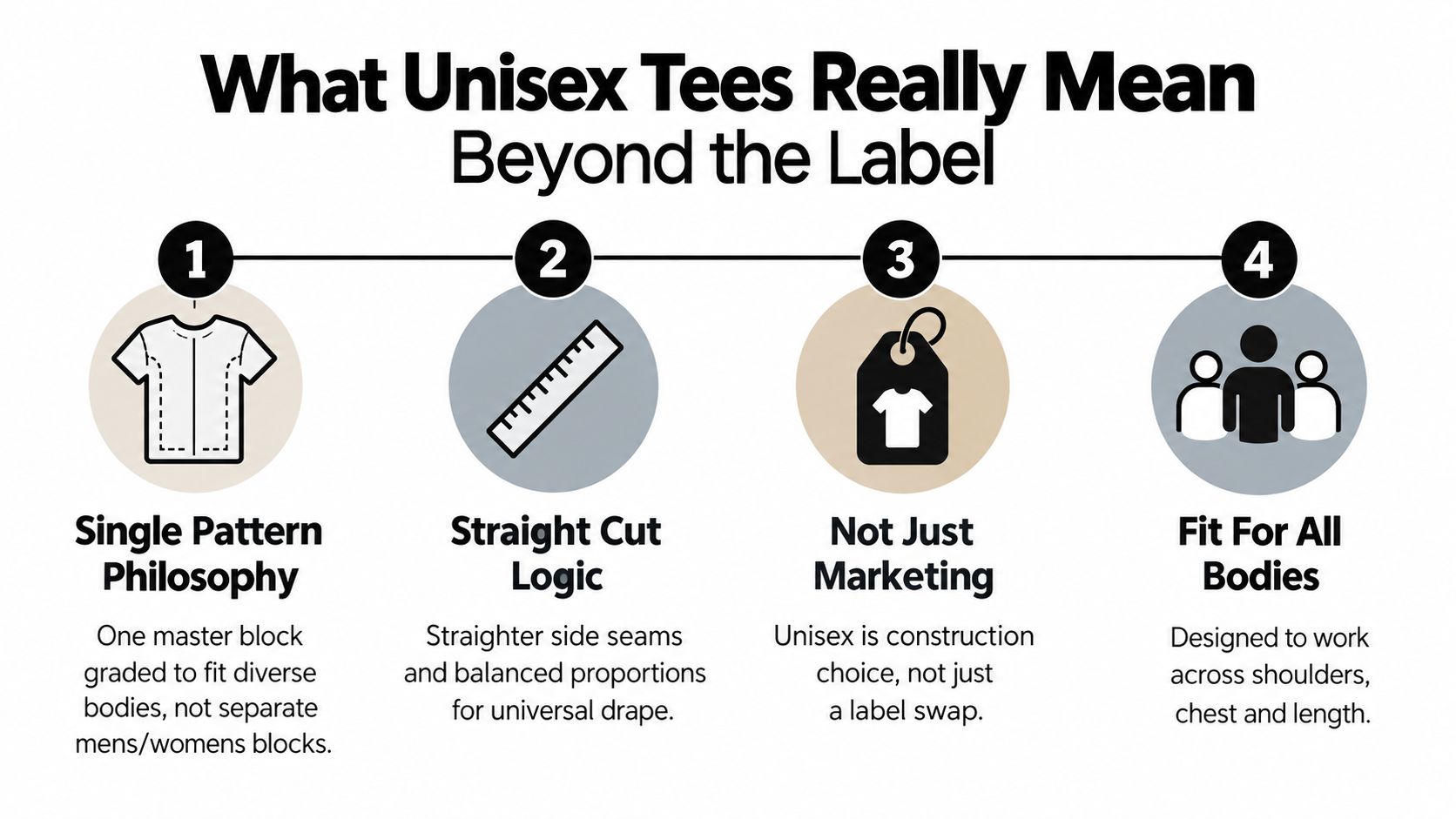
It's a construction choice, not just a marketing word
A true unisex tee usually starts from one measurement framework instead of separate men's and women's blocks. That affects everything the wearer feels right away. Shoulder line. chest room. body straightness. sleeve balance. hem drop.
The goal isn't to carve the body into a very specific shape. The goal is to give the shirt enough neutrality to style in different ways. That's why unisex cuts live so comfortably in streetwear, basics, blanks, and layered wardrobes.
Published unisex sizing also reflects that broad-fit logic. A size chart from Silverts maps XS through 3XL across chest ranges from 32 to 34 inches up to 53 to 56 inches, with waist ranges from 25 to 27 inches up to 46 to 49 inches in one shared framework, as shown on the Silverts unisex clothing size page.
Why the category became the default
The modern tee didn't start unisex. Its history moved there over time. One fashion history summary notes the T-shirt began as a men's undergarment, became widely adopted by women in the 1960s, and was “unisex” by the 1970s, as outlined in this T-shirt industry timeline.
That shift matters. Once the tee stopped being defined by one gendered use, it became a wardrobe basic first and a category label second.
Market data backs up how central that format is today. One roundup reports that 85% of T-shirts sold globally are unisex, while women's T-shirts are projected to grow at 6.1%. The same roundup cites broader market research estimating the global T-shirt market at US$169.14 billion in 2021, rising to US$261.58 billion by 2033 at a 3.7% CAGR, according to this T-shirt market statistics summary.
Unisex isn't niche. In the T-shirt world, it's the commercial center.
That lines up with how people dress in New York too. A lot of wardrobes here are built around pieces that can shift with layers, weather, and mood. A straighter tee makes room for that. It doesn't lock you into one formula.
How Unisex Fit Compares to Gendered Cuts
The fastest way to understand unisex tees is to compare them to the cuts most shoppers already know. Not by labels. By the five fit levers your body notices immediately.
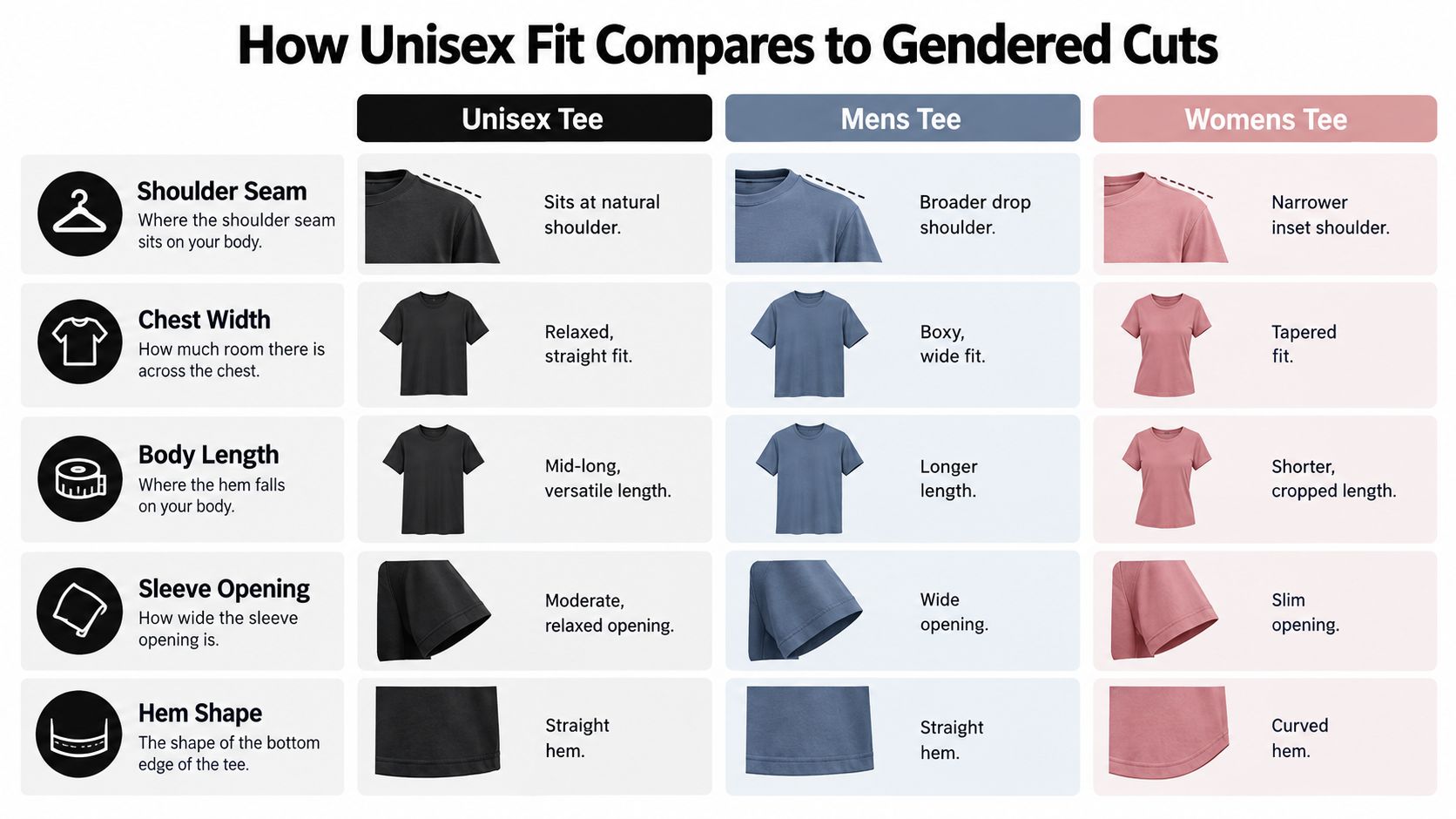
A classic women's tee often narrows in more through the torso and sleeve. A traditional men's tee can feel broader and boxier. A unisex tee usually sits between those two, but not perfectly in the middle. It tends to favor a straighter line that can be worn relaxed, fitted, or oversized depending on sizing.
What changes when the cut changes
| Fit Feature | Unisex Tee | Mens Cut | Womens Cut |
|---|---|---|---|
| Shoulder seam | Usually sits near the natural shoulder | Often broader, sometimes with more drop | Usually narrower or more inset |
| Chest width | Straight and relaxed | Boxier or wider | More tapered |
| Body length | Mid to long | Often longer | Often shorter |
| Sleeve opening | Moderate and easy | Wider | Slimmer |
| Hem shape | Straight | Straight | Often curved or more shaped |
That table won't predict every brand. It gives you the read you need before trying one on.
Fit shortcut: If you dislike cling through the waist, unisex will often feel easier than a fitted women's tee. If you hate excess width, sizing down may matter more in unisex than in a tapered cut.
Here's another way to think about it. A women's cut often follows the body more closely. A men's cut often assumes broader shoulders and a roomier frame. A unisex cut tries to create one clean line that doesn't over-define the body either way.
That's why the same size can look sleek on one person and oversized on another. The shirt isn't promising sameness. It's offering a shared shape.
A quick visual can help lock that in before you buy.
How this plays out on body
If your shoulders are narrower, a unisex tee may read a little more dropped or relaxed even when the chest fits well. If your shoulders are broader, the same tee may look more standard and less oversized. If you're shorter, body length becomes the thing to watch first, not chest.
That's why “just order your usual size” is weak advice.
A better question is this:
- Do you want the shoulder neat or slightly dropped?
- Do you want the torso close, relaxed, or boxy?
- Do you want the hem to sit at the belt line, below it, or deep over it?
Once you answer those, the label matters less.
Fabric Weight Shrink Control and Why Quality Shows
Cut tells you the shape. Fabric tells you how that shape behaves.
A unisex tee in a soft lightweight jersey can still have a straight silhouette on paper, but if the fabric collapses, clings, or goes semi-sheer in bright light, it won't read the same on body. Weight changes everything.
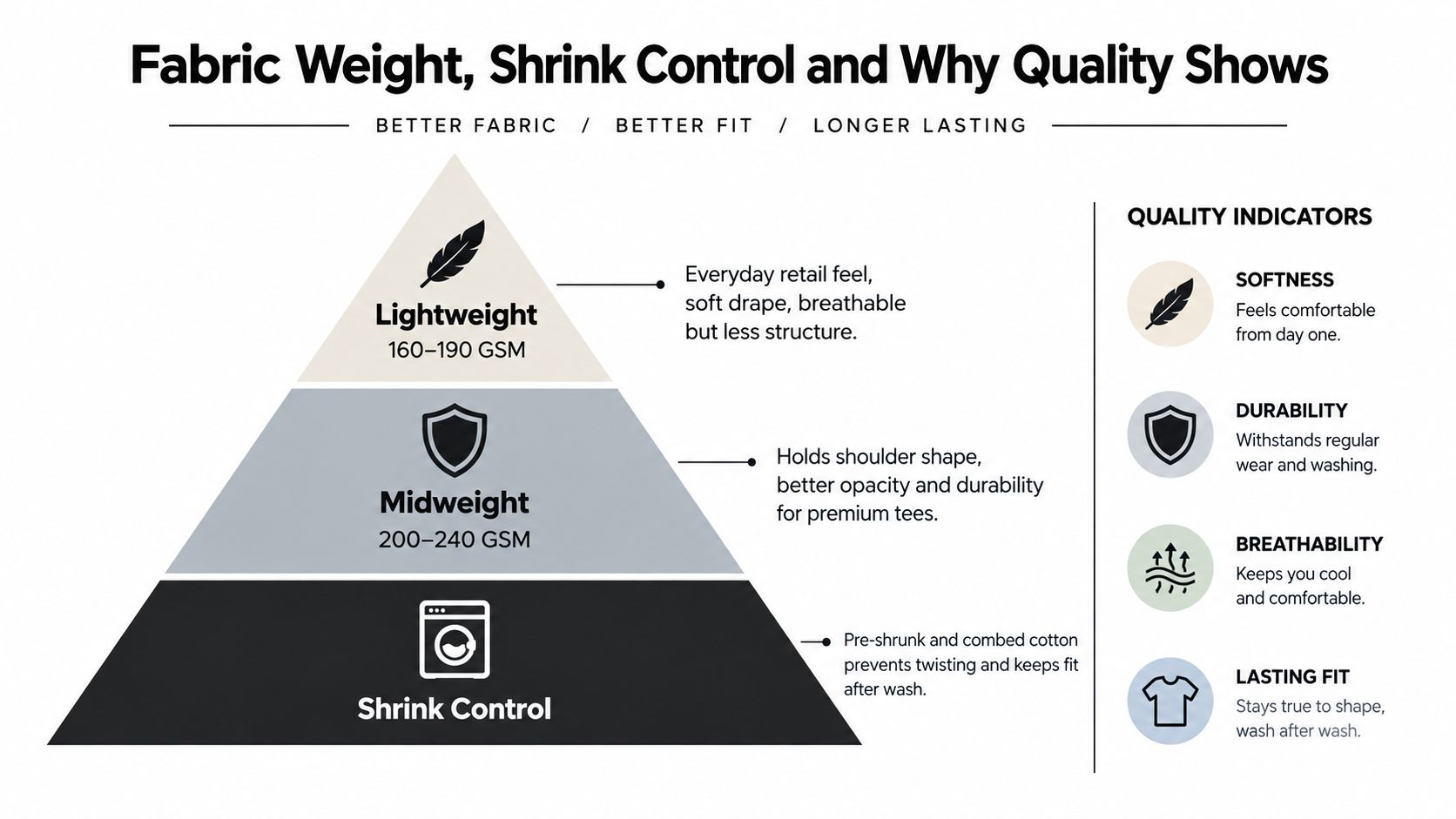
GSM is the cheat code
GSM means grams per square meter. For shoppers, it's the fastest clue to drape, opacity, and structure.
According to this fabric weight guide from SANVT, everyday retail tees usually land in the 160 to 190 GSM range. The same guide describes 200 to 240 GSM as a more structured, premium streetwear weight that holds shoulder shape better and resists hem twisting more effectively. It also notes that 140 to 160 GSM suits hot weather and layering but can raise show-through risk in lighter colors, while 180 to 200 GSM is often the most balanced zone for a unisex core line.
That translates cleanly into real life:
- Lighter fabric: softer drape, easier layering, less structure
- Balanced midweight: enough body to sit flat without feeling stiff
- Heavier fabric: cleaner lines, more streetwear presence, stronger shoulder shape
If you want a tee to anchor an outfit instead of disappearing into it, weight matters.
Why shrink control is part of fit
A shirt can fit right on day one and go weird after washing. That's where shrink control steps in.
Industry guidance gathered in this T-shirt shrinkage overview notes that untreated cotton jersey can shrink around 5 to 10% in early washes, often with more shrinkage in length than width. The same source says properly compacted or pre-shrunk fabric is often held to about ±3 to 5% after home laundering.
A unisex tee lives or dies on proportion. If length pulls up faster than width, the whole silhouette changes.
That's why pre-shrunk or compacted cotton matters more than people think. It helps preserve the line the designer intended.
For shoppers comparing options, it's worth learning the basics of best fabrics for T-shirts, especially if you care about repeat wear instead of one good try-on.
Decoration matters too
Print sits on top. Embroidery goes through the fabric.
That difference shows in wear. Industry suppliers describe embroidered logos as textured, long-lasting, and well suited to repeated laundering, as noted in this fashion-week supplier guide. For hoodies and crewnecks, that kind of finish gives streetwear staples a more durable, premium surface feel.
How to Find Your Perfect Size in Unisex Tees
Sizing unisex tees gets easier the second you stop starting with your usual label and start with a shirt you already love.
Take that favorite tee out of your closet. Lay it flat. Smooth it gently. Don't stretch it. Now you've got a real reference point instead of a guess.
Use flat measurements first
Two measurements do most of the work:
-
Chest width
Measure straight across the shirt, about an inch below the armholes. -
Body length
Measure from the highest point near the shoulder down to the bottom hem.
That's the language many size charts are speaking.
One published unisex size guide shows adult tees ranging from XS at 16.5 inches width and 27 inches length to 3XL at 28 inches width and 33 inches length, with youth and toddler sizing using different systems, according to this gender-neutral clothing market report and sizing discussion.
That same source also notes the broader gender-neutral clothing category is estimated at USD 3.87 billion in 2025 and projected to reach USD 7.19 billion by 2031. The bigger takeaway for shoppers is simple. Demand is growing, but a lot of content still doesn't explain fit in a practical way.
Pick your silhouette on purpose
Once you know your favorite tee's flat measurements, compare them to the chart and decide what look you want.
A unisex size can play different roles:
- Closer fit: match your favorite tee closely, especially through chest width
- Relaxed fit: add a little room through body and sleeve without going oversized
- Boxy look: focus on width first, then check that the length won't overwhelm you
If you're between sizes, ask yourself whether shoulder line or length bothers you more. Some people don't mind extra width. A lot of people hate extra length.
Measure for the look you want, not the identity printed on the tag.
A quick try-on checklist
When you put on unisex tees, check these before you decide:
- Shoulders: seam should land where you want the structure to start
- Chest: enough room to move, not so much that the shirt balloons
- Length: hem should land where your outfit needs it
- Sleeves: should complement your arms, not squeeze or flare awkwardly
- After-wash reality: if the fabric isn't pre-shrunk, imagine the shirt a little shorter
If you want extra help reading broad sizing logic before buying tops in shared fits, this guide to unisex sweatshirt sizing applies the same measurement-first mindset.
For a concrete retail example, DM-FlexWear offers the NY Crown Crest Heavyweight Unisex Tee in S to 3XL, while the brand's family range also extends to baby crewneck tees from 6M to 4T for coordinated looks across ages.
Styling Unisex Tees for Every Body and Occasion
Once the fit is right, styling gets easy. That's the beauty of unisex tees. They don't ask for much. They just need clear proportions around them.
For a sharper everyday look
Start with a structured tee in Black, White, Grey, Navy, or Gold. Let the shirt do the clean-line work. Pair it with straight-leg denim or trousers and keep the shoulder tidy.
If the tee runs longer than you want, use a light front tuck. Not a full corporate tuck. Just enough to create shape and let the side seam relax.
For curves, width, or more shape
A straighter tee doesn't erase shape. You style shape into the outfit.
Try these moves:
- High-waisted bottoms: they shorten the visual drop of the tee and balance length
- Half tuck or bra tuck styling: useful when you want more waist definition
- Layer with open outerwear: an unzipped hoodie or open overshirt creates vertical lines
A lot of people think unisex means shapeless. It doesn't. It means the shape comes from styling choices instead of heavy tapering built into the garment.
If the tee feels too straight on body, don't panic. Change the proportion around it before you reject the shirt.
For weekend and downtown layering
A heavyweight tee under a crewneck or under an embroidered hoodie gives you visible structure at the hem and collar. That little edge matters.
New York style is full of these small proportion plays. You see it around runway week too. The official CFDA calendar lists September 10 through September 15, 2026 for New York Fashion Week, and current coverage describes the event as a citywide six-day run with roughly 70 shows and presentations, according to the CFDA announcement for the September 2026 official NYFW schedule application. That kind of fashion context matters because layered basics are still the uniform around the spectacle.
For casual wear, oversized works when the rest of the outfit stays intentional. If the tee is roomy, keep the pants cleaner. If the pants are wide, keep the tee's length under control.
For family matching moments, the easiest route is color coordination, not identical styling. Adults can wear the tee with cargos, denim, or a layered sweatshirt. Kids can carry the same crest story in a simpler fit without forcing the exact same silhouette.
Your Next Tee Made Simple
The easiest way to shop unisex tees is to stop asking whether they're “for men” or “for women” and start asking what silhouette they create. That one shift clears up most of the confusion.
Three decisions matter most:
- Cut: do you want straight and relaxed, neater and closer, or oversized
- Weight: do you want soft drape or more structure
- Size intent: are you matching a favorite tee, adding room, or building a boxier look
If you like clean NYC streetwear, a heavyweight unisex tee usually earns its place fast. It layers better. It holds shape better. It gives sneakers, trousers, denim, or sweats something solid to work with.
Color choice is simple too. Black and Navy sharpen. White brightens. Grey softens. Gold stands out. Then build around that with one textured layer, like a hoodie or crewneck, when the outfit needs more depth.
If you want more perspective on where staple tees fit into a modern wardrobe, this piece on what's next for T-shirts is a useful next read.
One well-chosen tee can carry a lot of outfits. That's always been the point.
DM-Flexwear.com offers a focused lineup of NY Crown Crest staples, including heavyweight unisex tees, embroidered hoodies, crewneck sweatshirts, and baby tees for coordinated styling across ages. If you want to put this fit-first approach to work with clean colorways and a straightforward size range, visit DM-Flexwear.com.