

The most repeated advice in streetwear is also the least useful: 100% cotton is always the premium choice. Cotton has a great hand feel and a strong place in structured, heavyweight silhouettes, but daily rotation puts different demands on a tee. Repeated washing, city humidity, layering, travel, decoration, and long hours on the move all expose cotton's weaknesses.
That's where 50/50 blend T-shirts earn their place. The cotton-polyester mix doesn't chase a single extreme. It balances comfort with shape retention, airflow with faster drying, and a familiar natural feel with the resilience needed for real wardrobes. The right question isn't whether a blend sounds more luxurious on a label. It's whether the garment still fits, feels, and looks right after life happens.
Table of Contents
- Why the 50 50 Blend Rules the Streets
- The Anatomy of a Perfect Poly-Cotton Mix
- Shrinkage and Durability in Everyday Wear
- Breathability and Climate Performance
- Printing vs Embroidery on Blended Fabrics
- Sizing and Fit for Unisex Streetwear
- Caring for Your Blanks and Looking Ahead
Why the 50 50 Blend Rules the Streets
Streetwear doesn't live on a product rack. It lives in subway stations, studio sessions, airport terminals, packed venues, hot sidewalks, and laundry baskets. A tee that looks excellent on its first wear but twists, wrinkles, or changes size after washing isn't a premium foundation. It's a short-term visual.
100% cotton still works beautifully for rigid boxy cuts, heavyweight layering, and graphics that benefit from a dense, absorbent surface. But a daily staple needs more than softness. Polyester gives the fabric a structural backbone, helping it resist wrinkles and maintain its intended shape, while cotton keeps the surface more breathable and comfortable against the skin. That combination makes the shirt easier to wear repeatedly without treating it like a delicate object.
Streetwear rule: Choose fabric for the rotation you actually live in, not for the outfit photo.
The appeal is practical. A 50/50 tee generally dries faster than cotton-only clothing, holds its silhouette more reliably, and asks less of the wearer between washes. It also offers a more familiar hand feel than a fully synthetic performance shirt. That middle ground is why the blend works across uniforms, casual basics, team apparel, and fashion-led blanks.
The same logic suits a New York wardrobe. A tee may sit under a jacket in a heated train, emerge into damp summer air, then spend the evening layered under a hoodie. A fabric that manages those transitions without feeling overly clingy or excessively heavy has a real advantage.
The blend also supports consistent branding. A streetwear logo needs to remain proportional and clean after laundering, especially when the same garment is sold across colors and sizes. Dimensional stability helps protect that consistency, which matters more than a dramatic first impression.
The result isn't a compromise. It's a deliberate choice for longevity, low-maintenance wear, and dependable comfort. That's why 50/50 fabric continues to make sense for modern basics, including crest-led New York apparel designed to be worn often rather than preserved.
The Anatomy of a Perfect Poly-Cotton Mix
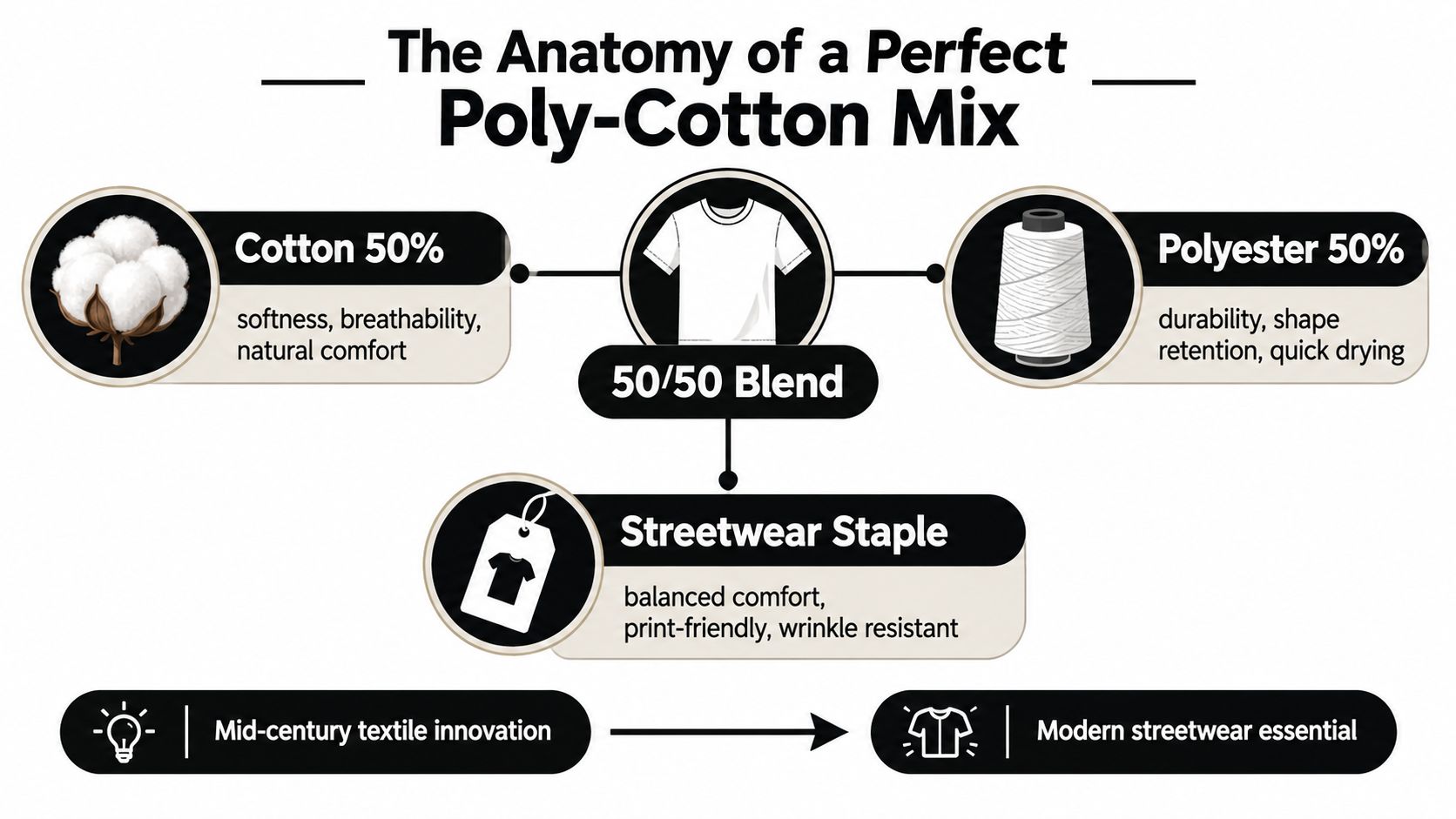
The 50/50 ratio became influential because each fiber handles a weakness in the other. Cotton contributes softness, breathability, and natural skin comfort. Polyester contributes resilience, wrinkle resistance, quicker drying, and better shape memory. Together, they create a fabric that feels approachable but behaves with more discipline than cotton alone.
Polyester was commercialized during the 1940s and 1950s, and mills adopted blended fabrics widely during the 1950s because the synthetic fiber reduced wrinkling and shrinkage while cotton improved comfort and breathability. By the 1970s and 1980s, 65/35 and 52/48 constructions had become especially common in uniforms and T-shirts, showing how quickly poly-cotton moved from textile innovation into everyday clothing. The historical progression is documented in this overview of cotton and polyester blend T-shirts.
How the fibers divide the work
Cotton fibers create a softer, more breathable contact surface. They help the shirt feel less slick than a fully synthetic garment and make the fabric more comfortable for casual wear. Polyester fibers add strength and stability throughout the knit, reducing the tendency of the garment to lose its proportions through ordinary use.
That doesn't mean every 50/50 blank feels identical. Yarn quality, knit construction, finishing, weight, dye process, and cut all affect the final result. A basic open-end blend won't feel like a refined retail blank because both contain the same fiber ratio.
The ratio works because it creates a credible middle path:
- Cotton contributes comfort: The natural fiber helps preserve breathability and a familiar tee-shirt hand feel.
- Polyester provides structure: The synthetic component helps the garment resist wrinkles, drying delays, and unwanted shape change.
- The blend supports decoration: A more stable base gives prints and stitched motifs a steadier platform.
- The result suits repeat wear: The fabric performs across everyday outfits instead of being restricted to one climate or activity.
For a deeper comparison of common tee materials, the guide to the best fabrics for T-shirts is useful when evaluating a blend against cotton-rich and synthetic alternatives.
Shrinkage and Durability in Everyday Wear
The biggest advantage of a 50/50 tee often appears after the first wash, not the first fitting-room mirror. Cotton can change dimensions when heat, moisture, and agitation affect the fibers. Polyester helps stabilize the construction, so the garment is more likely to preserve its original proportions.
A 2018 fabric-testing study compared a 50% cotton and 50% polyester T-shirt with a 100% cotton shirt. The blended shirt recorded air permeability of 151.8 ft³/ft²/min, compared with 107.4 ft³/ft²/min for cotton. It also recorded bursting strength of 10,646.74 psi, compared with 5,161.59 psi for the cotton garment. The results appear in the fabric-testing study on cotton-polyester T-shirts.
The same test reported shrinkage in the blend ranging from 2.32% at the sleeve opening to 10.25% at the neck opening, which is a useful reminder that “low shrinkage” doesn't mean “no dimensional change.” Construction, finishing, and the specific garment zone still matter.
| Metric | 50/50 Blend | 100% Cotton |
|---|---|---|
| Air permeability | 151.8 ft³/ft²/min | 107.4 ft³/ft²/min |
| Bursting strength | 10,646.74 psi | 5,161.59 psi |
| Reported shrinkage range in the tested blend | 2.32% to 10.25%, depending on garment opening | Not specified in the cited test |
Why shape retention matters to brands
A shirt that changes fit after laundering creates problems beyond personal annoyance. A customer may order a second color expecting the same silhouette, or a team may distribute coordinated garments that no longer look coordinated after regular washing. Better dimensional stability helps keep the relationship between collar, shoulder, chest, sleeve, and graphic more predictable.
Neutral apparel guidance commonly places typical 50/50 shrinkage around 1–3%, compared with about 5% for cotton-only garments, while also recommending pre-shrunk or low-shrink blanks for repeat-wear basics and uniform programs. Those ranges are discussed in this practical guide to cotton-poly blends.
The practical choice is straightforward:
- Choose the blend for frequent laundering: It's better suited to uniforms, family orders, team apparel, and daily rotation.
- Check the finishing details: Pre-shrunk and low-shrink claims matter more than the fiber ratio alone.
- Test the actual blank: A sample reveals collar recovery, sleeve proportion, surface feel, and post-wash fit better than a specification sheet.
Pure cotton remains valuable when deliberate shrinkage, stiffness, or a more substantial break-in character is part of the design. For dependable streetwear basics, though, the blend usually gives the wearer fewer reasons to retire the shirt early.
Breathability and Climate Performance
A 50/50 tee doesn't behave like a pure performance shirt, and it shouldn't be sold as one. Its strength is balance. Cotton preserves a breathable, familiar feel, while polyester helps move moisture through the garment and supports faster drying. That combination can feel more versatile than either extreme during long urban days.
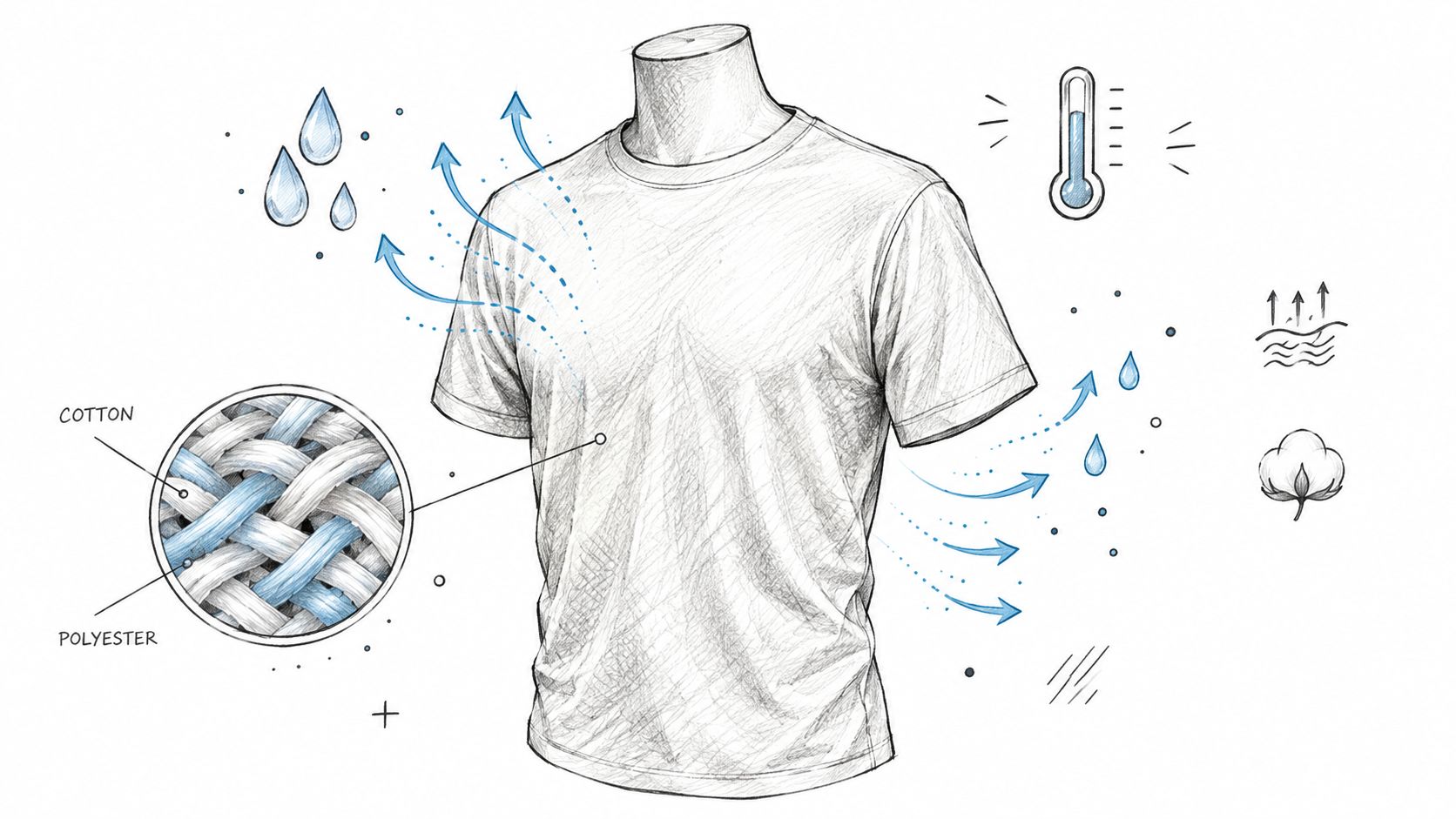
Heat and humidity expose the difference between comfort and performance. Cotton can feel pleasant at first because it breathes naturally, but moisture may remain in the garment longer. Polyester's wicking behavior helps move sweat away from the skin and through the fabric, although the final result depends on knit structure, finish, fit, and laundering.
Independent testing and garment-physics research support a nuanced view. The 50/50 construction can offer a balanced thermophysiological profile with measurable air permeability and water-vapor resistance, while polyester contributes to sweat movement. The relevant research on 50/50 cotton-polyester performance also reinforces why the fabric should be judged by use case rather than by a simple “breathable” or “not breathable” label.
Where the blend makes sense
For layering, the blend works well because it doesn't feel as clammy as a wet cotton tee and doesn't have the slick surface associated with some performance synthetics. Under an overshirt or light jacket, that balance helps the base layer transition between indoor heating and outdoor air.
For travel and long city days, faster drying and wrinkle resistance reduce maintenance. A tee can be washed, hung, and put back into rotation without requiring the same drying time or ironing attention as a cotton-only garment.
For active use, the answer depends on intensity. A 50/50 tee suits walking, commuting, casual outdoor events, and moderate movement. For sustained high-sweat training, a purpose-built polyester performance shirt may manage moisture more aggressively.
Washing can materially change wicking behavior, so the shirt may feel different after several laundering cycles. That's why sample testing should include both a fresh garment and a washed garment, especially when a brand is selecting a core blank for humid climates.
The video below offers another visual perspective on how blended fabric construction relates to everyday wear and moisture management.
A 50/50 tee won't erase climate variables. A loose cut, breathable knit, and sensible layering still matter. But when the brief calls for one shirt that can handle heat, movement, indoor transitions, and repeat washing, the blend is often the most adaptable option.
Printing vs Embroidery on Blended Fabrics
Decoration changes the performance equation. A blank may feel excellent on the body but still fail visually if the ink cracks, the graphic distorts, or heavy stitching pulls the knit out of alignment. The 50/50 base helps because polyester contributes dimensional stability, but decorators still need to match the method to the artwork.
When screen printing is the right move
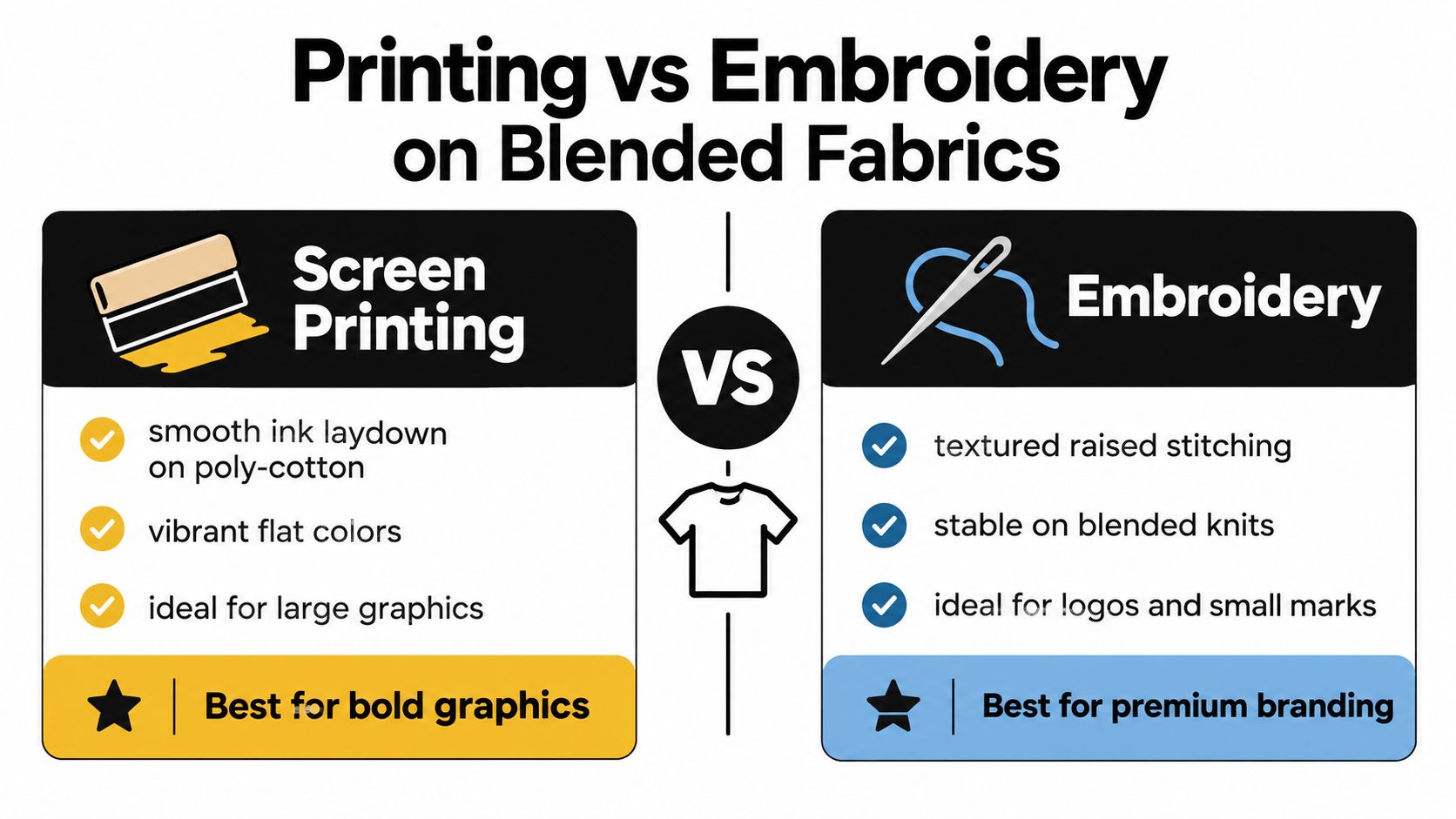
Screen printing remains the strongest choice for broad, graphic-led streetwear. The ink sits across the fabric surface, making the method effective for large artwork, bold shapes, and flat color fields. A 50/50 shirt can provide a stable, comfortable canvas while retaining more hand comfort than a fully synthetic blank.
The polyester content does introduce a technical consideration. On some blends, dye migration can affect light ink colors, especially when heat is involved, so the printer may need the correct ink system, curing approach, and underbase. That isn't a reason to avoid the fabric. It's a reason to test the actual colorway and decoration recipe.
The screen print versus embroidery comparison helps frame the choice around artwork rather than habit.
When embroidery earns the premium
Embroidery gives a garment a raised, tactile surface. It suits small logos, initials, crests, and marks where the decoration should feel like part of the garment instead of a flat layer on top. The 50/50 knit can support this approach well, but a stabilizer and suitable stitch density remain important.
Heavy embroidery can pucker a lightweight tee. Dense thread coverage can also add weight and pull against the fabric, especially when the motif is oversized. A restrained crest, compact wordmark, or chest emblem usually produces a cleaner result than forcing a highly detailed illustration into a small area.
Decoration principle: Let the graphic determine the method. Use print for visual scale and embroidery for tactile authority.
For adult streetwear blanks, full-front graphics are commonly sized around 11–12 inches wide by 11–14 inches tall on a medium shirt, while full-back placements are often around 12 by 14 inches. These production norms are outlined in this adult T-shirt design size chart. The exact dimensions should still be adjusted for the garment cut and size range.
A practical decision matrix looks like this:
- Large illustration: Screen print, because the technique handles broad visual coverage efficiently.
- Small crest or premium mark: Embroidery, because raised stitching adds texture and perceived permanence.
- Fine photographic detail: Test a suitable transfer or digital process rather than assuming a standard screen print will preserve every nuance.
- Heavy stitch density on a light blank: Reduce density, simplify the artwork, or move the motif to a more stable garment.
The best decorated 50/50 tee doesn't merely survive production. It keeps the intended relationship between fabric, graphic, and silhouette after repeated wear.
Sizing and Fit for Unisex Streetwear
A 50/50 blend will not fix a bad pattern. The same fabric can look sharp and relaxed in one blank, then pull across the shoulders or hang poorly in another. Evaluate the cut, shoulder construction, sleeve length, and finished measurements alongside the fiber content. For streetwear, those details determine whether the tee keeps its intended silhouette after repeated wear.
Adult unisex sizing usually follows men's proportions. A common range runs from XS through 2XL, with chest measurements such as S at 35–37 inches, M at 38–41 inches, L at 42–45 inches, XL at 46–49 inches, and 2XL at 50–53 inches. Our unisex tees sizing guide explains how those measurements translate into actual garments, while an external unisex adult T-shirt size guide offers a useful secondary reference.
Reading the silhouette
A standard unisex tee gives more room through the torso than a fitted women's cut. That extra volume creates the relaxed proportion associated with streetwear, but it can look oversized on someone between sizes or anyone who prefers a closer fit.
Use the garment's measurements to make the final choice:
- For a clean everyday fit: Match the chest measurement first, then check body length. A correct chest width does not help if the hem finishes too high or low.
- For an oversized look: Size up only after checking shoulder width and sleeve proportion. Extra width without corresponding length can make the tee look accidental.
- For layering: Allow room for an undershirt or light base layer. Do not expect the blend's limited stretch to compensate for a restrictive pattern.
- For decorated garments: Check where the print or embroidery will sit across the body. A graphic can distort when a close-fitting chest pulls, while excess fabric can make a motif look disconnected from the silhouette.
The blend's shape retention helps a relaxed tee hold its shoulder line and hem proportion through regular wear. It still cannot correct inaccurate measurements or make every cut suit every body.
Coordinated family orders require separate sizing logic. Infant and toddler garments use different proportions from adult unisex blanks, so matching colors and motifs does not mean applying the same fit chart. Brands covering several age groups should publish clear charts and finished measurements for each garment, rather than relying on one shared product name.
Fit check: Measure a favorite tee flat, then compare chest width, body length, shoulder width, and sleeve length with the blank's chart.
This method matters especially for online purchases, where the same size label can conceal major differences between manufacturers. Judge the actual garment and its measurements, not only the XS, M, or 3XL printed on the listing.
Caring for Your Blanks and Looking Ahead
A 50/50 tee is easy to care for, but “easy care” doesn't mean careless care. Cold washing and low-temperature drying protect the cotton component while allowing the polyester component to do its work. Turning decorated garments inside out also reduces surface friction against prints and stitched details.
Use a simple routine:
- Wash cold: This limits unnecessary stress on the cotton fibers and helps preserve color.
- Dry low or air dry: The blend dries efficiently, so extended high heat usually adds more risk than value.
- Avoid over-drying: Remove the shirt when it's dry rather than leaving it in a hot drum.
- Inspect decoration: If a print begins to lift or embroidery puckers, change the care routine before the damage spreads.
- Follow the garment label: Finishing treatments and decoration methods can change the safest settings.
The sustainability question deserves equal honesty. A 50/50 shirt combines two fiber types, which makes end-of-life separation and recycling more complicated than processing a single-fiber garment. A 2024 scientific paper on chemical recycling of mixed textile waste uses a white 50/50 polyester-cotton T-shirt as a representative polycotton waste stream, highlighting the technical challenge described in its research on mixed textile recycling.
The broader textile recycling market is projected to reach US$5.1 billion in 2026 and US$7.0 billion by 2033, according to the same verified research reference. Those projections don't make every blend automatically sustainable. They do show why brands and shoppers need better answers about fiber separation, recycled polyester, collection systems, and actual garment lifespan.
The most responsible purchase is still the garment that gets worn repeatedly and maintained properly. Recycled inputs may improve a product's material story, but they don't remove the need to assess durability, sourcing, care, and end-of-life options together.
That perspective fits the culture around New York apparel. The CFDA has scheduled New York Fashion Week for Thursday, September 10 through Tuesday, September 15, 2026, presenting American fashion on a global stage, with Diane von Furstenberg opening the week and Thom Browne closing it, according to the official September 2026 NYFW schedule. A dependable 50/50 tee belongs in that wider fashion conversation because streetwear depends on staples that can carry identity without sacrificing daily function.
Choose a 50/50 blank when you want comfort, faster drying, reliable shape retention, and decoration that stays consistent through real rotation. DM-FlexWear.com offers NY Crown Crest tees, embroidered hoodies, crewneck sweatshirts, and baby tees across coordinated colorways and sizes, making it easy to build a New York-inspired wardrobe for adults and young children. Visit DM-Flexwear.com to explore the collection and find a staple that's built to be worn, washed, and worn again.