

You buy a T-shirt because it feels perfect in the fitting room. The surface is smooth, the drape looks clean, and the fabric almost disappears against your skin. Then laundry day keeps coming. The tee loses its shape, develops a rough halo of fuzz, or feels fine until an embroidered patch or heavy print turns the front stiff.
That's why finding the softest fabric for shirts isn't really a first-touch ranking. The better question is: which fabric delivers the hand-feel you want, keeps that comfort through regular washing, and still suits the way you wear or decorate the garment? A fluid tee for layering around New York needs a different balance from a structured heavyweight shirt built for embroidery.
Softness has a technical side, but you don't need a lab coat to use it. You need to understand what your hand is sensing, how yarn and finishing change the result, and whether the shirt's construction matches your wardrobe. The sections ahead move from measurable hand-feel to fiber comparisons, then into laundering, decoration, and practical buying decisions.
For a fast-moving NYC wardrobe, that balance matters. A good staple has to work under a jacket, stand alone on a hot day, survive commutes and repeat wear, and still look intentional when you reach for it again.
Table of Contents
- Introduction Why Softest Does Not Always Mean Best
- What Softness Really Means for Shirt Fabrics
- The Softest Shirt Fabrics Compared Head to Head
- Why Fiber Length Spinning and Finishing Change Everything
- Softness That Lasts Through Washing and Wearing
- How to Choose the Right Soft Fabric for Your Lifestyle
- Final Takeaways for Soft Durable Everyday Shirts
Introduction Why Softest Does Not Always Mean Best
A shirt can win you over in the fitting room and lose its place in your rotation after a few washes. A fluid tri-blend may feel luxurious, with a smooth surface and flexible drape, yet look too loose for a sharp oversized streetwear silhouette or lack the stability needed beneath dense embroidery.
Rigid cotton creates the opposite tradeoff. It can hold a crisp shape and give graphics a clean foundation, while feeling rough around the neck or under the arms. Neither fabric is automatically better. Each solves a different wardrobe problem.
First wear versus real wear
Shoppers use “soft” to describe several sensations:
- Smoothness: The fabric does not catch against your fingers or skin.
- Flexibility: It bends and drapes without resisting movement.
- Low friction: It glides across the body instead of dragging.
- Cushion: It feels gentle under pressure, especially in a knit.
These qualities can overlap, but they are not interchangeable. A thin modal jersey may feel silky and fluid. A long-staple cotton tee may feel smoother, more substantial, and better suited to a clean boxy cut. A heavyweight shirt may not feel cloud-like in your hand, but its structure can make a New York streetwear fit look deliberate and give embroidery a steadier surface.
Textile testing turns this first-touch impression into measurable hand-feel. The Kawabata Evaluation System, the Fabric Touch Tester, and related low-stress methods examine properties such as smoothness, friction, bending, and compression. The result is not a magical fiber ranking. It is a comparison of how fabric behaves when it slides, flexes, bends, and compresses. AITEX's overview of Total Hand Value and tactile evaluation explains how fabric hand can be formalized for comparison.
The smarter buying question
Start with the shirt's job. For a drapey base under layered, NYFW-inspired looks, modal, micro-modal, or a soft tri-blend may fit. For a coordinated family basic, printed tee, or heavyweight unisex shirt with a stable silhouette, ringspun cotton or a considered cotton blend may work better. If embroidery is part of the plan, prioritize a hand-feel that stays comfortable while the knit or jersey provides enough support for the decoration.
The best shirt is not the one that wins a blind touch test. It is the one that still feels right after the novelty fades, the wash cycle repeats, and the outfit asks for more than softness alone.
What Softness Really Means for Shirt Fabrics
Run your fingers across printer paper, a glossy magazine page, and a soft sketchbook. All are paper, yet your skin catches differences in texture, drag, flexibility, and response to pressure. Shirt fabric behaves the same way. Two garments can share a fiber category while feeling completely different because their surfaces, yarns, knit structures, and finishes interact differently.
Textile researchers describe this sensation as hand-feel, the combined impression created when fabric touches your hand or body. Its main physical drivers are surface smoothness, friction, bending rigidity, and compression behavior. Smoothness reduces noticeable irregularities. Low friction helps the cloth glide. Low bending rigidity lets it fall and flex. Compression shows what happens when you press the fabric, not just stroke it.
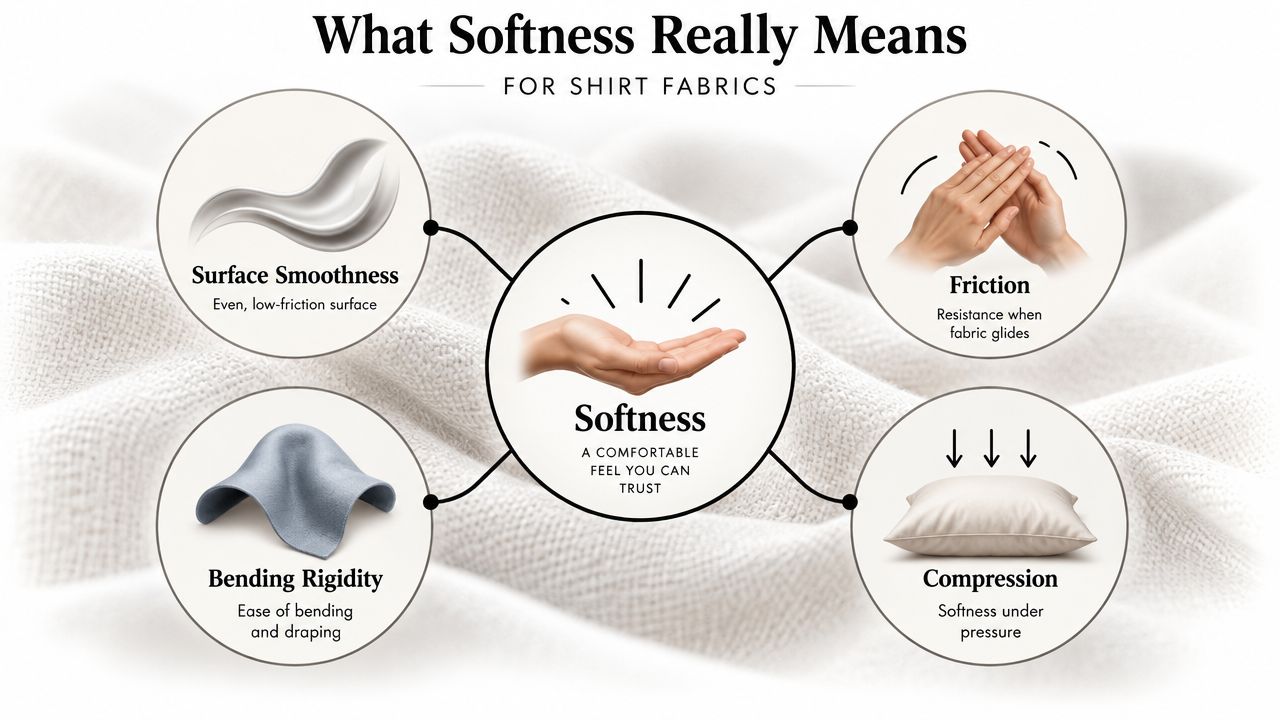
How low-stress testing mirrors your hand
The Kawabata Evaluation System, or KES, measures fabric behavior under low stress across tensile and shear, bending, compression, and surface modules. The tests do not yank or tear the textile. They track the small forces involved as cloth bends, slides, compresses, and recovers, which better resembles how a shirt moves in your hand and against your body. Cotton Incorporated's explanation of KES low-stress fabric testing explains why these properties support tactile comparisons.
A fabric that bends easily can create relaxed, fluid drape. Greater bending resistance can make it feel firmer and give a shirt a more architectural shape. Your perception also shifts with garment weight, fit, skin contact, and the difference between wanting loose movement or a stable silhouette.
Reading a hand-feel score
One industry measure, Total Hand Value, rates overall fabric feel from 0 to 5, with 5 representing the highest hand-feel quality. AITEX's tactile-parameter reference connects this score with measurable textile behavior.
Treat the rating as a lab description, not a universal shopping verdict. A silky fabric may suit a close-fitting undershirt yet lack the support needed for a structured embroidered crewneck. A smooth, dense cotton may feel less slippery while giving a heavyweight tee a steadier base for decoration and a more deliberate streetwear shape.
Practical rule: Treat “soft” as a bundle of measurable sensations, then match that bundle to the garment's job.
Softness can also be compared statistically. Textile researchers use methods such as ANOVA and factor analysis to separate tactile differences, making softness a formal material comparison rather than only a marketing phrase. For wardrobe decisions, read those measurements alongside yarn, knit density, weight, finishing, and decoration needs. This guide to the best fabrics for T-shirts offers a practical comparison of those construction details.
The Softest Shirt Fabrics Compared Head to Head
Modal and micro-modal usually lead the conversation because they combine fine fibers with smooth surfaces and a fluid hand. Instrumented textile comparisons have reported that Modal fabrics typically score 15 to 20% higher in softness ratings than standard lyocell, with about 25% lower surface roughness in some tests. Those figures come from comparative research summarized by Apparel Resources, not from a universal guarantee for every modal garment. The report on Lenzing's fabric softness measurement work provides that context.
Regenerated cellulosics can also produce lower surface-vibration peaks than cotton in textile testing, a signal that their surfaces may feel smoother under that method. Cotton still has a serious place in the softness conversation, especially when long-staple fibers, fine yarns, combing, and knit construction raise the finish quality.
| Fabric | Softness Profile | Best For | Trade Off |
|---|---|---|---|
| Modal and micro-modal | Silky, smooth, fluid, low-friction hand | Close-fitting tees, undershirts, fashion layering | Less naturally structured than heavier cotton |
| Pima and extra-long-staple cotton | Smooth, breathable, substantial softness | Premium everyday tees and polished casual shirts | Quality varies with spinning and finishing |
| Bamboo viscose | Soft, cool, fluid, often drapey | Relaxed basics and lightweight layering | Fiber label alone doesn't reveal construction or longevity |
| Tri-blends | Broken-in, soft, lightly stretchy, easy drape | Fashion tees and lifestyle merchandise | Can feel too fluid for dense decoration or a firm silhouette |
| Combed ringspun cotton | Smooth, familiar, cleaner surface than basic cotton | Printed tees, daily wear, structured basics | May not feel as slippery as modal |
| Lyocell and TENCEL-type cellulosics | Smooth, breathable, drapey | Fluid shirts and layered looks | Usually needs the right blend or construction for more structure |
Modal and micro-modal
Modal has strong technical and industry credibility as a softness leader. Lenzing has described Modal fibers as the softest in its portfolio, while comparative testing has placed Modal ahead of standard lyocell for softness and surface roughness in some evaluations. The TENCEL softness study also supports the broader conclusion that man-made cellulosics can outperform standard cotton on instrumented softness measures.
Cotton with better fiber credentials
Pima and extra-long-staple cotton close the gap through fiber length and yarn quality. They deliver breathable softness with more body, making them strong choices when the tee needs to look clean rather than cling or collapse. That's the difference between a soft shirt that melts into a layer and one that gives a fit some presence.
Tri-blends and bamboo viscose
Tri-blends are popular for their lived-in hand and relaxed movement. Bamboo viscose can offer a similarly smooth, cool impression, but shoppers should inspect the full composition, knit, and finish rather than assuming the plant-based name guarantees performance.
For a NYFW-adjacent outfit, modal and tri-blends bring movement. For a heavyweight streetwear tee, premium cotton and ringspun construction often bring the stronger balance of softness and shape.
Why Fiber Length Spinning and Finishing Change Everything
A heavyweight embroidered tee can feel soft at the collar yet still hold its shape after a full day on the street. That result comes from more than the fiber name. Fiber length, yarn preparation, and finishing shape hand-feel, durability, and how well the fabric supports decoration. Two shirts labeled cotton can land very differently against the skin and under an embroidery design.
Extra-long-staple cotton shows why. Long-staple cotton measures roughly 1.14 to 1.38 inches, while extra-long-staple cotton sits above 1.38 inches. It represents less than 3% of global cotton production, according to this cotton fabric guide. Longer fibers can form finer, smoother yarns with fewer loose ends. The surface feels cleaner, with less fuzz to catch on skin, seams, or repeated wear.
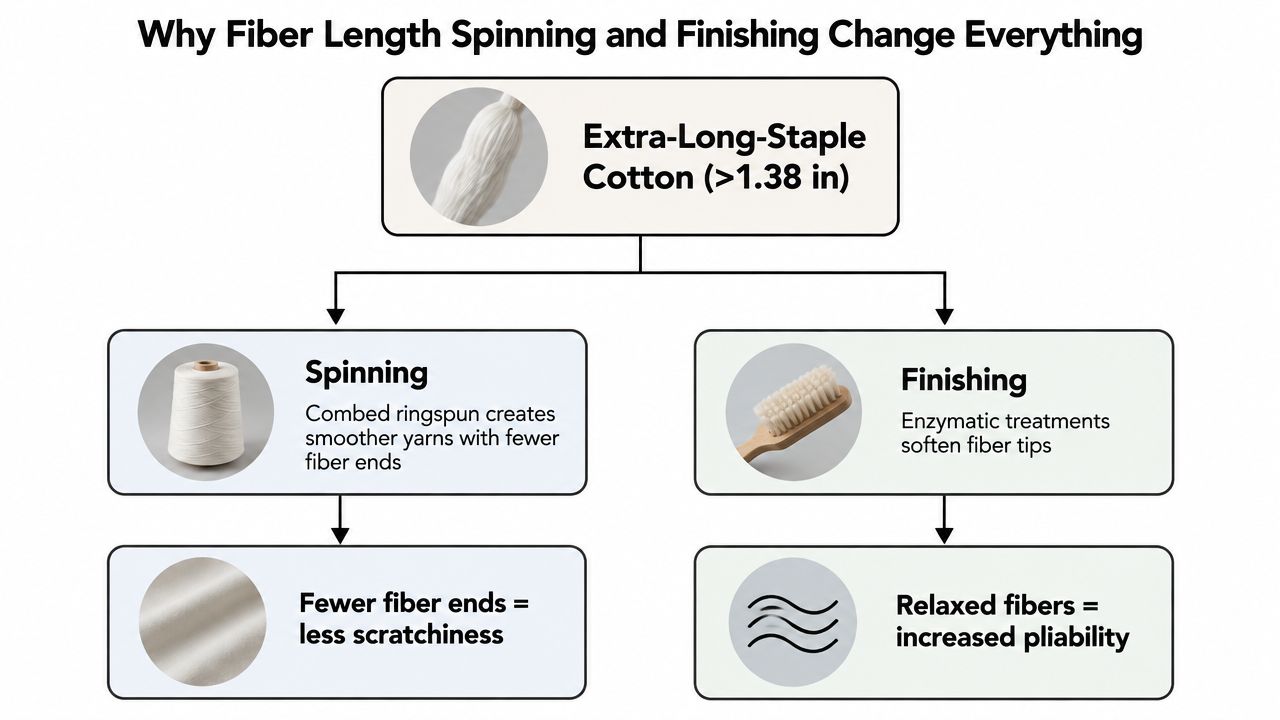
Spinning determines the yarn surface
Combed cotton removes shorter fibers, leaving a cleaner strand. Ringspun yarn twists fibers into a smoother, finer structure than a basic rough-spun yarn. In jersey, that difference sits directly against your body. It can make the shirt feel more polished at first touch and reduce the fuzzy surface that often makes inexpensive cotton feel scratchy.
“100% cotton” still leaves major details unanswered. A tee made with longer fibers and carefully prepared yarn can feel smoother, wear cleaner, and give embroidery a steadier base than another shirt with the same fiber percentage. For a heavyweight streetwear cut, that steadiness matters. Dense stitching needs fabric that supports the design instead of puckering around it.
Finishing changes the final touch
Enzyme washing softens fiber tips and reduces a raw, fuzzy sensation. Mercerization works differently. It smooths surface irregularities and changes the fiber cross-section, often creating a cleaner, cooler touch with subtle shine. The fabric may still retain a firmer feel through its bulk. This explainer on mercerized cotton explains how swelling relaxes cotton's natural twist and reduces its fuzzy texture.
Modal-blend jerseys get their luxury reputation from smooth cellulosic fibers, fine yarns, and fluid drape. Pura Fabric's guide to soft jersey composition identifies modal blends as known for an exceptionally soft, luxurious feel.
Why this matters for heavyweight streetwear
A heavyweight unisex tee needs a controlled hand, not just a soft surface. It must hold an oversized cut, keep the collar intentional, and carry a graphic or embroidery without looking limp. Fine ringspun cotton, premium long-staple cotton, or a balanced blend can create that middle ground.
Softness lives at the yarn and finish level, not just on the fiber label.
Product descriptions should include terms such as combed, ringspun, long-staple, mercerized, enzyme-washed, and modal blend. Those details reveal more about likely hand-feel, structure, and decoration compatibility than a broad claim like “premium cotton.”
Softness That Lasts Through Washing and Wearing
A shirt can feel luxurious in the fitting room and rough after repeated laundry. Your first touch measures the opening hand-feel. Wear and washing show whether that comfort belongs to a stable garment or a surface that develops fuzz, pills, thins out, or loses its clean shape.
Construction controls the difference. Longer fibers leave fewer loose ends on the yarn surface, while combing removes more short fibers and creates a cleaner strand. Finishing can make the first touch softer, but fabric weight and blend ratio determine whether that softness supports the shirt's structure. This guide to soft T-shirt materials emphasizes that softness depends on construction and finishing, not only on the material name.
Choose for the hand-feel you want later
A soft tri-blend suits a relaxed, lived-in look from the start. Premium long-staple cotton is a stronger choice when you want the shirt to soften gradually while keeping a defined body. Modal can feel exceptionally smooth, yet its fluid drape may work better for layering than for a boxy tee or dense embroidery.
Care helps preserve the original balance:
- Use gentle washing: Harsh agitation can roughen exposed fiber ends and change the surface.
- Avoid excessive heat: High heat can stress shape and hand-feel, especially in blends.
- Skip unnecessary softener: Coatings may reduce breathability and hide the fabric's natural surface.
- Dry with restraint: Air drying or low heat treats fibers more gently than aggressive drying.
- Follow the garment label: The maker's finishing and blend determine the safest routine.
A shirt in weekly rotation should earn its softness through construction, not depend on delicate handling. Parents coordinating family basics need tees that stay comfortable through regular use. Streetwear shoppers need the same reliability from shirts worn beneath hoodies, jackets, and crewnecks.
Decoration changes the equation
A soft body does not automatically make a good embroidery base. Dense stitching needs enough stability to support the design. Loose, ultra-fluid jersey can pucker or make the decoration feel like a heavy patch, while denser ringspun or heavyweight cotton can keep the surface cleaner and the graphic more controlled.
Printing follows a similar rule. A smooth, tight surface gives artwork a steadier foundation. Heavily textured or unstable fabric can shift the final appearance, even when the shirt feels pleasant against the skin.
For daily streetwear, fabric weight affects more than visual presence. This guide to the heavyweight T-shirt explains why a denser tee can better support structure and decoration. Choose softness that survives washing, wearing, and the garment's actual workload.
How to Choose the Right Soft Fabric for Your Lifestyle
You are dressing for a layered city look, a gym session, family photos, or an embroidered heavyweight tee. Each situation asks softness to do a different job. Choose the fabric by its hand-feel, shape, wash tolerance, and ability to support decoration, rather than by first touch alone.
If you want fluid layering
Choose modal, micro-modal, lyocell, or a soft tri-blend for cloud-like drape and fluid movement. These fabrics sit smoothly beneath an overshirt or jacket and suit the relaxed silhouettes common in fashion-forward city dressing. They work well as close-fitting base layers because the tee moves with the outer garment instead of bunching beneath it.
That fluidity can work against a boxy hem, sharp shoulders, or dense embroidery. Here, softness means glide and movement, while the outfit may still need visual weight and shape.
If you want all-day comfort
Pima cotton, extra-long-staple cotton, and bamboo viscose suit shoppers who want breathable softness with a familiar everyday feel. Inspect the construction as closely as the fiber. Combing, ringspun yarn, and a finish that limits surface fuzz can make the shirt feel smoother and stay more composed. This guide to long-staple cotton explains why longer fibers leave fewer microscopic ends on the yarn surface.
Wardrobe test: Hold the shirt by the shoulders and let the body hang. Check whether the softness creates useful drape or whether the fabric collapses too easily.
If you need structure for decoration
Embroidered hoodies, crewnecks, heavyweight tees, and printed unisex basics need structured softness. Combed ringspun cotton, long-staple cotton, and cotton-rich blends usually offer a cleaner, steadier base than an ultra-light, loose tri-blend. The fabric should feel comfortable against skin while retaining its shape and supporting the decoration.
Dense stitching places tension on the knit. A stable face helps a crest look intentional, while a loose, fluid jersey can pucker or make the embroidery feel like a separate patch. Printing also benefits from a smooth, even surface that gives artwork a consistent foundation.
A heavyweight tee under a work jacket needs presence. Use this guide to choosing the next T-shirt when comparing everyday silhouettes and fabric choices.
If you want performance softness
Activewear changes the brief. Moisture management, stretch, drying behavior, and abrasion resistance may matter more than a silky hand. Microfiber and performance blends can be the better direction, even if they feel less like premium cotton in the fitting room.
| Lifestyle priority | Fabric direction | What to inspect |
|---|---|---|
| Fashion layering | Modal, micro-modal, lyocell | Drape, surface glide, weight |
| Everyday comfort | Pima, extra-long-staple cotton, bamboo viscose | Breathability, yarn quality, finish |
| Embroidery and prints | Combed ringspun cotton, heavyweight cotton, cotton-rich blends | Stability, density, surface evenness |
| Active use | Microfiber, performance blends | Stretch, moisture handling, recovery |
| Luxury hand-feel | Modal blends, fine cotton, silk-cotton blends | Smoothness, drape, care needs |
The strongest choice matches your movement, laundry habits, preferred silhouette, and decoration needs. Softness earns its place when the shirt still feels good and looks controlled after real wear.
Final Takeaways for Soft Durable Everyday Shirts
The search for the softest fabric for shirts gets easier once you stop treating softness as a single ranking. Fabric hand is measurable through surface behavior, friction, bending, compression, and broader hand-feel systems such as Total Hand Value. Your skin notices the result, but textile construction explains it.
Fiber length matters. Extra-long-staple cotton can produce smoother yarns because longer fibers leave fewer loose ends. Spinning matters because combed ringspun yarn can reduce fuzz. Finishing matters because enzyme washing and mercerization change how the surface meets your skin. Modal and micro-modal bring a silky, fluid feel, while premium cotton can deliver softness with more body.
Then comes the part most quick comparisons miss: softness has to fit the garment's future. A relaxed tri-blend may be perfect for a drapey fashion tee. A structured cotton or cotton-rich blend may be smarter for a heavyweight shirt, screen print, embroidery, or family basic that needs to stay composed through regular wear.
That balance defines strong NYC streetwear staples. The NY Crown Crest lineup at DM-Flexwear.com keeps the focus on tees, hoodies, and crewnecks that can coordinate across adult and young children's sizing, while the right fabric choice helps each piece feel comfortable without losing its visual structure.
Shop by hand-feel, construction, care routine, and purpose. Hype can sell the first touch, but the best shirt earns its place every time you wear it.
Build your everyday rotation around DM-Flexwear's NY Crown Crest heavyweight tees, embroidered hoodies, crewneck sweatshirts, and coordinated baby tees in multiple colors and sizes. Visit DM-Flexwear.com to find soft, structured staples for NYC-inspired family dressing and daily layering.